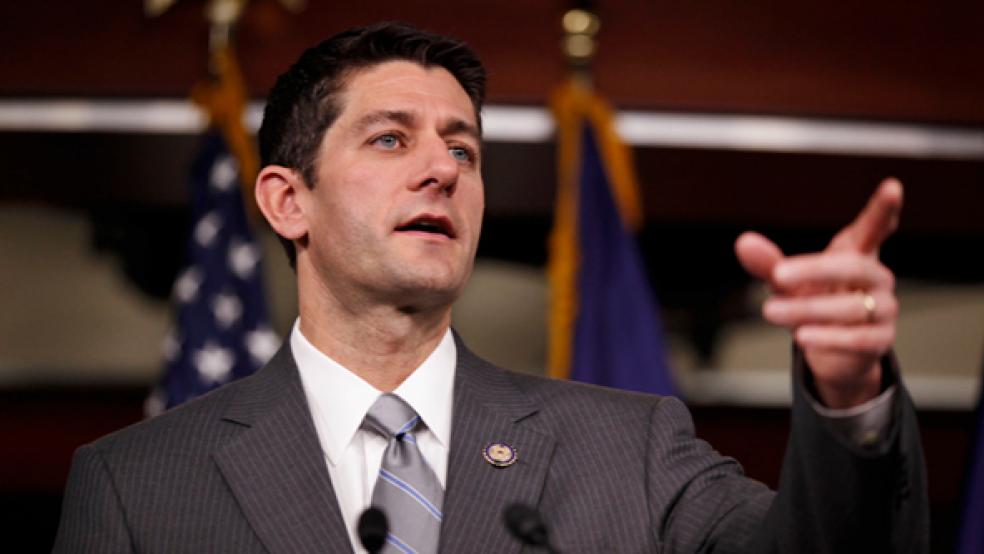
House Budget Committee Chairman Paul Ryan this morning began rolling out a Republican spending blue print and tax overhaul measure that has virtually no chance of being enacted this year but that sharply focuses election year differences between the Republicans and Democrats.
The plan includes deeper domestic spending cuts than called for in last summer’s deficit reduction deal that was negotiated by the White House and congressional leaders and a reprise of Ryan’s call last year for major changes in Medicare and other entitlement spending. But the surprise was a comprehensive tax overhaul proposal that would sharply cut tax breaks and provide for just two individual brackets of 10 percent and 25 percent.
Ryan’s plan, which he plans to detail later this morning, would end the Alternative Minimum Tax, which originally was conceived as a way to insure that wealthy Americans couldn’t escape paying some tax but that over time has ensnared more and more middle income taxpayers. The plan would lower the top corporate tax rate to 25 percent from 35 percent, while also nearly eliminating U.S. taxes on American corporations’ earnings from overseas operations.
“Our budget spurs economic growth with bold tax reform – eliminating complexity for individuals and families and boosting competitiveness for American job creators,’ Ryan said in a Wall Street journal opinion piece this morning outlining his new “Path to Prosperity budget. “We reject calls to raise taxes, but revenue nevertheless remains steady under our budget because we close special-interest loopholes. More important, our reforms will grow the economy – and the faster the economy grows, the more revenue the government will have to meet its priorities and start paying down the debt.’
Ryan claims that his budget would tackle excessive government borrowing head-on by cutting debt as a share of the economy by roughly 15 percent over the next decade. But his plan does not include specific offsets for the hundreds of billions of dollars in proposed new tax cuts, or detail how those tax changes would impact the long term deficit. It is certain to draw sharp fire from the Obama administration and congressional Democrats who are calling for tax equity and higher rates on the wealthiest Americans.
Ryan’s plan is quite similar to GOP presidential candidate Rick Santorum who earlier this year proposed dropping the number of tax brackets from six down to two at 10 and 28 percent and eliminating the Alternative Minimum tax. However, Santorum would cut the corporate tax rate from 35 percent to 17.5 percent and completely exempt domestic manufacturers.
Former Massachusetts Governor Mitt Romney would take a slightly different approach, retaining six individual income tax brackets but cutting rates by 20 percent across all of them. But like Ryan, Romney endorses a corporate rate cut to 25 percent.
In total contrast to all three plans, the Obama administration called late last month to lower the top corporate tax rate from 35 percent to 28 percent, while ensuring that U.S. manufacturers pay no more than 25 percent.