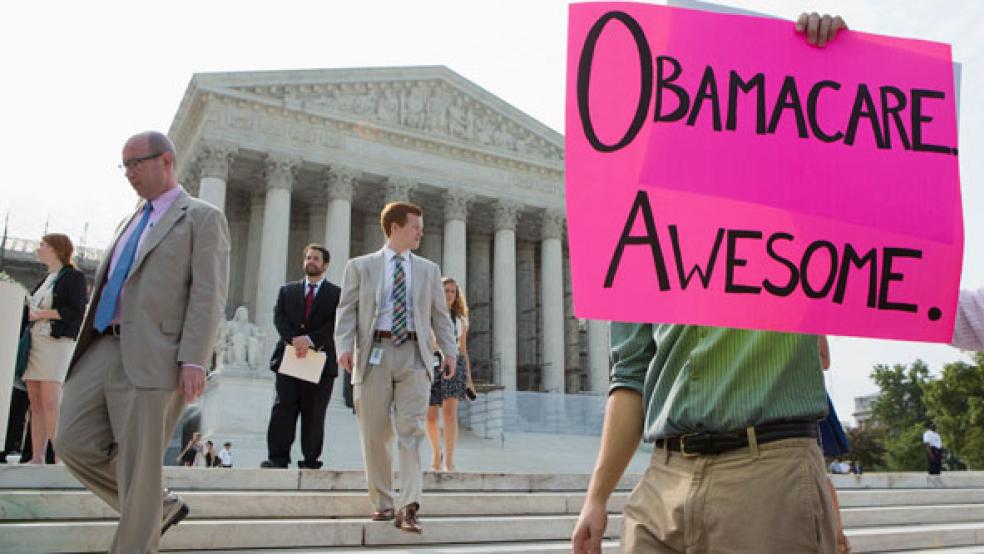
Relying on the unquestioned taxing power of the federal government, the Supreme Court ruled Thursday that the entire health care reform law – the signature achievement of President Barack Obama’s presidency – is constitutional.
The decision means the government can continue moving forward in its implementation of health insurance coverage expansion that had been projected to extend coverage to an estimated 30 million Americans to gain coverage. However, in the one victory for the 27 Republican-controlled states who challenged the constitutionality of the act, the high court said the federal government could not penalize states that opt out of the Medicaid expansion, which accounts for about half of the coverage expansion.
RELATED: Supreme Court Upholds Health Care Reform
Chief Justice John Roberts joined four liberal justices in the 5-4 decision, which immediately reverberated across America’s divided political landscape. Reform advocates, who have pushed for nearly three-quarters of a century to make universal health insurance coverage a reality in the U.S. as it is in every other advanced industrial country, cheered the decision. Conservative commentators on Fox News immediately blasted Roberts for “joining with the left” and called the decision “a huge win for the Obama administration.”
“Our precedent demonstrates that Congress had the power to impose the exaction in (the law) under the taxing power,” the majority decision said, “and that (section) need not be read to do more than impose a tax. This is sufficient to sustain it.”
Speaking for the four minority justices who dissented from the decision, Justice Anthony Kennedy declared, “In our view, the entire Act before us is invalid in its entirety."
RELATED: High Court Can't Stop Some Key Health Care Reforms
After weeks of speculation about how a court decision eliminating the mandate would affect both the economics and politics of health care reform, the bottom line is that the 50 states can now go forward in setting up insurance exchanges like ones in Massachusetts and Utah that allow individual citizens and small businesses to purchase lower-cost group insurance policies starting in 2014. The subsidy scheme for people who can’t afford the premiums remains in place.
Since expanded coverage isn’t expected to go into effect until 2014, the immediate impact of the court’s decision to allow states to opt out of expanded Medicaid coverage remains unclear. "Nothing in our opinion precludes Congress from offering funds under the ACA to expand the availability of health care, and requiring that states accepting such funds comply with the conditions on their use,” the majority opinion said. “What Congress is not free to do is to penalize states that choose not to participate in that new program by taking away their existing Medicaid funding.”
The law provided most of the funding for states to cover an estimated 15 million new people under Medicaid in the early years of the expansion. But future Congresses are free to reduce support and many states, especially in the Deep South, have opted out of prior Medicaid coverage expansion because of the matching requirements it would impose on state budgets.
The decision also leaves intact the sweeping delivery system reforms that are designed to reduce the growth of health care spending over the coming decades when 77 million baby boomers join the ranks of elderly Americans receiving Medicare, the government’s fastest growing spending program. While analysts differ as to the reason why, health care spending has slowed in recent years to its slowest pace in decades.
Many other sweeping provisions in the law that had little to do with broadening coverage or regulating the health insurance market, while rarely discussed in the run-up to the decision, also will remain in place. For instance, the law expanded generic drug competition to biotechnology companies. A number of billion-dollar blockbusters are coming off patent in the next few years. Generic competition could lower health care costs by billions of dollars annually and the Food and Drug Administration will still have legal authority to approve generic competition after today’s ruling.
The decision also left intact the requirement that health care providers disclose payments to physicians starting in 2013. Originally sponsored by Sen. Charles Grassley, R-Ia., the Physician Payments Sunshine Act will give patients information to decide whether their physicians’ decisions about treatments have been influenced by payments from drug, medical device or other health providers.
Millions of Americans stayed glued to their computers, television sets and radios awaiting word. Over 850,000 people signed onto the Scotus blog where long-time Supreme Court reporter, Lyle Dennison, 81, and others, provided close coverage and analysis of the momentous decision.