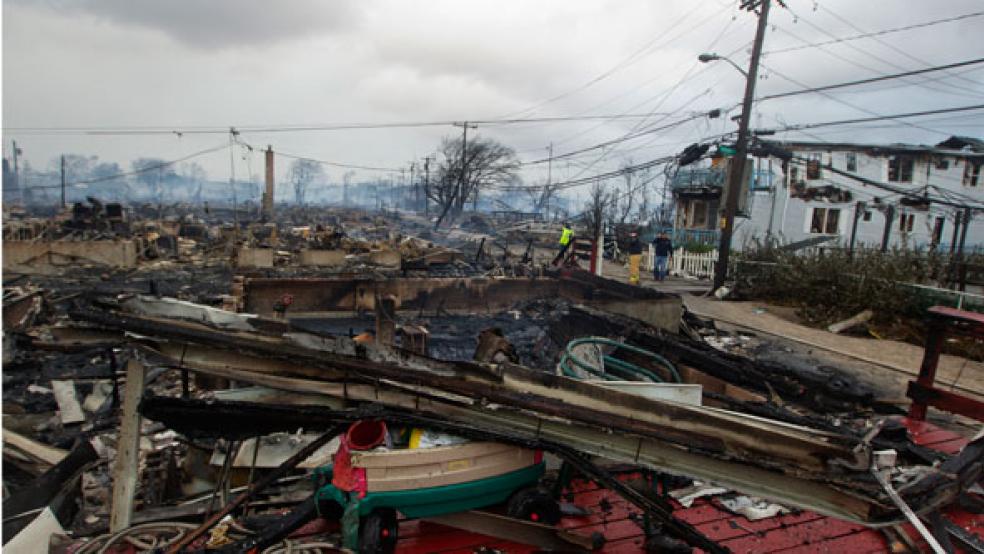
Superstorm Sandy might have devastated vast swaths of the Northeast, disrupting life and business for millions of people and whipping up billions of dollars worth of damage. But as residents of the Eastern seaboard take the first steps toward rebuilding their neighborhoods and resuming their routines, the scope of the destruction is gradually becoming clearer. Here, an overview of the storm and its effects:
72
People killed by the storm across eight states, a number that was still rising late Wednesday
At least 30
People killed in New York City, according to Mayor Michael Bloomberg
$10 billion to $20 billion
Early estimate of the damage from catastrophe modeling firm Eqecat, with half of the total being covered by insurers
$10 billion
Daily GDP of the area affected by the storm, according to economist Ryan Sweet of Moody’s Analytics
Up to $200 million
Daily cost of lost economic activity in New York City, comptroller John Liu told Reuters
$29.2 million
Amount New York City has paid for emergency preparations including equipment, supplies and workers, according to Liu. The city spent $12 million on those preparations for Hurricane Irene last year
485 miles
Distance from the center of the storm that tropical storm-force winds extended, according to the National Weather Service. With a total width of more than 900 miles, Sandy was nearly twice as large as Hurricanes Irene and Isaac
2 million
Square miles covered by Hurricane Sandy’s wind swath, according to data from the National Oceanic and Atmoshperic Association and calculations by The Huffington Post
13.88
Record height of the storm surge, in feet, at Battery Park in New York City, nearly 4 feet higher than the previous record of 10.02 feet set in the same place, according to AccuWeather
6.06 million
Homes and businesses still without power as of Wednesday afternoon, according to the Department of Energy
8.46 million
The peak number of customers without power due to the storm, according to the DOE
58,000
Workers repairing power lines across the Mid-Atlantic. Utility companies from California to Canada and Mexico were sending staff to help, according to the DOE
More than 19,500
Flights cancelled due to the storm as of Wednesday afternoon, according to tracking site FlightAware.com
25
Percentage of cellphone towers, broadband Internet and cable televisions that were knocked out across 10 states, according to the Federal Communication Commission
$3.521
The average national price of a gallon of regular gas as of early Wednesday, according to the AAA Daily Fuel Gauge Report. The average price a week ago was $3.625.
$3.927
The average price of a gallon of regular gas in New York as of early Wednesday, according to the AAA Daily Fuel Gauge Report. A week ago, the average New York price was $3.994.