GOP Governor Asks Voters to Raise Their Own Taxes
Michigan voters go to the polls today to vote on Proposal 1, a referendum that would hike the state sales and gasoline taxes. An unexpected twist in the story, though, is who is backing the plan and why. Support for the proposal speaks to the declining state of infrastructure in the U.S. and the increasing urgency with which states are taking matters into their own hands.
Proposal 1 is a complex mix of policy changes that would raise more than a billion dollars to fund road construction and repair, plus hundreds of millions for education and other purposes. It would do so by hiking the Michigan state sales tax from 6 percent to 7 percent. That represents a 17 percent increase in total sales taxes Michiganders will face on taxable items.
Related: America’s Energy Infrastructure in Desperate Shape
However, the bill also abolishes the sales tax on gasoline – Michigan is one of the few states in which gas is not exempt from state sales tax – and would dramatically increase the wholesale gasoline tax. The net effect, according to the Detroit Free Press, would be an increase of between 7 and 9 cents per gallon in what consumers pay at the pump. The proposal would net about $1.9 billion per year for the state’s coffers, the majority of it coming out of the pockets of Michigan’s taxpayers. (A small percentage would come from out-of-state visitors paying taxes on items purchased in Michigan.)
Normally, a $2 billion tax hike – the biggest in the state in a generation – would be the sort of thing Republican politicians would attack mercilessly, but in Michigan, Republican Governor Rick Snyder is a strong proponent of the deal. And Snyder isn’t alone. Prominent Republican and Democratic lawmakers have thrown their support behind the measure.
Related: Get Ready to Pay More Tolls If Infrastructure Isn’t Funded
The move also has significant support from the business community. Unsurprisingly, the biggest backers of the deal are the construction companies and related industries. But there is also support in the general business community, even among some companies whose products would be more expensive.
Even with substantial support from legislative leaders and businesses, though, the prospects for Proposal 1 looked poor heading into the vote today Public opinion remains generally against the proposition despite a multimillion-dollar advertising campaign by supporters that has dwarfed efforts by the opposition.
Should the vote fail, though, the state’s pothole-pocked roads and crumbling bridges won’t fix themselves, so legislators will have to find the revenue somewhere, either by increasing taxes via a different route, or cutting spending from an already tight state budget.
Majority of Tax Cuts Going to Filers Earning More Than $100K: JCT
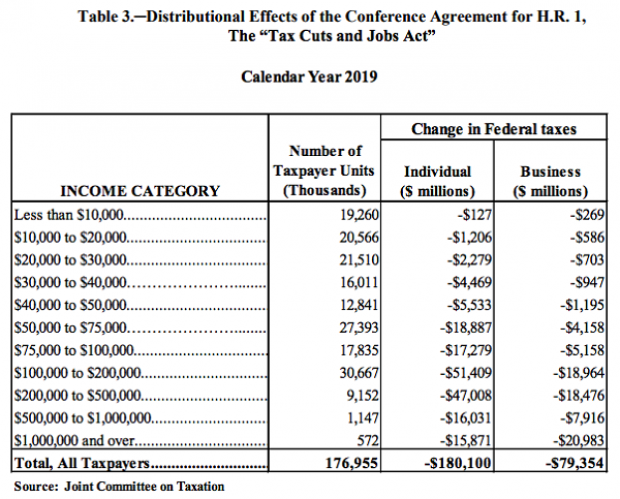
Ahead of a House Ways and Means Committee hearing scheduled for Wednesday, the Joint Committee on Taxation prepared an analysis of the distributional effects of the 2017 Republican tax bill. The New York Times’ Jim Tankersley highlighted the fact that according to the JCT analysis, about 75 percent of the individual and business benefits of the tax cuts will go to filers earning more than $100,000 in 2019. And nearly half of the benefits will flow to filers earning over $200,000.
The Trump Budget's $1.2 Trillion in 'Phantom Revenues'
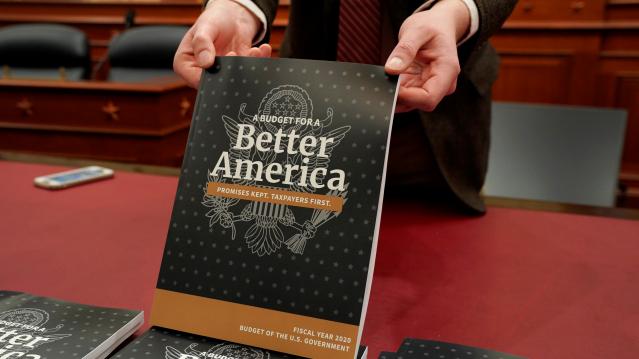
President Trump’s 2020 budget includes up to $1.2 trillion in “potentially phantom revenues” — money that comes from taxes the administration opposes or from tax hikes that face strong opposition from businesses, The Wall Street Journal’s Richard Rubin reports, citing data from the Committee for a Responsible Federal Budget. That total, covering 2020 through 2029, includes as much as $390 billion in taxes created under the Affordable Care Act, which the president wants to repeal.
The $1.2 trillion in questionable revenue projections is in addition to the White House budget’s projected deficits of $7.3 trillion for the 10-year period. That total is itself questionable, given that the president’s budget relies on optimistic assumptions about economic growth and some unrealistic spending cuts, meaning that the deficits could be significantly higher than projected.
Republicans Push Ahead on Medicaid Restrictions
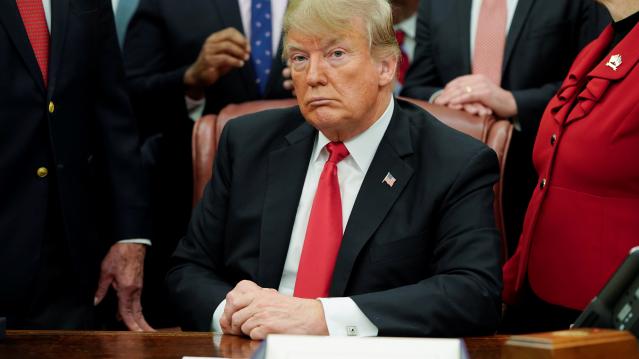
The Trump administration on Friday approved Ohio’s request to impose work requirements on Medicaid recipients. Starting in 2021, the state will require most able-bodied adults aged 19 to 49 to either work, go to school, be in job training or volunteer for 80 hours a month in order to receive Medicaid benefits. Those who fail to meet the requirements over 60 days will be removed from the system, although they can reapply immediately.
The new work requirements include exemptions for pregnant women, caretakers and those living in counties with high unemployment rates and will apply only to those covered through the expansion of Medicaid under the Affordable Care Act. There are currently about 540,000 people on Medicaid in Ohio who receive coverage through the expansion, according to Kaitlin Schroeder of The Dayton Daily News, compared to roughly 2.6 million Medicaid recipients in the state overall.
Once implemented, the work requirements are expected to result in 36,000 people losing their Medicaid eligibility, according to state officials, though critics say the reductions could be significantly larger. Similar work requirements in Arkansas pushed 18,000 people off the Medicaid rolls in six months.
A larger GOP project: The creation of new work requirements is part of a larger effort by Republicans to limit the expansion of Medicaid, says The Wall Street Journal’s Stephanie Armour. Since the Affordable Care Act passed in 2010, 36 states have expanded their Medicaid programs under the ACA and the number of people in the program has grown by 50 percent, from roughly 50 million to about 75 million. But many red-state governors have expressed concerns about the cost of Medicaid expansion and worries about a lack of self-sufficiency among the able-bodied poor, and are embracing new limitations on the program for both fiscal and political reasons.
In 2017, the White House in 2017 gave states the green light to explore ways to limit the reach and expense of their Medicaid programs. Governors have proposed a variety of new rules, which require waivers from the federal government to enact. Kentucky, for example, wants to drug-test Medicaid recipients, and Utah wants a partial expansion and a cap on payments. Kaiser Health News summarizes the variety of waivers states have requested, which are governed by Section 1115 of the Social Security Act, in the chart below.
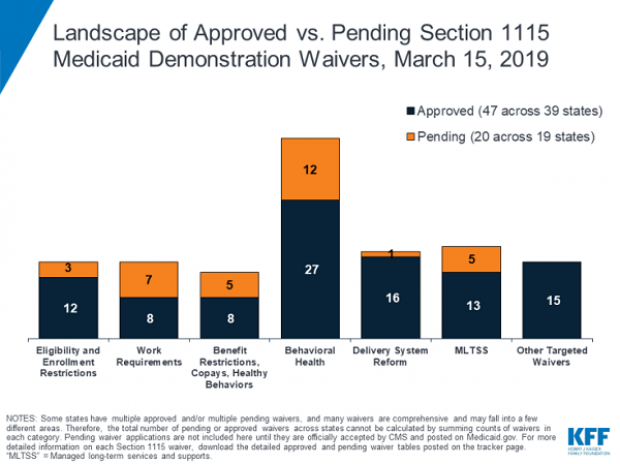
Legal challenges: Efforts to restrict Medicaid have received legal challenges, and U.S. District Judge James Boasberg blocked work requirements in Kentucky last year. The same judge, who has expressed doubts about the administration’s approach to Medicaid, will rule on the legality of work requirements in both Kentucky and Arkansas by April 1.
The bottom line: The Trump administration is seeking fundamental changes in how Medicaid works. Even if Boasberg rules against work requirements, expect the White House and Republican governors to continue to push for new limitations on the program.
Chart of the Day: Trump's Huge Proposed Cuts to Public Investment
Ben Ritz of the Progressive Policy Institute slams President Trump’s new budget:
“It would dismantle public investments that lay the foundation for economic growth, resulting in less innovation. It would shred the social safety net, resulting in more poverty. It would rip away access to affordable health care, resulting in more disease. It would cut taxes for the rich, resulting in more income inequality. It would bloat the defense budget, resulting in more wasteful spending. And all this would add up to a higher national debt than the policies in President Obama’s final budget proposal.”
Here’s Ritz’s breakdown of Trump’s proposed spending cuts to public investment in areas such as infrastructure, education and scientific research:
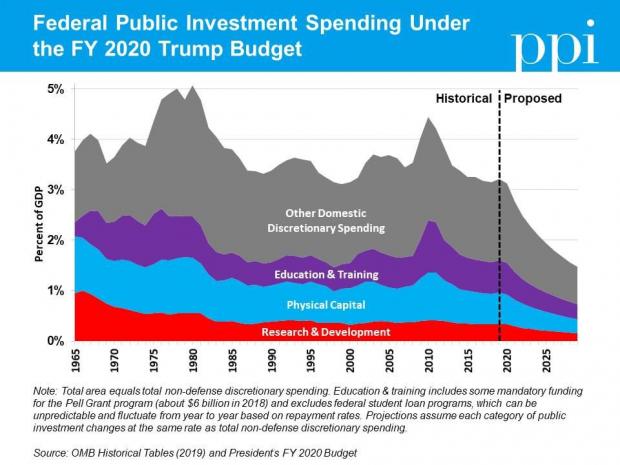
Chart of the Day: The Decline in Corporate Taxes

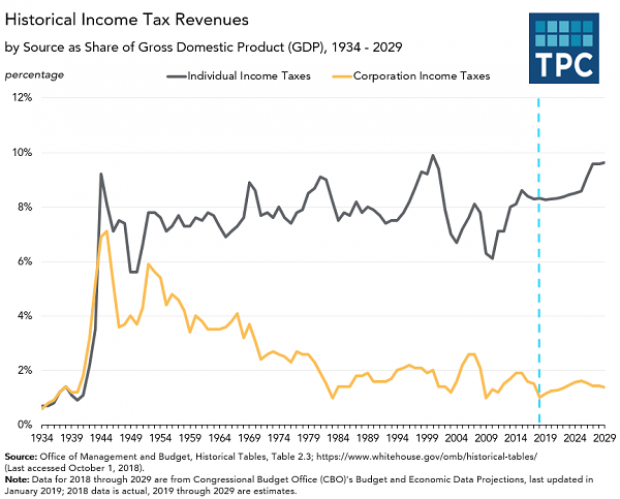
Since roughly the end of World War Two, individual income taxes in the U.S. have equaled about 8 percent of GDP. By contrast, the Tax Policy Center says, “corporate income tax revenues declined from 6% of GDP in 1950s to under 2% in the 1980s through the Great Recession, and have averaged 1.4% of GDP since then.”