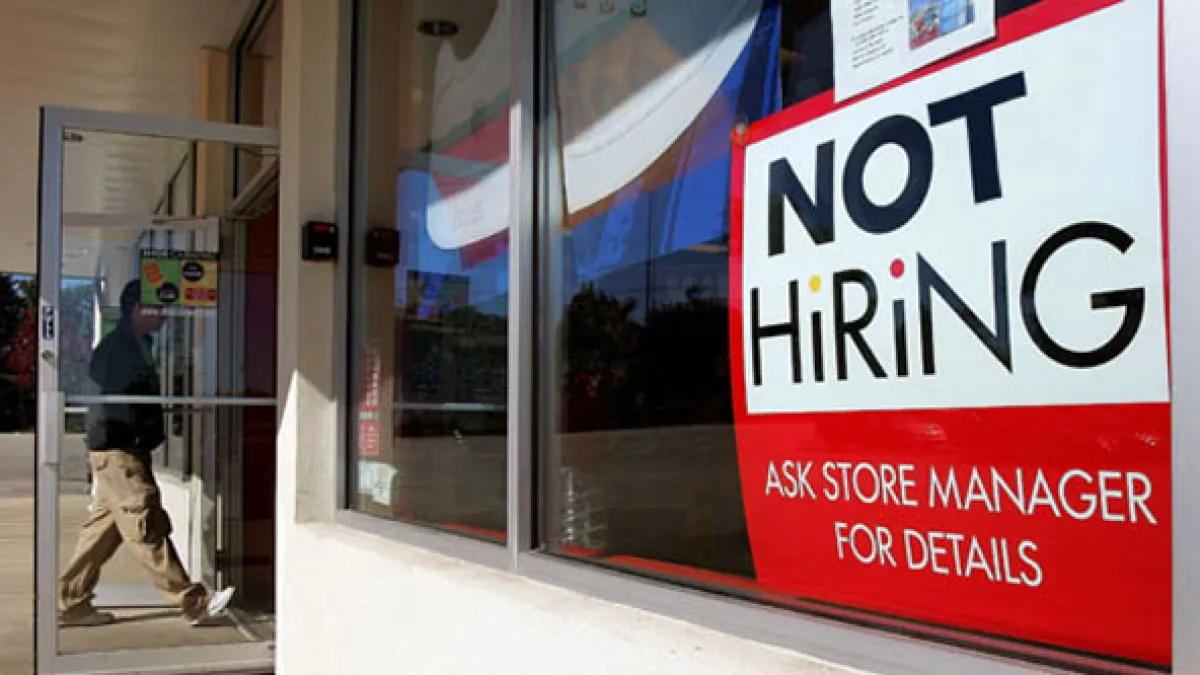
The U.S. economy added 50,000 jobs in December, according to data released by the Bureau of Labor Statistics on Friday.
The job growth total fell short of expectations, continuing a trend of tepid hiring by employers stretching back to the second quarter of 2025. Data for the previous two months were revised lower, as well, underscoring the trend.
At the same time, the unemployment rate dropped a tenth of a point to 4.4%, easing concerns about a rapid deterioration in the labor market. However, the rate fell largely due to workers leaving the market, a worrying sign.
The December numbers bring total job growth for 2025 to a modest 584,000. By comparison, the U.S. economy added about 2 million jobs in 2024, and 2.6 million in 2023. On average, the economy added just 49,000 jobs per month in 2025 — the weakest average monthly growth during a non-recessionary year since 2003, when the economy was still recovering from the dot-com bust.
The great majority of the job growth in 2025 came in just two sectors, healthcare and social assistance. Employment in healthcare grew by 405,000 during the year, while social assistance employment grew by 308,000.
Employers hit the brakes on hiring: The hiring slowdown since April, when President Trump announced his “liberation day” tariff increases, is notable. About 85% of the job growth during the year occurred by the end of April, after which employers slammed the brakes on hiring.
Although Trump has portrayed his tariffs as an effort to revive manufacturing employment, the levies appear to be having the opposite effect. Since the tariffs were announced, the goods-producing sector has lost about 90,000 jobs, and employment has shrunk for eight months straight.
Employment has also fallen over the course of the year in the mining, wholesale trade, and transport and warehouse sectors. Government employment is lower, as well, thanks in large part to the administration’s DOGE project to slash the size of government. Federal employment is down by about 277,000, or 9%, since January.
What the analysts are saying: The labor market has clearly lost much of its momentum, though employers have avoided large-scale layoffs, even as they slow hiring to a trickle.
“The United States is in a jobless boom,” Heather Long, the chief economist at Navy Federal Credit Union, told CNN. “There was almost no hiring in 2025 … we would be talking about job losses in 2025, if it weren’t for health care and social assistance.”
Appearing on CNBC, Long noted that, “It’s a great scenario for Wall Street, but an uneasy feeling on Main Street.”
U.S. Bank Chief Economist Beth Ann Bovino told The Wall Street Journal that the labor market is at an “inflection point” despite strong economic growth. “[T]he jobs market is very fragile — the unemployment rate is low, but businesses aren’t hiring,” she said.
Catherine Rampell, economics editor at The Bulwark, noted that some corners of the manufacturing sector are getting by as the tariffs help some companies but hurt others. “Manufacturing overall is contracting,” she wrote. “If you drill down you'll see metal manufacturing is doing ok, because Trump pummeled their competition with tariffs. Meanwhile the downstream US firms that have to buy more expensive metal (machinery, autos) are screwed.”
The lack of hiring is showing up in the long-term jobless numbers. In December, the number of people out of work for more than 27 weeks increased by nearly 400,000 compared to a year ago, and the number of people who are working part-time but would prefer full-time work has increased by nearly 1 million.
Revisions ahead: Some experts are warning that, as weak as the 2025 numbers are, they could be much worse after final revisions. “With these revisions, the story of payroll employment in 2025 will convert, ex post facto, from ‘snail-like growth’ to ‘recessionary-like conditions,’” Brian Bethune, an economist at Boston College, said Friday, per CNN.
The bottom line: The “no hire, no fire” labor market persisted through the end of 2025. The question for 2026 is whether the economy will keep growing at a decent clip even without big jumps in employment, or if the lack of hiring becomes a drag that forces the economy to shift into a lower gear.
