
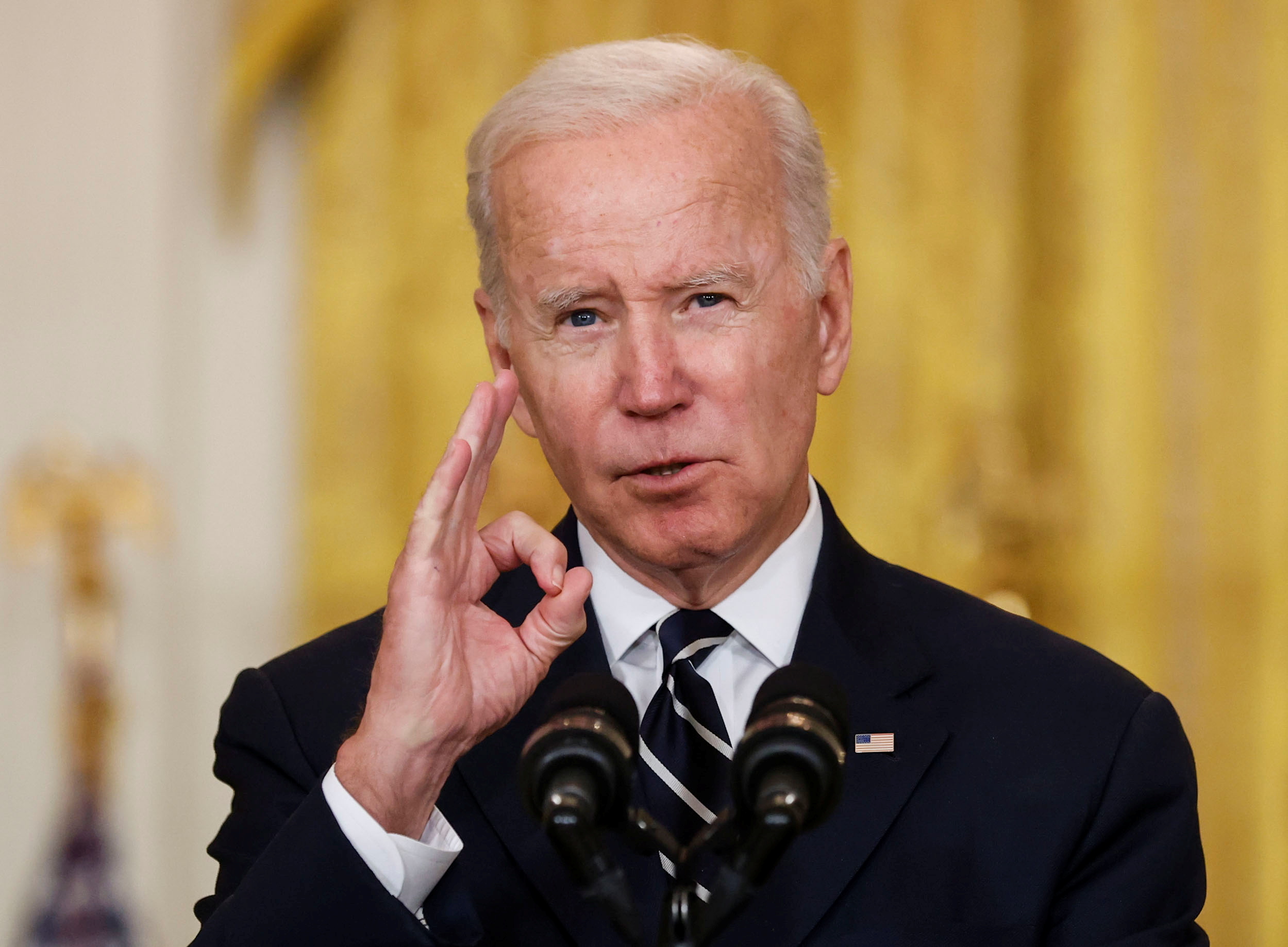
President Joe Biden went to Capitol Hill Thursday with an urgent message for lawmakers still debating his domestic agenda: “We badly need a vote.”
Aiming to unify Democrats behind a slimmed-down, $1.85 trillion version of his Build Back Better plan, Biden delayed a trip to Europe by a few hours to plead with House Democrats to embrace the proposal.
In a closed-door meeting, Biden touted his “framework” for the plan, a still-developing draft that was released to the public later in the day. Saying that it’s not “hyperbole to say that the House and Senate majorities and my presidency will be determined by what happens in the next week,” Biden pushed House Democrats to move quickly to approve his spending plan, thereby opening the door to a vote on a separate bipartisan infrastructure bill that has been on hold since August.
Together, the bills would unlock roughly $3 trillion in spending on a wide variety of public investments and social programs over the next 10 years.
But while many lawmakers offered an enthusiastic reception to Biden’s plea – twice rising to their feet during the meeting to chant “Vote, vote, vote!” according to one attendee – others were wary, citing uncertainty about the final shape of the bill as well as concerns about its support in the Senate.
Pelosi pushes for a vote: With the release of the framework, House Speaker Nancy Pelosi (D-CA) is pushing for an immediate vote on the bipartisan infrastructure bill, which has already been passed by the Senate but has been delayed as part of the struggle over the larger Build Back Better plan.
But liberal Democrats are sticking to their strategy of withholding support for the smaller infrastructure bill in order to pressure conservative Democratic senators to back Biden’s larger spending plan, and on Thursday they said that the release of the framework was not enough to win their support for the infrastructure bill.
In the meeting with Biden, Pelosi amped up the pressure by warning Democrats not to “embarrass” the president by rejecting the infrastructure bill just as he was headed overseas to meet with allies. But that threat was not enough to bring the progressives into the fold, and with success in question, a vote is not expected Thursday – though the situation remains fluid and a vote could occur in the coming days.
Progressives need more: Following their meeting with Biden, progressive lawmakers said they need to see more details about the plan and be convinced that it would win 50 votes in the Senate before they agree to vote in support of the bipartisan infrastructure bill.
“We enthusiastically endorse the framework that the President laid out today,” Progressive Caucus chair Rep. Pramila Jayapal (D-WA) said after the meeting. However, “there are too many no votes for the [bipartisan infrastructure bill] to pass.”
Asked about supporting the smaller infrastructure bill following Biden’s plea for unity, Rep. Rashida Tlaib (D-MI) offered a succinct reply: “Hell no.”
Rep. Cori Bush (D-M)), another key progressive vote, defended their approach. “We need both bills to ride together. And we don’t have that right now,” Bush said. “I feel a bit bamboozled because this was not what I thought was coming today,” she added, citing the framework’s weaker-than-expected family benefits.
Sen. Bernie Sanders (I-VT) said he would push to improve the Build Back Better draft framework by putting provisions related to Medicare benefit expansion and federal authority to negotiate drug prices back into the bill.
Major hurdles remain: While progressive House Democrats indicated that they support Biden’s plan “in principle,” they made it clear that they need two things before they’re willing to move forward to a vote on the infrastructure bill.
First, they need to see final text of the Build Back Better bill, which, despite Pelosi’s assurances to the contrary, is still just a draft, and an incomplete one at that. “We understand that it's 90 percent written,” Jayapal told reporters, “that 10 percent should just hopefully be very quick.” Final text would allow both bills to advance at the same time, a key demand for progressives.
Second, some progressives are saying they need to hear that the two main obstacles to passing the bill in the Senate – Democratic Sens. Joe Manchin (WV) and Kyrsten Sinema (AZ) – are on board with the plan. Neither senator offered clear public statements of support Thursday.
Instead, Sinema said simply that she and the White House “have made significant progress on the proposed budget reconciliation package,” while Manchin deflected a question about his support, saying, “This is all in the hands of the House right now.”
Underlining the importance of being certain about the support of the two conservative Democratic senators, Sanders backed the approach House progressives are taking. “I think both of the bills are linked and I think the House of Representatives has a right to know before they sign off on the infrastructure bill that the 50 senators are prepared to support a strong reconciliation,” Sanders said.
The bottom line: Democrats took a big step forward Thursday, greatly improving the odds that a big chunk of Biden’s agenda will become law. But important details still need to be ironed out, leaving the whole effort in a state of flux that could persist for days or longer.