
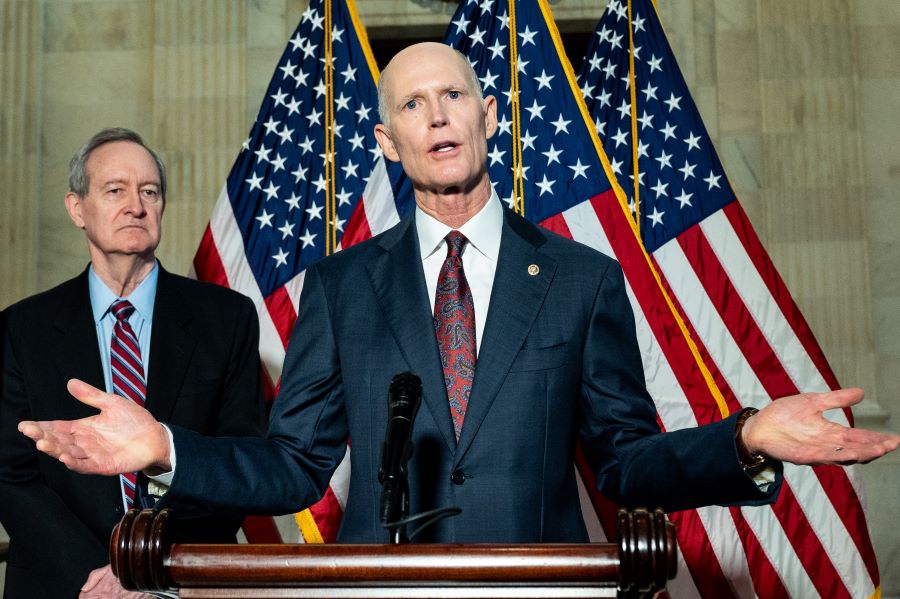
We told you yesterday about the “Rescue America” plan released by Sen. Rick Scott that laid out his blueprint for what the GOP should do if it takes back power in Washington in the 2022 and 2024 elections. The Florida Republican made it clear that he understands that some might reject his plan for being too radical – “I’ll warn you; this plan is not for the faint of heart,” he cautioned in the introductory letter – and on Wednesday critics on both the left and right quickly proved him right.
Ed Kilgore of New York Magazine, for example, noted that the 50% cut in funding and workforce at the IRS Scott calls for might make it very difficult to enforce tax code, while the forced sunsetting of all federal legislation every five years – “If a law is worth keeping, Congress can pass it again,” Scott said – would likely produce an unprecedented level of legislative chaos.
But of the many parts of the plan that came under fire, one detail in particular proved particularly unpopular among both Democrats and Republicans: Reviving the Romney-esque conservative complaint that “over half of Americans pay no income tax,” Scott called for all Americans to pay some kind of income tax so they “have skin in the game.”
Some critics noted that Scott’s complaint is incorrect as stated, since many of the low-income Americans who currently pay no federal income taxes do pay all kinds of other taxes, including state income taxes, payroll taxes and sales taxes. More broadly, critics wondered if it was such a good idea for a Republican senator to call for a tax increase on millions of people.
Dave Carney, a Republican strategist, told Politico that the proposal would not be popular among Republicans. “Tax increases — our voters don’t dig tax increases,” he said. “To be fair to [Scott], I don’t know what the hell the context is. Generally, taxes are not very popular with Republicans.”
White House Press Secretary Jen Psaki echoed the point, charging that Scott’s plan would raise taxes on millions of Americans, "including on seniors and working families."
Scott, who chairs the National Republican Senatorial Committee, responded to the barrage of criticism, saying that his proposed tax increase wouldn’t apply to the elderly or to those who are not “able bodied.” But the damage appears to have been done, likely reducing the chances that Scott’s proposal will have its intended effect of rallying Republicans around his plan, at least as far as tax increases go.
“It’s dramatically off-message for where Republicans are going on taxes — they shouldn’t be talking about raising taxes on anybody,” Brian Riedl of the conservative Manhattan Institute told The Washington Post. “The GOP has moved away from the 2010 ‘makers and takers’ framework — so it’s a little outdated.”
Michael Strain, an economist at the conservative American Enterprise Institute, agreed, saying the Republican view on contributing to society has become more nuanced. “Raising kids is a contribution; working is a contribution; being a member of your community is a contribution,” he said. “Yes, let’s have a stronger norm that everyone is a contributing member of our society — but I don’t know why that means everyone needs to contribute through a nominal income tax.”