
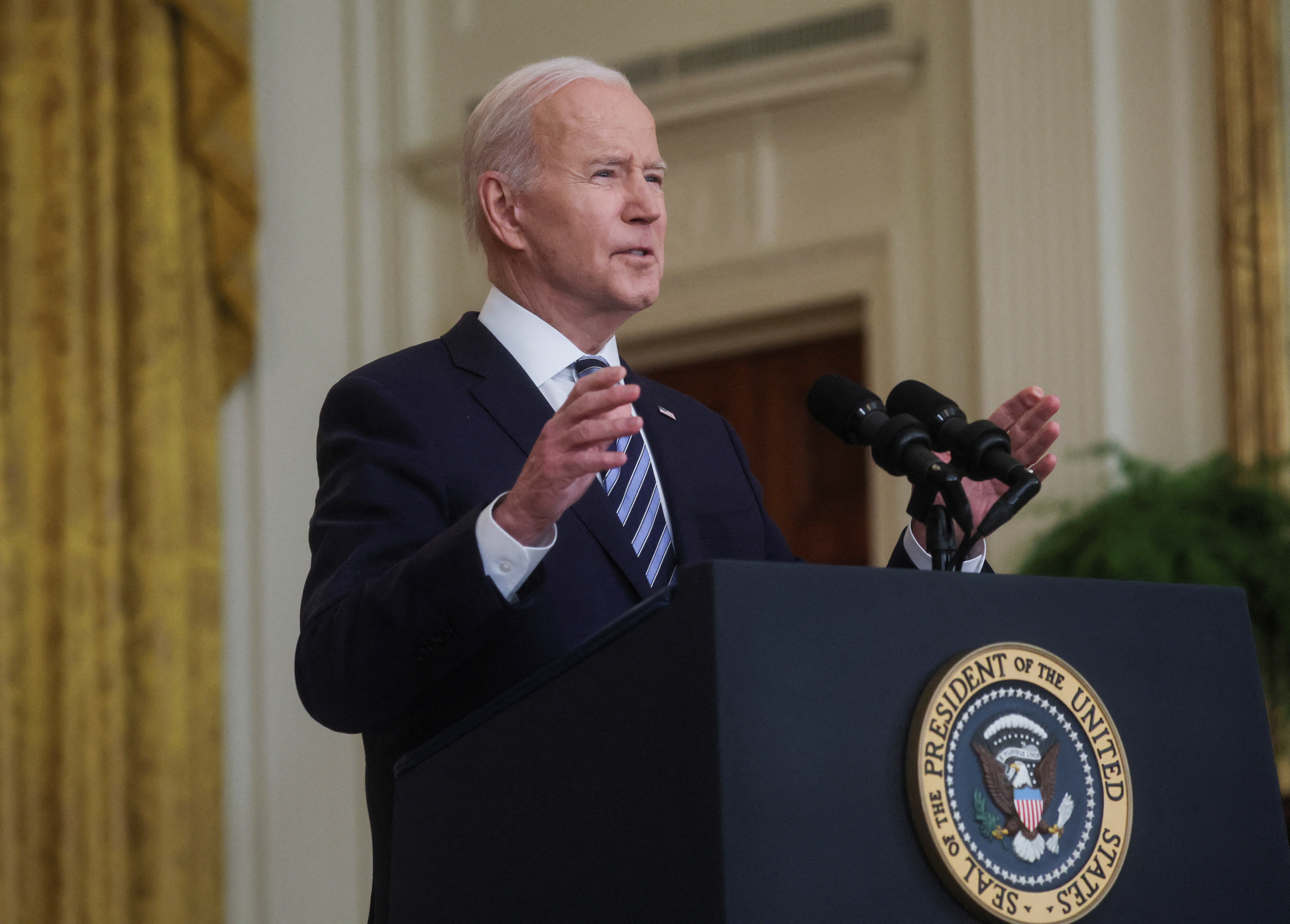
As the Russian invasion of Ukraine continues, the White House on Friday reportedly asked Congress for $6.4 billion in additional funding to deal with the crisis and its humanitarian fallout.
Bloomberg’s Erik Wasson reports that $2.9 billion would be used to address humanitarian and security needs for Ukraine and neighboring nations, while $3.5 billion would go toward the Defense Department response. “The funds are in addition to the $650 million in security aid and $52 million in humanitarian aid the US already committed to Ukraine over the last year as well as a previous $1 billion sovereign loan guarantee,” Wasson reports.
The request comes as congressional lawmakers are looking to pass a spending bill providing billions of dollars to help the Ukrainian military and refugees fleeing the conflict. The new money could be added to a broader, full-year spending package that Congress is looking to pass by March 11.
Sen. Chris Coons (D-DE), who chairs the Senate Appropriations subcommittee that oversees foreign aid, told reporters Friday that there is strong bipartisan support in Congress for additional funding. "There is strong enthusiasm to provide ongoing resupply and training and whatever other covert and overt support is necessary and appropriate for the Ukrainian resistance," he told reporters a day after returning from a week-long trip to Germany, Poland and Lithuania.
Coons predicted that $10 billion or more will be needed. “I am confident that we will need billions of dollars to support the likely millions of refugees that will flood into Poland and a half-dozen other countries throughout NATO and Eastern Europe," he said. “It would be a wild guess on my part, but I would be supportive of an emergency supplemental of at least $10 billion, perhaps more, to meet these vital national security and humanitarian needs."
About 100,000 Ukrainians have already been displaced, according to estimates from the United Nations High Commissioner for Refugees cited by The Wall Street Journal.
Coons noted that his $10 billion estimate for the size of the aid package is likely low because it does not factor in what may yet be a “robust” request from the Defense Department. He added that lawmakers should be prepared to provide additional funding for global Covid response and public health needs, and he emphasized that he would not support shifting money from existing programs. “Before this crisis we were going to fall well short of the funding we need to meet what is a record number of refugees and food insecurity globally, so the idea that we would shift billions of dollars from meeting the need of refugees in other places in the world … I strongly oppose that, and I’ve been speaking up about this with the administration for weeks now.”
Lawmakers in both parties have voiced support for a sizable military and humanitarian aid package. Sen. Lindsey Graham (R-SC), who also sits on the Appropriations Committee, said this week he wanted Congress to move ahead with an emergency Ukraine spending bill when lawmakers return from their recess next week.
Politico’s Andrew Desiderio, Connor O’Brien and Jennifer Scholtes write that, despite the bipartisan desire to provide aid funding and calls from some lawmakers for quick action, it could still take weeks to finalize the additional aid — and that may be too late to make a near-term difference.
They point to comments by House Armed Services Chair Adam Smith (D-WA), who warned on CNN Thursday about the limits of providing more equipment to the Ukrainian military at this point: “I don’t think it’s realistic to think that we’re going to be able to reinforce them enough in the short-term to repel the invasion,” Smith said. “We do need to try and help them as much as possible, and it is quite possible that what we’re looking at here is a more long-term insurgency.”
The bottom line: Lawmakers in both parties have made clear that they see the need for a military and humanitarian aid package, but the specific amount and timing of any additional funding remain unclear for now.