
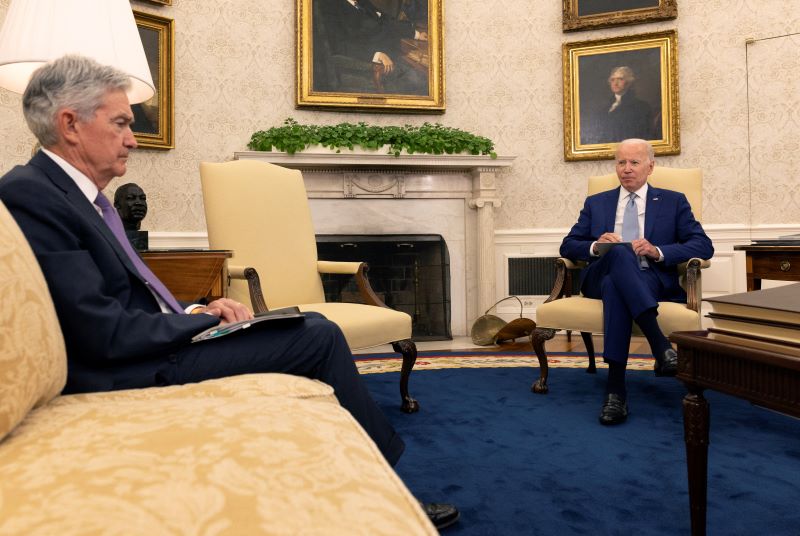
Facing a brutal mix of sky-high prices and rock-bottom poll numbers, President Joe Biden on Tuesday unveiled a new three-part plan for fighting inflation, kicking off a month-long effort by the White House to focus its public message on the state of the U.S. economy.
In an op-ed published in The Wall Street Journal, Biden made the case for his management of the economy so far. “In January 2021, when I took office, the recovery had stalled and Covid was out of control,” he wrote. “In less than a year and a half, my administration’s economic and vaccination plans helped achieve the most robust recovery in modern history. The job market is the strongest since the post-World War II era, with 8.3 million new jobs, the fastest decline in unemployment on record, and millions of Americans getting jobs with better pay.”
At the same time, Biden recognized the stubborn persistence of inflation, and said it is now his top economic priority. His plan to fight inflation consists of three main pillars:
1. Recognize that the Federal Reserve plays the primary role, and avoid interfering with the central bank’s efforts.
2. Reduce prices and boost the productive capacity of the economy.
3. Lower the federal budget deficit.
Biden addressed the politically sensitive issue of high fuel prices specifically, saying they are driven by Russia’s invasion of Ukraine. He highlighted his release of oil from the national strategic reserve to reduce prices and called on Congress to pass tax credits to boost new investments in clean energy. He also called for fixing supply chains, investing in infrastructure, negotiating lower drug prices and reducing the cost of daycare.
Shifting the blame? While some critics expressed support for Biden’s plan – former Obama economic adviser Jason Furman said it offered “sound recommendations on dealing with inflation” – at least as many expressed doubts about how effective the plan would be, and some accused the president of seeking to blame others for problems in the economy.
Heading into a meeting with Federal Reserve Chair Jerome Powell on Tuesday, Biden emphasized the role the central bank plays. “My plan to address inflation starts with a simple proposition: Respect the Fed,” he said. “My job as president is not only to nominate highly qualified individuals for that institution but to give them the space they need to do their job. I'm not going to interfere with their critically important work.”
But by citing the Fed as his first line of defense against inflation, Biden could be seen as shifting some portion of responsibility for the effort to reduce inflationary pressure to the central bank. “He wants to deflect responsibility and make clear that the other guy is in charge,” CNN’s David Goldman wrote.
Bloomberg’s Nancy Cook, Justin Sink, and Josh Wingrove agreed, saying that Biden’s declaration of support for Fed independence is “simultaneously shifting responsibility for taming decades-high inflation ahead of the November midterms.”
Politico’s Ben White highlighted the finger-pointing game that has consumed Washington on inflation. “President Joe Biden blames Vladimir Putin,” he wrote late last week. “Republicans blame Biden and the Democrats. Some economists and Wall Streeters put it all on the Fed.”
No easy solutions: In part, the blame game is driven by the fact that controlling inflation is difficult, especially in the short run. “The administration … has few means for curbing inflation, possibly putting Biden’s political fortunes at the mercy of global markets,” Zeke Miller, Josh Boak and Christopher Rugaber of the Associated Press wrote. “The president has twice ordered the release of oil from the U.S. strategic reserve, only to see a short-term and muted impact on gas prices.”
Harvard economist Megan Greene underlined the difficulty that both Biden and the Fed are facing. “It’s not just the Fed or the end of infrastructure or the exact kind of stimulus or any one single thing,” she told Politico. “I actually thought the Fed had pulled it off last year waiting for inflation to come down on its own as the pandemic waned. Then Omicron hit China and Russia invaded Ukraine. A lot of this is just very, very bad luck.”
One eye on inflation, another on the polls: Whatever the causes, it’s clear that inflation is hurting Biden politically. The president is reportedly upset about his declining ratings, and White House officials are uncertain how to change course.
“I’ve heard him say recently that he used to say about President Obama’s tenure that everything landed on his desk but locusts, and now he understands how that feels,” a White House official told NBC News, referring to Biden.
The president is reportedly particularly upset about his poll numbers, and can’t understand how his level of support has fallen to levels in roughly the same range as the man he replaced. “He’s now lower than Trump, and he’s really twisted about it,” a source told NBC.