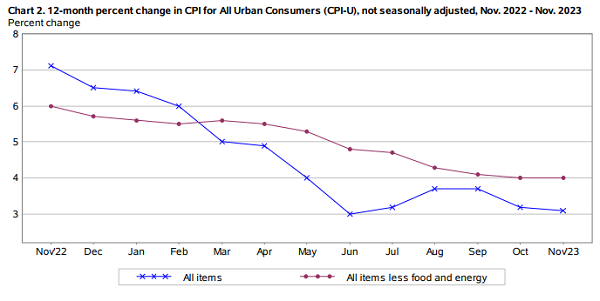
The consumer price index rose a modest 0.1% on a month-over-month basis in November, according to data released Tuesday by the Labor Department. Relative to a year ago, prices rose 3.1%, a slight drop from the 3.2% rate recorded in October.
Both numbers were roughly in line with expectations, though the monthly figure came in one-tenth of a percentage point higher than expected. Overall, the results point to an ongoing if somewhat bumpy process of disinflation in the U.S. economy (see the chart below).
The bumps were evident in some of the technical measures that economists use to evaluate underlying trends. The core CPI rate — a closely watched measure that strips out volatile food and fuel prices — accelerated slightly in November, rising from 0.2% on a monthly basis to 0.3%, while the annual core inflation rate clocked in at 4%, the same as in October. And the so-called super core services index — a measure favored by the Federal Reserve that strips out goods and shelter costs — rose 0.4% on a monthly basis and 3.9% on an annual basis, up two-tenths of a percentage point from a month earlier.
Those increases could raise some eyebrows at the Fed, and some analysts are guessing that the central bank will delay rate cuts for longer in 2024 as officials wait to see more convincing evidence that the inflation rate has fallen sustainably to their 2% target.
The latest report “reinforces this idea that it’s going to be a bumpy road to disinflation,” Blerina Uruci, chief U.S. economist at T. Rowe Price, told The New York Times. “The Fed cannot cut interest rates too soon in the face of resilient services inflation.”
At the same time, there is little in the report to suggest that officials will want to raise rates at their final meeting of the year, which concludes on Wednesday. “Even as November’s core inflation ticked up to a pace more consistent with 3% annual inflation, long-term measures suggest the Fed has made significant progress on disinflation over the past six months,” said Bloomberg economists Anna Wong and Stuart Paul.
Moody's Analytics Chief Economist Mark Zandi said the report provided “more good inflation news, with CPI steadily moderating.” But he also noted the economic toll inflation has taken: The “typical household must spend $1,031 more per month to buy the same things as 3 years ago due to inflation,” he wrote. Fortunately, household incomes have risen by $1,087 over the same period. “Want to see real income gains, but this is real progress,” Zandi said.
Yellen sees soft landing: Treasury Secretary Janet Yellen said Tuesday that the U.S. appears to be successfully bringing inflation under control without triggering a recession. “To me, a soft landing is the economy continues to grow, the labor market remains strong and inflation comes down. And I believe that’s the path we’re on,” Yellen said at an event hosted by The Wall Street Journal.
Yellen added that she thinks the Fed’s 2% target is well within reach. “It’s certainly meaningfully coming down. And I see no reason, on the path that we’re currently on, why inflation shouldn’t gradually decline to levels that are consistent with the Fed’s mandate and targets,” she said. “I personally don’t see any good reason to think that the last mile is going to be especially difficult.”
Still, some analysts caution that there are potential dangers ahead, including a possible reignition of inflation or a recession sparked by high interest rates. “The odds of a soft landing have certainly increased dramatically in recent months,” Greg McBride, chief financial analyst for Bankrate.com, told The Hill. “There’s probably a better than 50-50 chance that we do get that very rare soft economic landing, but it’s too early for victory laps.”