
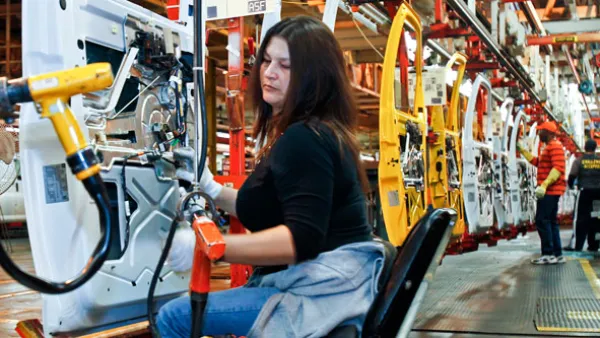
The White House said Wednesday that is granting U.S. automakers a 30-day reprieve from the 25% tariffs imposed on goods imported from Mexico and Canada.
The new tariffs threaten automakers with a sharp increase in the cost of their products, which may cross the borders with Canada and Mexico multiple times during the manufacturing and assembly process. The announcement came after President Donald Trump spoke with leaders of the major American vehicle manufacturers, Ford, General Motors and Stellantis.
In a statement read by White House Press Secretary Karoline Leavitt, Trump said, “We are going to give a one-month exemption on any autos coming through USMCA,” a reference to the free trade agreement Trump reached with Mexico and Canada during his first term. Trump added that the delay comes “at the request of the companies associated with USMCA” and is being provided “so they are not at an economic disadvantage.”
More exemptions ahead? Leavitt said the president is “open” to considering exemptions for other sectors of the economy — a comment that helped send stocks sharply higher as investors speculated that the burgeoning trade war might be less painful than feared. But she added that a new set of “reciprocal” tariffs on trading partners, which will mirror tariffs imposed on U.S. goods around the world, will take effect on April 2, as previously indicated.
Asked about worries that the tariffs will harm American producers and consumers, Leavitt echoed Trump’s comments in his speech to Congress. “The American people elected this president to have monumental reform and change, including rebuilding our manufacturing base in this country, standing up to foreign nations who have been ripping off our country for decades,” she said, “and that requires a little bit of disruption.”
Leavitt also advised investors to be grateful for Trump’s actions. “I think for folks on Wall Street who may be concerned, look at what this president did for you in his first term. Wall Street boomed. Stock market boomed. The president expects that to happen again,” she said. “But most importantly, Main Street is going to boom.”
Economy or drugs? Leavitt’s comments veered from the argument that Trump has made about the primary reason for the tariffs, which focuses primarily on illegal immigration and drugs, especially fentanyl. Illicit drugs were reportedly a topic of conversation Wednesday between Trump and Canadian Prime Minister Justin Trudeau, the first direct communication between the leaders since Trump imposed the tariffs on Tuesday. Apparently, the conversation was a bit rocky.
“Justin Trudeau, of Canada, called me to ask what could be done about Tariffs,” Trump wrote on his social media platform. “I told him that many people have died from Fentanyl that came through the Borders of Canada and Mexico, and nothing has convinced me that it has stopped. He said that it's gotten better, but I said, ‘That's not good enough.’”
Trump added that the discussion ended in a “somewhat” friendly manner, but then accused Trudeau, who is stepping down as prime minister, of using the issue “to stay in power.” Trump also referred to Trudeau as “Governor,” reminding the prime minister that he has called for Canada to join the U.S. as the 51st state — a less-than-friendly suggestion.
The bottom line: Trump postponed the immediate financial pain of tariffs for one group of American manufacturers, but plenty of economic chaos is still on the horizon. Trump’s stated goals for the tariffs continues to oscillate, from drug interdiction to manufacturing rebirth to “making America rich again and making America great again,” as he put it last night in his speech to Congress — raising serious questions about how trading partners could possibly find ways to respond to his demands and head off what could be a long and damaging trade war.