
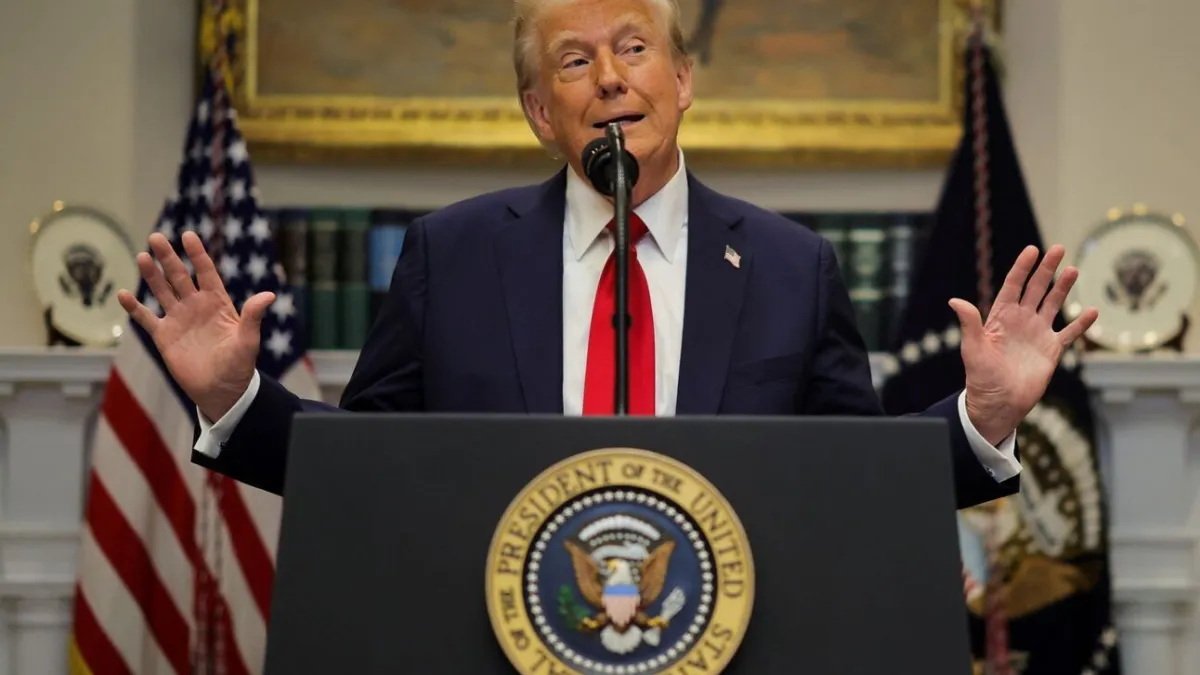
As markets around the world continued their violent reaction to the new U.S. tariffs unveiled this week, with the S&P 500 falling nearly 6% and the Dow Jones Industrial Average plunging 5.5%, President Trump defended his trade plan and called for the Federal Reserve to cut interest rates — not because the tariffs are causing a market meltdown and threaten to trigger a recession, but because they economy is doing so well under his guidance.
On Friday morning, the Labor Department reported that job growth was stronger than expected in March, with non-farm payrolls increasing by 228,000, far stronger than the economists’ estimate of 140,000. The unemployment rate rose, but only modestly, to a still-low 4.2%, driven by new entrants into the job market. Economists said the report reflected a remarkably resilient labor market that is still operating at or near full employment, sustaining the long period of solid growth that began under former President Joe Biden.
Trump was quick to take credit for the surprisingly strong report, saying on his social media platform that his plans are “already working.” He also called on Federal Reserve Chair Jerome Powell to lower interest rates, given the apparent strength of the economy. “CUT INTEREST RATES, JEROME, AND STOP PLAYING POLITICS!” Trump wrote.
Powell’s warning: The Fed chair, however, provided a different take on the current economic situation, telling a group of business journalists at a meeting in Virginia that thanks to Trump’s new tariffs, the U.S. economy now faces an increased risk of slower growth and higher inflation.
“While uncertainty remains elevated, it is now becoming clear that the tariff increases will be significantly larger than expected,” Powell said. “The same is likely to be true of the economic effects, which will include higher inflation and slower growth. The size and duration of these effects remain uncertain.”
Accordingly, Powell said the Fed is in no hurry to make a move on interest rate policy and will wait to see what the data says in the coming weeks and months. Higher inflation would pressure Fed policymakers to raise rates or hold off on cuts, while slower economic growth would lead to calls for rate reductions.
Some analysts worry that heightened concerns about tariff-driven inflation will keep the Fed from cutting rates or doing so quickly, potentially allowing Trump’s trade war to cause more economic damage than it might do otherwise. “The Fed is in no position to offer the kind of insurance to the economy that they did in the 2018, 2019 trade war because inflation is too high and it’s above their target,” Julia Coronado of MacroPolicy Perspectives told Bloomberg. “Even if they conclude that they need to cut rates, they’re likely to go later and slower than they would otherwise because we will be in the middle of an inflation impulse.”
Other experts warned that a certain amount of economic damage is all but baked in at this point, assuming Trump stays the course. “Prices are going to go up, period,” Martha Gimbel of the Yale Budget Lab told The New York Times. “These are really big tariffs. These are not things we can expect companies to just absorb.”
Retaliations begin: In an ominous sign for the expansion of Trump’s trade war, China retaliated against his new 34% tariff on Chinese goods by imposing its own 34% tariff on all American goods, starting on April 10. China also imposed new export restrictions on seven rare earth materials used in manufacturing and placed new restrictions on specific U.S. companies, including two poultry suppliers and 11 defense companies.
The Chinese Finance Ministry challenged the legitimacy of the Trump tariffs. “The US action does not abide by international trade rules, severely undermines China’s legitimate and lawful rights and interests, and is typical unilateral bullying,” the ministry said in a statement.
Some analysts characterized the Chinese response as more restrained than it could have been, especially since the total tariff rate on Chinese imports coming into the U.S. is now 54%. “China’s retaliation seems still proportional and targeted by design, focusing mainly on agricultural goods and defense contractors,” said Wen-Ti Sung of the Atlantic Council’s Global China Hub. “Both of which are key Trump coalition constituencies.”
Nevertheless, Trump responded to China’s actions on social media in fairly strident terms, saying, “CHINA PLAYED IT WRONG, THEY PANICKED — THE ONE THING THEY CANNOT AFFORD TO DO!”
China is not the only trade partner announcing retaliations. On Thursday, Canadian Prime Minister Mark Carney said he is imposing a 25% tariff on all auto imports from the U.S. Carney expects to collect about $5.7 billion from the retaliatory tariffs, which he said would be used to help Canadian workers and businesses hurt by the U.S. trade war.
“We take these measures reluctantly,” Carney said. “And we take them in ways that’s intended and will cause maximum impact in the United States and minimum impact here in Canada.”