
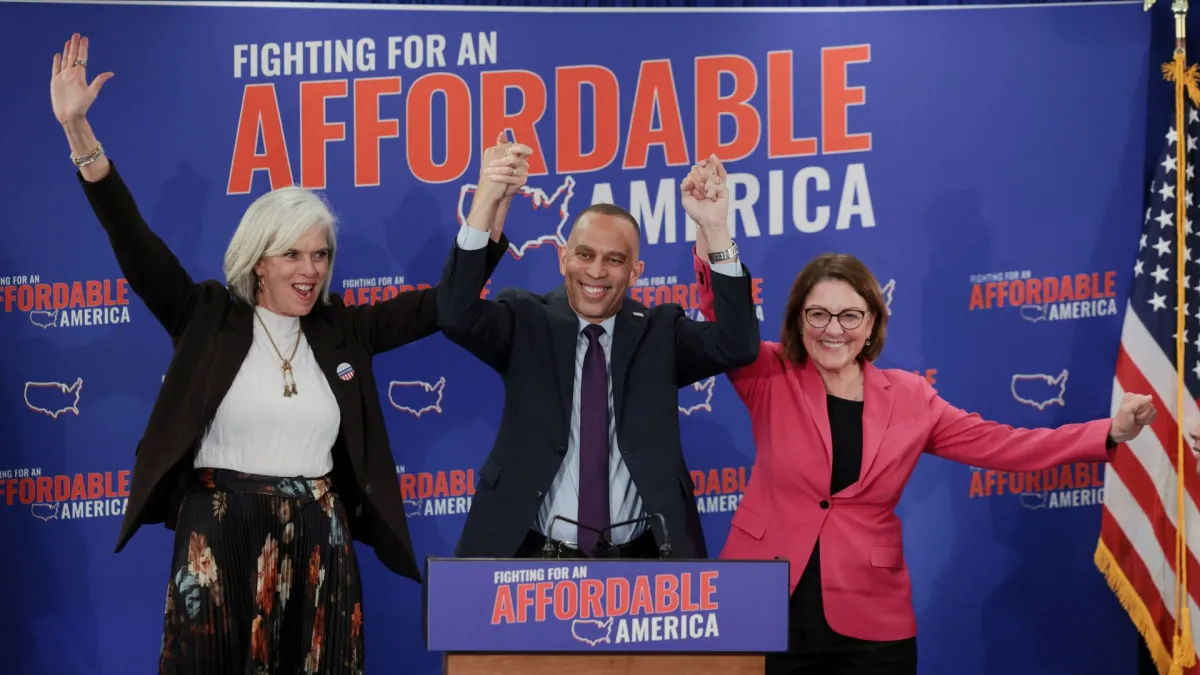
Democrats today are celebrating the massive “blue-nami” that swept them into large House and Senate majorities in the next Congress, including historic wins in many races across the American heartland and the deep South — places that had gone for Republicans by double-digit margins just two years ago or that hadn’t seen Democratic wins in decades.
“It wasn’t simply a blue wave, it was an American tsunami,” said Rep. Hakeem Jeffries of New York, who is poised to become the first Black speaker of the House, with a comfortable majority that could help mitigate the challenges of leading a caucus that still must contend with differences between moderates, progressives and Democratic socialists.
Democrats have already won 237 House seats, according to an Associated Press tally, with 59 races yet to be called. Jeffries predicted his party’s lead would grow to the largest Democratic majority since the early 1990s.
“We will win at least 255 seats, if not more, once every vote has been tallied,” Jeffries told reporters, calling the result a “stunning rebuke of MAGA extremism” and a great night for the country. “It’s a historic majority in the 21st century.”
That historic majority stretches to the Senate and statehouses, too. Democrats flipped seven Republican-held Senate seats and are poised to hold a majority of at least 54 seats, with races in Alaska and Mississippi — deep red Mississippi! — still too close to call.
Democrats won Senate seats in South Carolina for the first time since 1998, in Texas for the first time since 1988 and in Kansas for the first time since 1932. The BBC notes that the last time a Kansas Democrat was in the Senate, “The Wizard of Oz” was playing in movie theaters. “Against all odds, Democrats have won the Senate, and we have five words for the American people: Relief is on the way,” Senate Democratic Leader Chuck Schumer said at a Wednesday news conference.
Democrats are also set to hold a majority of governorships for the first time in 16 years, including in Georgia, where Keisha Lance Bottoms is set to become the first Black woman to ever hold the office, and in Texas, where Gina Hinojosa easily unseated incumbent Gov. Greg Abbott as part of a dramatic and complete flip of statewide offices. Democrats also flipped governors’ seats in Iowa, Nevada and Ohio.
Republican mid-decade redistricting plan flops: President Trump and Republicans sought to give themselves an edge in the race for the House by launching an unusual mid-decade redistricting battle focused on strengthening the GOP advantage in Texas, Florida and other states. Party leaders had hoped to redraw maps to create a net gain of some 15 seats. That plan failed miserably, as Democrats have won or are leading in 13 of the 15 districts targeted by the GOP. Democrats, meanwhile, targeted six seats in California and Utah and are poised to flip them all.
Trump deflects blame: The president did not question the Democratic victories, which were simply too big for him to claim they were rigged. But faced with a sharp rebuke by voters, Trump largely dismissed his responsibility for the massive Republican losses.
“Congratulations to the Democrats,” Trump said Tuesday night in a phone call with Fox News. “They did a good job. They’ve been looking for this one for 11 years and they finally got it. But I don’t view it as a hit on me. I think we’ve done a — we’ve had the greatest two years in the history of the presidency in terms of the economy, in terms of all the things that we’ve done.”
Trump essentially ignored the numerous times he had called for voters to act as if he was on the ballot and his backing of weak candidates like Ken Paxton in Texas and Sen. Darline Graham in South Carolina, even as other Republicans worried about candidate quality.
“I wasn’t on the Ballot and if I was, we would have won IN A LANDSLIDE!” Trump posted just after 10:30 p.m. on Tuesday night, as the magnitude of Republican losses was becoming apparent. He later added: “FoxNews bears responsibility for these losses by constantly and consistently putting on the Dumocrat opposition, and worse.”
Republican repercussions already being felt: Other Republicans were more willing to point the finger at Trump and his policies.
“Not only were folks upset about the war, inflation and gas prices, but add to that the fact they think he was making them eat a shit sandwich in Darline, and they just had enough,” Mick Mulvaney, a former Trump White House chief of staff and South Carolina congressman, told Politico.
On Wednesday, Trump spoke at length at a White House event — touting his new ballroom. He ultimately did acknowledge that the Iran war and its effect on energy prices were a factor in the vote, but he defended his decision to attack. “The Iran thing we had to do, and we continue to do it,” Trump told reporters.
In a lengthy social media post, Vice President JD Vance pinned the blame for the GOP wipeout on the war.
“One of the pollsters I really respect told me that our economic messaging wasn’t sharp enough down the stretch. I’m sure that’s true. But the real reason we lost is obvious to almost everyone,” Vance wrote, adding, “The reason we lost is the war. The president himself said so last night. If you'd like to argue it was worth it, that losing the Senate for the next 6 years was worth it, then do so. Argue it was a worthwhile cost to pay. Agree or disagree, that's at least honest. But everyone knows why we lost.”
Some Republicans are reportedly already turning against Defense Secretary Pete Hegseth, with speculation that he might take the blame for the GOP election pummeling and could face an impeachment vote as soon as next week. Trump defended Hegseth on Wednesday and said he has no plans to fire him.
GOP leadership fights brewing: Speaker Mike Johnson, who won re-election in his Louisiana district, reportedly told his staff Wednesday that he will step aside as the House Republican leader, though he did not specify whether he plans to stay in Congress or resign his seat.
Republican Reps. Steve Scalise, the current House majority leader, and Jim Jordan, who now chairs the Judiciary Committee, quickly announced bids to become Republican minority leader next year.
Scalise wrote in a letter to colleagues that “the election was far worse than any of us expected” and that Republicans “will need to be honest with ourselves about what happened, but it is more important now than ever for us to emerge from this stronger and united because the stakes couldn’t be higher.”
Jordan, meanwhile, said in his own letter to colleagues that it is a “staggering day” for the House Republican conference, but argued that Republicans must go on offense if they hope to win back the majority in two years. “I am battle-tested on the oversight front and I know the Democrats’ playbook,” he wrote.
The House Republican conference will hold leadership elections next week. Whatever the outcome, GOP finger-pointing and MAGA blowback are likely to continue as the party wrestles over its path toward a post-Trump future.