
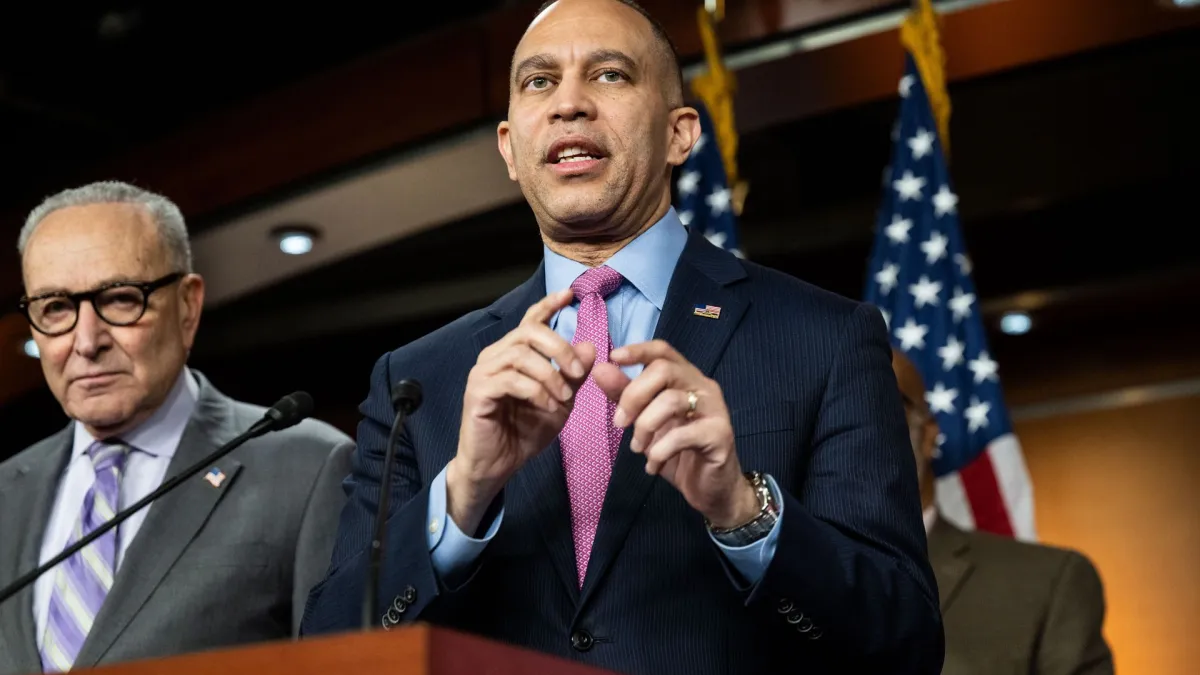
Democratic lawmakers plan to pass a series of bills soon after taking control of Congress in January, with a focus on one of the key issues that helped produce their historic performance in the midterms: affordability.
In their first 100 hours in power, Democrats reportedly intend to introduce legislation that would:
- reinstate enhanced subsidies for health care plans sold under the Affordable Care Act that were allowed to expire by Republicans;
- reverse cuts to Medicaid that Republicans made in their budget bill last year;
- undo tariffs imposed by President Trump on goods from countries around the world while restoring the power of Congress to oversee trade policy;
- call for Trump to end the war with Iran or seek authorization from Congress to continue it.
The other important focus: At the same time that they address economic issues, Democrats plan to ramp up investigations of Trump and his administration, though they have not yet determined how to balance the legislative and investigative drives.
“We haven’t evaluated who are going to be the targets of the investigation right out of the gate,” Minority Leader Hakeem Jeffries, who is expected to become the next speaker of the House, said Wednesday. “We’ll have those conversations over the next couple of weeks.”
Still, Jeffries has signaled that he intends to lean into the economic part of the Democratic agenda. “The American people don't want us to get even. They want us to get things done on their behalf because life is way too expensive,” Jeffries said on MS NOW’s Morning Joe. “We ran on affordability, we won on affordability, and now it's our job to govern on affordability.”
In a statement Wednesday, Sen. Ron Wyden, the senior Democrat on the Senate Finance Committee, said he plans to hold Trump and the Republicans accountable for their actions over the last two years, even as he remains focused on pocketbook issues.
“For the last two years Republicans have used the Finance Committee to execute and defend the most craven parts of Trump’s agenda: ripping health insurance away from millions, driving up costs with tariffs, covering up Epstein’s financial records, and letting Trump treat the Treasury Department like his personal piggy bank,” Wyden said. “Trump and Republicans have been running a smash-and-grab job on the American people. Under my leadership, the top priorities of the Finance Committee will be affordability for us, accountability for them.”
Some Democrats, though, seem more focused on the investigative and punitive angle. As the election results were streaming in late Tuesday, Rep. Robert Garcia, who is expected to become the next chairman of the House Committee on Oversight and Accountability, sent a simple message on X: “LAWYER UP.”
Looking for leverage: Despite the big wins for Democrats Tuesday, a Republican still controls the White House, and Democrats will fall short of 60 votes in the Senate, creating serious obstacles to enacting their priorities.
Analysts at Goldman Sachs said Wednesday that they expect Democrats to use must-pass bills as opportunities to push through their agenda. Government funding will need to be extended by December 11, and Democrats could call for a short-term extension to give them an opportunity for more extensive policymaking in a major funding bill in early 2027. The debt ceiling will likely need to be raised at some point next year, as well, providing another opportunity to work out a multi-faceted deal.
The Goldman analysts said they expect to see the spending cuts passed by Republicans to be reversed early on by Democrats, and that doing so would raise spending by about 0.25% of GDP. “A deal on discretionary spending or expanded health insurance subsidies would add modestly to that total,” the analysts said.