
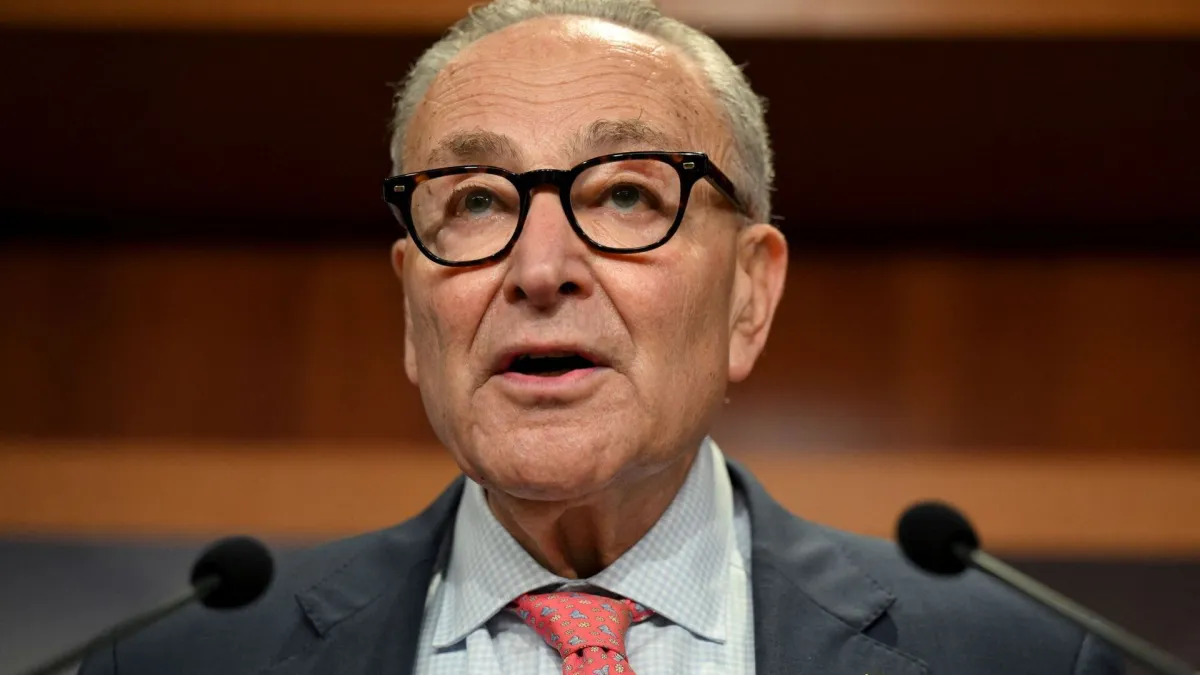
Senate Democrats this week began discussing and debating their agenda for their first days in the majority next year — but before they can dive into their legislative priorities, they’ll first have to get through a pressure-packed and potentially divisive leadership contest.
Maryland Sen. Chris Van Hollen announced Thursday night that he will run for Senate majority leader, challenging longtime Senate Democratic Leader Chuck Schumer.
“In this election, the American people called for change. They called for a change from Donald Trump’s disastrous policies — but even bigger than that, a change from the status quo that isn’t working for working people,” Van Hollen said. “It’s now on us to meet this moment, and to do that we need new leadership. This is not about any one person — it’s about answering the call of the American people.”
Van Hollen has won the support of a faction of Democrats eager to see the party move further left and push more aggressively to check President Trump and advance progressive priorities. But Van Hollen, 67, isn’t necessarily a prototypical change agent; he’s been in Congress since 2003, first in the House for 14 years and then in the Senate since 2017. He has chaired both the Democratic Congressional Campaign Committee and the Democratic Senatorial Campaign Committee.
Van Hollen’s leadership bid, by all accounts, faces long odds, but it is a blow to the 75-year-old Schumer, who has faced frequent criticism from the party’s progressive base and calls to cede power to a new generation of Democrats. Schumer welcomed the challenge and repeated his prediction that he has the votes to win. “I welcome any discussion about the future of our caucus and the important work ahead,” Schumer wrote on social media. “I’m proud of what we’ve accomplished together—55 seats and counting is an amazing result—and I have the votes to continue serving as Democratic Leader. I look forward to leading our new Democratic majority and delivering for the American people.”
Some senators lined up to defend Schumer after Democrats’ sweeping election wins and Schumer’s record of recruiting and funding many of the candidates who won.
“Chuck Schumer is one of the principal architects of the most successful election in modern history, and I see no reason to change the leadership that helped make that success possible,” said Sen. Angus King of Maine, an independent who caucuses with Democrats. “Chuck has outlined an aggressive plan for the new Democratic majority which is directly responsive to the message we heard from the voters, and he has the experience and unique mastery of the Senate process to make it happen. Why would you fire the manager when you just won the World Series?”
Barring a change, the Senate Democratic leadership elections are still weeks away, though, potentially leaving time for support to shift as Democrats plan their agenda for early 2027.
What’s on Dems’ agenda: Democrats have made clear they intend to focus on ending the Iran war, stopping Trump’s tariffs, restoring more generous Affordable Care Act tax credits and reversing Republican cuts to Medicaid and SNAP food aid. They’ve also promised ethics reforms, including a bill to prohibit stock trading by members of Congress.
If and how those things get done could depend on the approach Democrats take. Schumer has been pitching a plan to address healthcare, affordability and other top priorities in a series of individual bills rather than one megabill. The idea is “to put single, rifle-shot measures on the floor week-by-week and dare Republicans to filibuster or Donald Trump to veto,” according to Igor Bobic and Oriana González of the Washington Sun.
That approach would require the help of at least four Senate Republicans — and, if those votes aren’t forthcoming, Democrats would then turn to budget reconciliation to pass their agenda on a party-line basis.
Some progressives are reportedly already pushing for a sweeping bill along those lines.
“They’re floating the idea even though they know there’s no chance it will become law,” Politico’s Brian Faler reports, “but that’s not the point. Rather, the purpose is to pick a big, showy fight with the president, and put a spotlight on the Democratic platform ahead of the 2028 presidential election.”
Van Hollen reportedly favors a reconciliation bill, though he also said that the Democratic caucus needs to discuss the options.
Other Democrats counter that they should be more focused on concrete achievements and delivering on promises than political messaging and 2028 positioning. And, Faler notes, a reconciliation fight carries other risks — it involves a more complicated process, for example, and “could spark a big, embarrassing internal fight over what ought to go into a bill.” It would likely also carry a big price tag that would either be offset by politically perilous tax hikes or “would antagonize the party’s fiscal hawks and give Republicans a fat target to criticize.”
The bottom line: Democrats may be riding high on their election wins, but they still face internal divisions and their process of building consensus — to the extent possible — about the party’s goals and tactics in the majority is just getting started.