
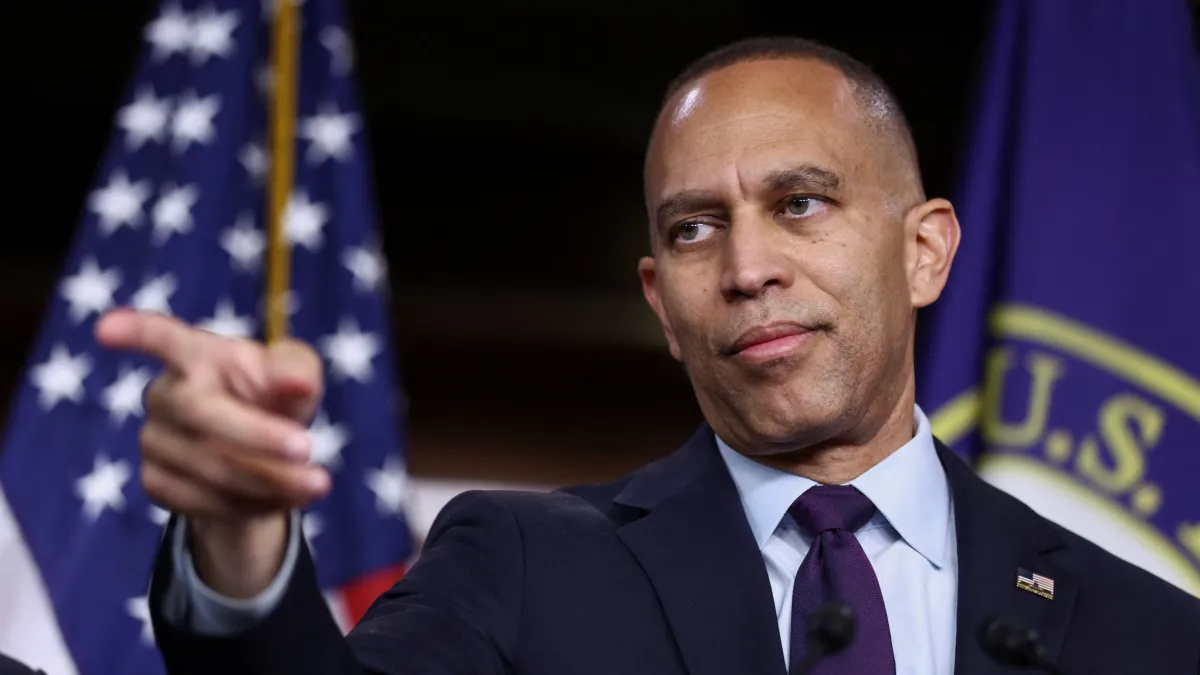
Set to take over the House majority in January, Democrats backed Jeffries, 251-11, in secret balloting that firmly establishes him as the likely speaker when the 120th Congress convenes in early 2027. Two Democrats reportedly did not vote in balloting that also included House delegates.
Jeffries will need a simple majority of 218 votes when the whole House chooses a speaker in January.
“It is a high honor and distinct privilege to stand before the American people today as the Democratic nominee to be the next speaker of the United States House of Representatives,” Jeffries said at a news conference at the Capitol. “We know the American people are struggling. We know millions of people are drowning in this failed Republican economy, and House Democrats are committed to turning things around.”
A small bloc of opposition: The 56-year-old Jeffries, who joined the House in 2013 and became minority leader in 2023, said that Americans are demanding “bold, dramatic and transformational change” and that Democrats are committed to delivering that change away from an “unacceptable” status quo.
Yet Jeffries himself faces some calls for change from a restive Democratic base. A group of newly elected progressives and Democratic socialists announced that they had voted against Jeffries, even as he ran unopposed.
“Whether on Medicare for All, stopping ICE terror, getting money out of politics, or ending the genocide in Gaza, our constituents sent us to Congress with a mandate on these issues. We have worked to secure commitments from Leader Jeffries in good-faith conversations,” the group said in a joint statement. “While we have seen meaningful progress, there is still work to be done to ensure that the direction our party takes this coming Congress reflects what our constituents are demanding of leadership. Those conversations are ongoing. As such, our vote in caucus today was no.”
The incoming members behind that statement included Darializa Avila Chevalier of New York, Adam Hamawy of New Jersey, Melat Kiros of Colorado, Donavan McKinney of Michigan, Chris Rabb of Pennsylvania and Claire Valdez of New York. Rep.-elect Frederick Haynes of Texas, also included in the statement, said he intended to vote against Jeffries but woke up ill and missed the vote.
Two other incoming members, Angela Gonzales-Torres of California and Don Leonard of Ohio, also announced that they had opposed Jeffries as part of a push for change. Leonard cited his desire to eliminate corporate and special-interest money in politics and funding for Israel.
Despite that opposition, Wednesday’s vote suggests that Jeffries and the incoming Democratic majority should be able to avoid some of the drama and disruption that has plagued a divided House Republican conference in recent years. Republicans now hold a bare 218-seat majority in the House, while Democrats are poised to have 260 seats starting next year.
Asked about the votes against him and whether he feels a need to get those opponents to yes, Jeffries said the results of today’s election speak for themselves. He said it is an honor to serve with a 260-seat majority from all across the country, including people with different perspectives. He said Democrats would work together.
“Our job is to fight MAGA extremism, not each other,” he said. “To fight MAGA extremism and to get big things done for the American people, and that is what we are going to accomplish together beginning on January 3rd.”
Other historic firsts for House Democratic leaders: Rep. Katherine Clark of Massachusetts is set to become the first female majority leader, while Rep. Pete Aguilar of California would be the first Latino majority whip. Clark and Aguilar both ran unopposed and were elected by acclamation.