
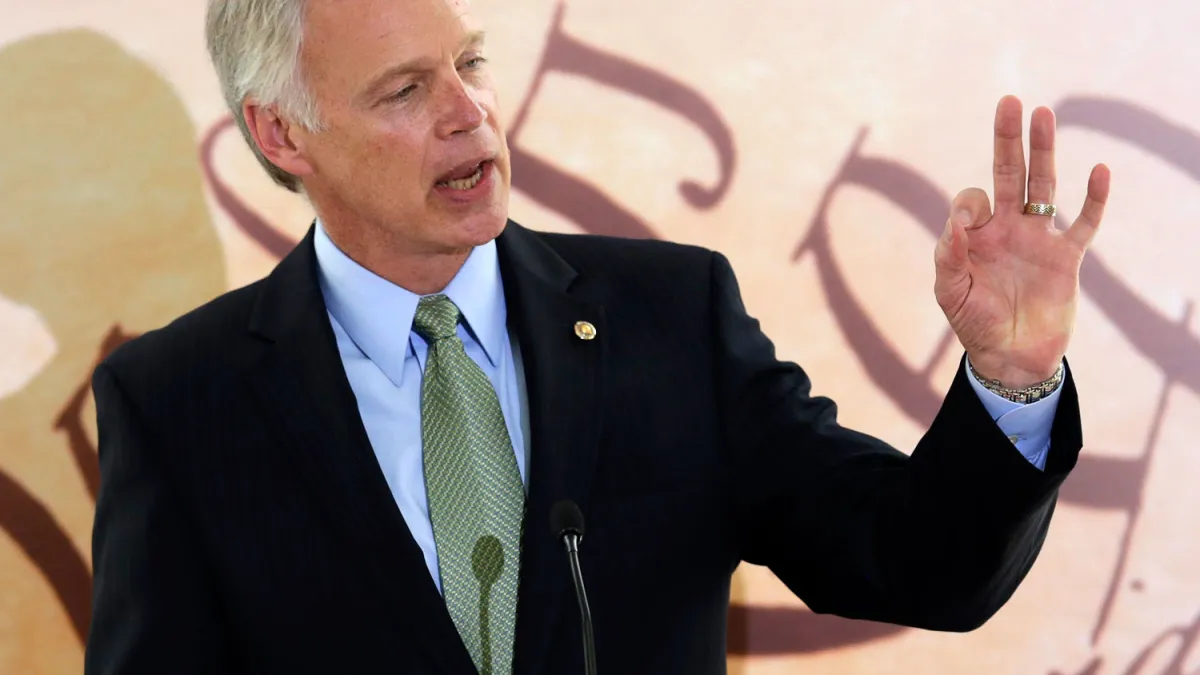
In an interview with Fox Business on Wednesday, Senate Budget Committee Chair Ron Johnson called Social Security “grotesque” and a “scam” that needs to come to an end.
"At this point, there's really no way to fix Social Security,” he said. “It's a Ponzi scheme. You can't fix it; you just shut it down and hope that you can recover some of your money.”
Later in the day, during a committee hearing examining Social Security, Johnson distanced himself from the statement, saying his remarks had been “imprecise.” He claimed that he had been discussing Ponzi schemes in general and was not proposing to shut down the popular retirement program.
On Thursday, though, he doubled down on his critique, some version of which he has been offering since at least 2010. “Social Security IS a legal Ponzi scheme,” he wrote on X.
To address the problem that inspired Johnson’s claim — a looming shortfall in revenues when the Social Security system’s trust funds run dry as soon as 2032, which could result in a 22% cut in benefits — Johnson has now offered a simple fix: Use general tax revenues to pay full benefits.
Sketching out the proposal, Johnson released the text of the Stop Scaring Seniors Act, which is intended to “ensure full payment of Social Security benefits” by transferring money from the general fund of the Treasury to the old-age program as needed.
Not a Ponzi, but financing remains a challenge: Although the accusation that Social Security is a Ponzi scheme remains popular in some precincts of the political right, experts generally reject the claim. While Social Security is indeed self-funded through a steady inflow of tax receipts, which are then transferred to beneficiaries, everyone is aware of the structure, which can be adjusted to maintain solvency at any time that Congress sees fit.
The problem, however, is that Congress has failed to act on the looming threat. Covering shortfalls from general funds seems like an easy fix, but fiscal experts warn that it would come at a high price.
“Paying for Social Security out of the general fund would absolutely explode the national debt, costing a whopping 165% of GDP over 75 years before even considering the economic implications,” the budget hawks at the Committee for a Responsible Federal Budget said in response to Johnson’s proposal. “This would bring us to a totally untenable level of borrowing that would almost certainly spark a crisis.”
A self-proclaimed fiscal hawk, Johnson is likely aware of the problem. But in a memo submitted to the Budget Committee this week, he explained his larger purpose: drawing attention to the nation’s persistent budget deficit.
“By fixating on Social Security, not acknowledging the multi-decade deception, and not focusing on the larger problem — a 10-year projected deficit of $24.4 trillion — we will be doing a huge disservice to future generations and in the end, fix nothing,” Johnson said. “A better solution would be to repeal that portion of the law that reduces Social Security benefits and quit scaring seniors. We should then roll up our sleeves and begin seriously addressing the main problem — our massive debt and deficits.”