U.S. Trade Representative Jamieson Greer is expected to announce new tariffs as soon as Tuesday evening aimed at dozens of major trading partners, including the European Union, China, Mexico and Japan.
Greer has been looking for ways to reinstate a slew of President Trump’s “Liberation Day” tariffs from April 2025 that the Supreme Court invalidated earlier this year. The new tariffs are expected to be based on a different legal authority, Section 301 of the Trade Act of 1974, which empowers the U.S. trade representative to retaliate against unfair trade practices.
In this case, Greer is expected to say that he has determined that the 16 trading partners covered by the new tariffs — including the EU, which comprises 27 member nations — have intentionally built up excess industrial capacity, enabling them to flood the global economy with cheap goods, thereby harming U.S. producers.
The tariff roller coaster: Trump has long argued that tariffs are an essential tool for rebuilding American industrial capacity, as well as a way to punish powerful competitors and ungrateful allies while raising new revenues. Most economists say the use of tariffs is far more complicated and fraught, and all but guarantees increased prices for domestic producers and consumers. Still, Trump persists, even after Republicans’ election losses that reflected voter dissatisfaction with economic conditions.
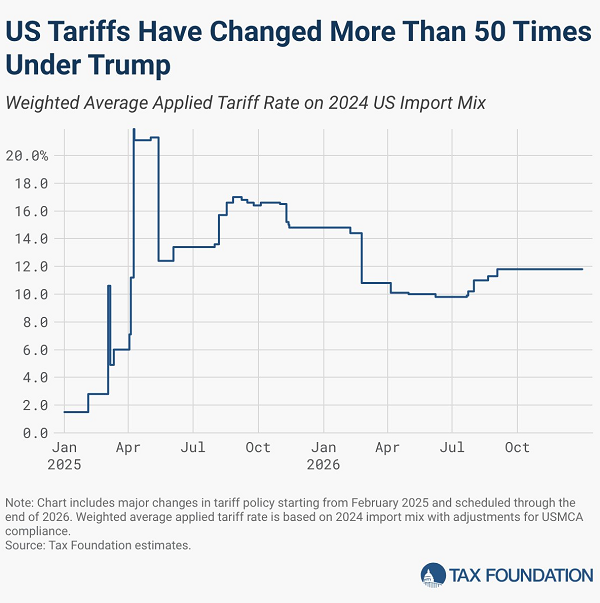
As the chart below from Erica York of the conservative-leaning Tax Foundation noted today, Trump has been both aggressive and inconsistent in his approach, having changed what had been a relatively stable tariff system more than 50 times in his second term. York said she expects the new round of import levies to push the average tariff rate back to where it was before the Supreme Court intervened, moving it from the current 12% closer to the previous average above 14%.
Some countries will be faced with higher tariffs on average, likely including China, which Trump has cited as a particularly aggressive manipulator of global commerce. At the same time, the new tariffs are expected to exclude certain goods, such as steel and aluminum, that are covered by an alternative set of rules.