
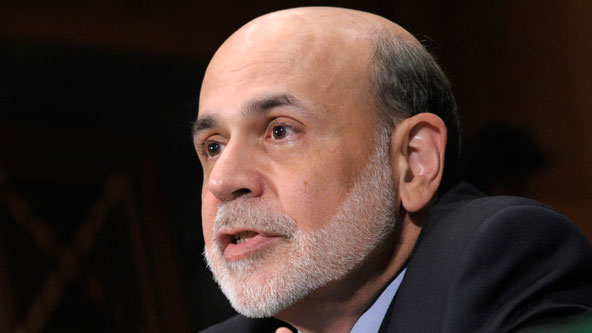
Could Be an Ugly Week for Bernanke
As soon as Ben Bernanke announced that he’d turn this month’s meeting of Fed policymakers into a two-day event, he triggered speculation that the Federal Open Market Committee will use the extra time to debate new measures to prevent the sluggish economy from flat-lining. That put him back in Republican Party crosshairs. Now he’s damned if he does and damned if he doesn’t; embarking on yet another round of aggressive and controversial measures to revive the economy is likely to trigger fresh attacks from Rick Perry & Co.
On the other hand, doing nothing may be just as risky an option. Economists expect the Commerce Department to release another dismal report about housing starts on Tuesday – the consensus forecast is that they dipped to a three-month low of 692,000 in August. On Wednesday, economists are looking for existing home sales to eke out a tiny gain from the eight-month lows hit in July, rising to 4.75 million in August. One question is whether the data will be bad enough to give Bernanke and his allies the ammo to counter another round of accusations that he’s too interventionist.
The Street’s Pathetic Record Picking Takeover Targets
Wall Street’s investment bankers have kept the M&A deal machine humming despite the bumpy market environment this summer, with some $2 trillion in mergers and buyouts worldwide announced as of the end of August. Notably absent from the list of companies involved, however, are those that Wall Street’s research analysts selected as obvious merger candidates – and thus obviously great investment ideas. Whoops.
Almost all the companies analysts expected to waltz down the aisle alongside an eager suitor are stuck being the bridesmaid, according to a new report from Birinyi Associates. Of the 123 companies put on target lists since early this year, only five were acquired, while not one of the nine most-often-cited targets – Boston Scientific, Lexmark, Humana, and Sprint among them – was involved in any M&A activity at all. Collectively, those nine stocks have lagged the S&P 500 index by 7.67% this year, reports Birinyi analyst Amanda Crumb.
What does this mean? Jeff Rubin, head of research at Birinyi, says Wall Street does investors a disservice by crafting investment products and strategies from appealing-looking themes. “Real alpha comes from stock picking, not trying to pick a group of stocks,” he says. Rubin also suggests being ultra-wary of some of the funky new themed ETFs (exchange traded funds) proliferating as Wall Street seeks to find ever-newer ways to slice and dice the markets.
The Problem at UBS Runs Deeper Than a Rogue Trader
If the investment banking world is bad at picking M&A candidates, it’s also showing some worrying signs of weakness in a far more critical area: risk management. Back in the mid-1990s it seemed that scarcely a year could pass without a fresh rogue trader hitting the spotlight. Two of them – Nick Leeson of Barings and Joseph Jett of Kidder Peabody – contributed to the effective demise of their institutions, while Toshihide Iguchi’s misadventures in bond trading not only cost Daiwa Bank of Japan a cool $1.1 billion but got it kicked out of the United States in 1995. After that, investment banks got religion: They sponsored ethics classes at business school, put new oversight programs and policies in place on trading desks, and tried to screen job candidates for personality traits that might signal a rogue trader in the making -- such as a reluctance to admit mistakes.
Now it seems as if those folks who rolled their eyes and said it would never work – that the only way to prevent rogue traders was to be ferociously vigilant in monitoring trading positions – were right. Only a few years after Jerome Kerviel produced a $7.16 billion loss for Société Générale, UBS trader Kweku Adoboli is accused of fraud in connection with losses that may reach $2.3 billion.
While the majority of those losses may have been incurred in the last few months, there have been reports that the roots of the problem date back to 2008. And that makes this more than just a financial problem for UBS. Still, UBS CEO Oswald J. Grübel sounds as if he’s shrugging his shoulders and saying, “Boys will be boys.” In an interview with Swiss newspaper Der Sonntag, Grübel commented that there’s not much anyone can do if someone decides to behave like a criminal. “If you ask me whether I feel guilty, I would say ‘no,’” he said. Well, give him points for honesty, at least.
Goldman Hires a Ringer
First came the announcement that Katinka Domotorffy, the head of quantitative investment strategies within Goldman Sachs Asset Management (GSAM), is leaving the firm at the end of the year and being replaced by new leaders, including outsider Ron Hua, the former chief investment office of noted quant investment firm PanAgora Asset Management. The other shoe dropped within hours, when Goldman announced it was closing the doors of its Global Alpha hedge fund, once the firm’s shining star. But Global Alpha, a quant fund, lost much of its luster -- along with 40% of investors’ capital -- in the financial crisis due to bad bets on everything from currencies to bonds. Related announcements? You betcha, says one Goldman insider.
GSAM -- the money management division that oversees mutual funds, hedge funds, and other asset management -- remains one of Goldman’s big hopes for generating profits in the future amidst turbulent banking and trading markets. It offers the bank a more stable source of revenues and profits and, to the extent that regulators crack down on market-making as well as proprietary trading, can be counted on to help the firm retain its appeal to investors. But only if its products and investment team are top of the heap. So it’s a savvy move to lure Hua away from PanAgora, one of the pioneering quant firms. If anyone can make lightning strike twice at GSAM, it’ll be someone like Hua.