
Neil Armstrong: An American Life

Neil Armstrong, the first man to set foot on the moon, passed away at age 82, his family said on Saturday, August 24, 2012. The former astronaut underwent heart-bypass surgery earlier this month, just two days after his birthday on Aug. 5, to relieve
Neil Armstrong, the first man to set foot on the moon, passed away at age 82, his family said on Saturday, August 24, 2012. The former astronaut underwent heart-bypass surgery earlier this month, just two days after his birthday on Aug. 5, to relieve blocked coronary arteries.
REUTERS/Gene Blevins
Neil Armstrong's love of flying began at the age of six, following his first plane ride. After years of studying and preparation, he obtained his pilot's license on his sixteenth birthday. Here he poses with an X-15 aircraft at the Dryden Flight Rese
Neil Armstrong's love of flying began at the age of six, following his first plane ride. After years of studying and preparation, he obtained his pilot's license on his sixteenth birthday. Here he poses with an X-15 aircraft at the Dryden Flight Research Center in California.
REUTERS/NASA
Armstrong, as commander of the Apollo 11 moon-landing mission, practices for the historic event in a lunar module simulation before the launch, in this June 1969 file photo.
Armstrong, as commander of the Apollo 11 moon-landing mission, practices for the historic event in a lunar module simulation before the launch, in this June 1969 file photo.
REUTERS/Stringer
The Apollo 11 astronauts almost instantly became household names across America in 1969. From left to right: Neil Armstrong, Michael Collins, and Edward "Buzz" Aldrin.
The Apollo 11 astronauts almost instantly became household names across America in 1969. From left to right: Neil Armstrong, Michael Collins, and Edward "Buzz" Aldrin.
REUTERS/NASA
This NASA remote camera file image shows the historic July 16, 1969, launch of Apollo 11, the first manned mission to land on the Moon, from the Kennedy Space Center Launch Complex in Florida.
This NASA remote camera file image shows the historic July 16, 1969, launch of Apollo 11, the first manned mission to land on the Moon, from the Kennedy Space Center Launch Complex in Florida.
REUTERS/Handout
This NASA file image shows astronaut Neil Armstrong, the Apollo 11 mission commander, standing next to the lunar module, "Eagle," on the surface of the moon, on July 20, 1969.
This NASA file image shows astronaut Neil Armstrong, the Apollo 11 mission commander, standing next to the lunar module, "Eagle," on the surface of the moon, on July 20, 1969.
REUTERS/Handout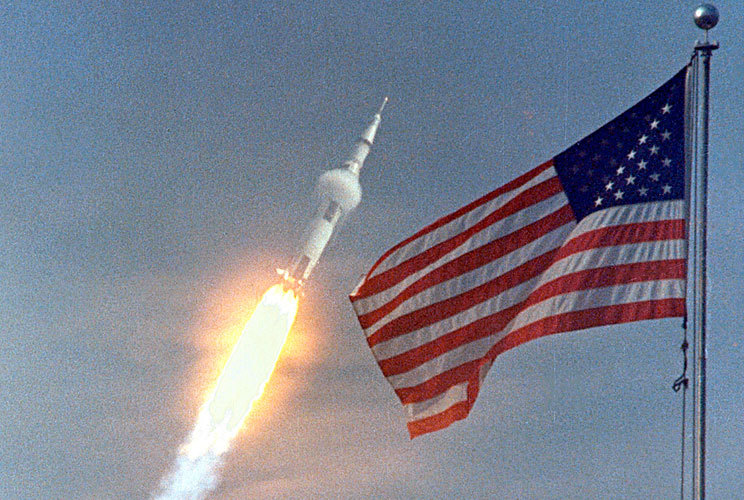
From 1961 to 1969, the United States and the USSR were engaged in an intense battle to land the first man on the moon. Five days after Apollo 11 lifted off into space on July 16, 1969, as millions of Americans watched on TV, this country won the race
From 1961 to 1969, the United States and the USSR were engaged in an intense battle to land the first man on the moon. Five days after Apollo 11 lifted off into space on July 16, 1969, as millions of Americans watched on TV, this country won the race.
REUTERS/Handout
The Apollo 11 astronauts Armstrong (left), Collins (center), and Aldrin share a laugh with President Richard Nixon in their isolation unit aboard the USS Hornet after their triumphant splashdown in the Pacific. The President was on hand to greet the
The Apollo 11 astronauts Armstrong (left), Collins (center), and Aldrin share a laugh with President Richard Nixon in their isolation unit aboard the USS Hornet after their triumphant splashdown in the Pacific. The President was on hand to greet the astronauts, while the nation cheered.
REUTERS/Handout

An official NASA portrait of astronaut Neil A. Armstrong, forever the commander of the Apollo 11 lunar landing mission, in his space suit, with his helmet.
An official NASA portrait of astronaut Neil A. Armstrong, forever the commander of the Apollo 11 lunar landing mission, in his space suit, with his helmet.
REUTERS/Handout