
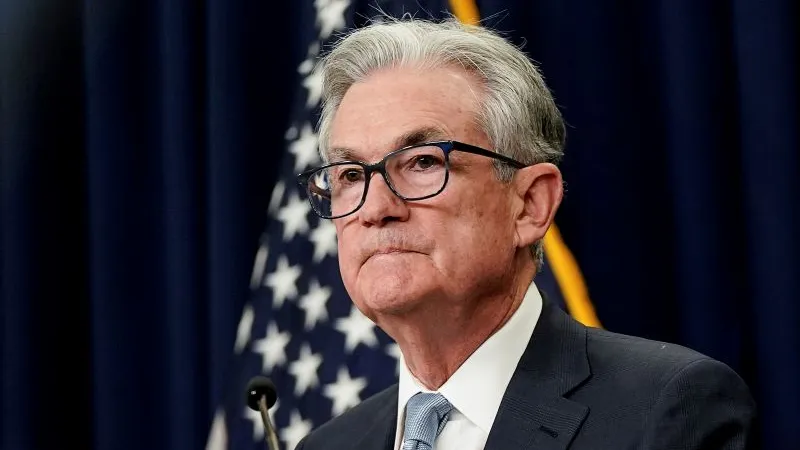
The Federal Reserve on Wednesday announced that it would hold interest rates steady for now, as officials declined to raise the central bank’s benchmark rate for the first time in more than a year.
Before today’s announcement, the Fed had raised rates at 10 consecutive meetings over 15 months in an effort to cool the economy and bring inflation under control. Many analysts expected the central bank to announce a pause today, thinking the Fed was likely done with rate increases, but the Fed’s policymakers surprised many observers by indicating that they expect to raise rates two more times this year, with the first of those increases potentially coming as soon as July.
“Holding the target range steady at this meeting allows the Committee to assess additional information and its implications for monetary policy,” the Federal Open Market Committee said in a statement. As before, officials said they would consider a wide variety of data points as they determine how to proceed in their campaign to return inflation to the target of 2%.
Higher for longer: Although Fed officials will wait to see what the data reveals in the coming weeks, with the path ahead still to be determined, Powell said most FOMC members believe that more rate hikes will be necessary, given the persistent and in some ways surprising strength of the economy. “Nearly all committee participants expect that it will be appropriate to raise interest rates somewhat further by the end of the year,” he said.
The economic projections released Wednesday show that most FOMC officials now believe that the benchmark rate will need to go up another half point from the current target range of 5.0% to 5.25%. Of the 18 members of the FOMC, 12 projected rates at or above the range of 5.5% to 5.75% by the end of the year.
“Inflation pressures continue to run high and the process of getting inflation back down to 2% has a long way to go,” Powell told reporters. Core inflation is still running hot, Powell said, and the labor market has proven to be resilient, indicating that pricing pressure has been slow to ease throughout much of the economy.
“Given how far we have come, it may make sense for rates to move higher but at a more moderate pace,” Powell said.
Some inflation hawks said they were glad to see the change in the Fed outlook, even with the pause in June. “Pleased to see that the Fed continues to be data dependent: they are expecting higher inflation & lower unemployment so raised their median expectation for rates by 50 [basis points],” said former Obama administration economist Jason Furman. “I wish they had gotten started on that process today, it may not be enough, but a reasonable place to land.”
Soft landing ahead? Furman and others also noted that the Fed’s economic projections show no recession, at least in the near term. “They're projecting 1.0% growth in 2023 (Q4/Q4),” he tweeted.
New York Times economics reporter Talmon Joseph Smith reached the same conclusion. “[D]espite hinting at a willingness to hike rates higher, it is now, in essence, projecting a soft landing,” he tweeted.
Powell reiterated his belief that a soft landing is a possibility. “There is a path to getting inflation back down to 2% without having to see the kind of sharp downturn and large losses of employment that we’ve seen in so many past instances,” he said. “It’s possible. In a way, a strong labor market that gradually cools could aid that along. But … the committee is completely unified in the need to get inflation down to 2% and will do whatever it takes to get it down to 2% over time.”
The projections indicate that Fed officials expect to see an inflation rate of 3.2% by the end of the year, with core inflation, which strips out volatile food and fuel prices, coming in at 3.9% — higher than the 3.6% projection made in March.
The bottom line: Strong economic data has pushed the Fed into a more hawkish stance on inflation, which more than likely means higher interest rates ahead.