
Democrats’ Election Rout Launches New Era for Trump, Congress
Happy Wednesday! Here's your evening update as we enter a new era in American politics.
Democrats' Election Landslide Sets Up New Era for Trump, Congress
Democrats today are celebrating the massive "blue-nami" that swept them into large House and Senate majorities in the next Congress, including historic wins in many races across the American heartland and the deep South - places that had gone for Republicans by double-digit margins just two years ago or that hadn't seen Democratic wins in decades.
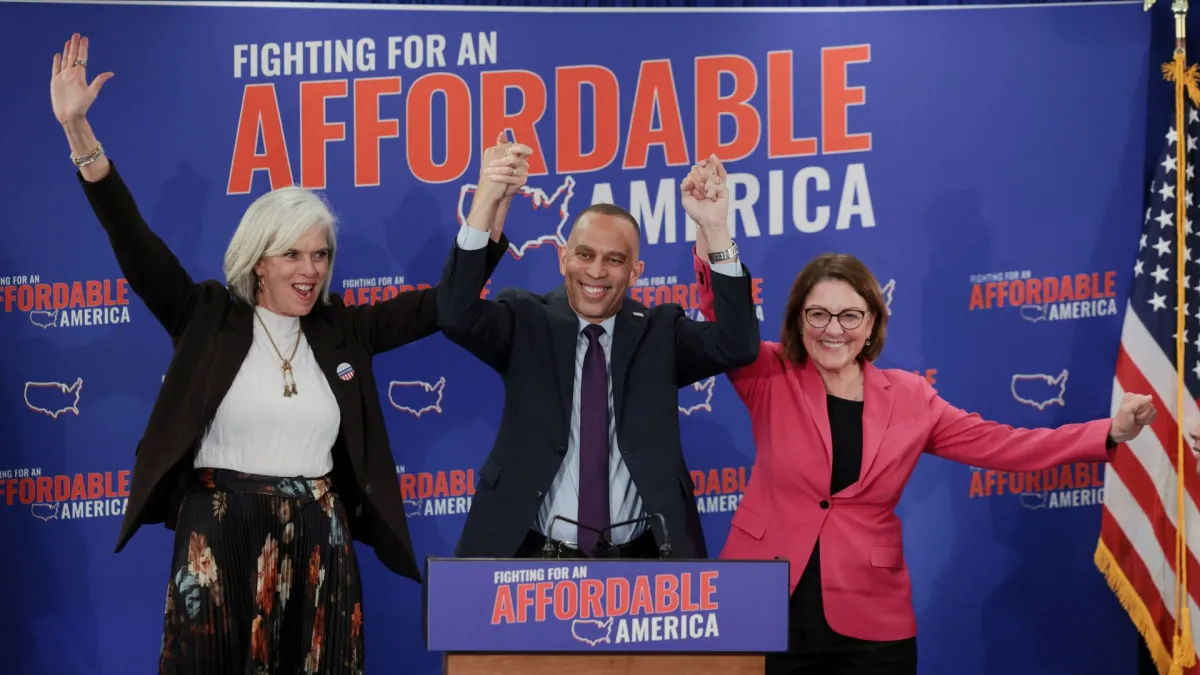
"It wasn't simply a blue wave, it was an American tsunami," said Rep. Hakeem Jeffries of New York, who is poised to become the first Black speaker of the House, with a comfortable majority that could help mitigate the challenges of leading a caucus that still must contend with differences between moderates, progressives and Democratic socialists.
Democrats have already won 237 House seats, according to an Associated Press tally, with 59 races yet to be called. Jeffries predicted his party's lead would grow to the largest Democratic majority since the early 1990s.
"We will win at least 255 seats, if not more, once every vote has been tallied," Jeffries told reporters, calling the result a "stunning rebuke of MAGA extremism" and a great night for the country. "It's a historic majority in the 21st century."
That historic majority stretches to the Senate and statehouses, too. Democrats flipped seven Republican-held Senate seats and are poised to hold a majority of at least 54 seats, with races in Alaska and Mississippi - deep red Mississippi! - still too close to call.
Democrats won Senate seats in South Carolina for the first time since 1998, in Texas for the first time since 1988 and in Kansas for the first time since 1932. The BBC notes that the last time a Kansas Democrat was in the Senate, "The Wizard of Oz" was playing in movie theaters. "Against all odds, Democrats have won the Senate, and we have five words for the American people: Relief is on the way," Senate Democratic Leader Chuck Schumer said at a Wednesday news conference.
Democrats are also set to hold a majority of governorships for the first time in 16 years, including in Georgia, where Keisha Lance Bottoms is set to become the first Black woman to ever hold the office, and in Texas, where Gina Hinojosa easily unseated incumbent Gov. Greg Abbott as part of a dramatic and complete flip of statewide offices. Democrats also flipped governors' seats in Iowa, Nevada and Ohio.
Republican mid-decade redistricting plan flops: President Trump and Republicans sought to give themselves an edge in the race for the House by launching an unusual mid-decade redistricting battle focused on strengthening the GOP advantage in Texas, Florida and other states. Party leaders had hoped to redraw maps to create a net gain of some 15 seats. That plan failed miserably, as Democrats have won or are leading in 13 of the 15 districts targeted by the GOP. Democrats, meanwhile, targeted six seats in California and Utah and are poised to flip them all.
Trump deflects blame: The president did not question the Democratic victories, which were simply too big for him to claim they were rigged. But faced with a sharp rebuke by voters, Trump largely dismissed his responsibility for the massive Republican losses.
"Congratulations to the Democrats," Trump said Tuesday night in a phone call with Fox News. "They did a good job. They've been looking for this one for 11 years and they finally got it. But I don't view it as a hit on me. I think we've done a - we've had the greatest two years in the history of the presidency in terms of the economy, in terms of all the things that we've done."
Trump essentially ignored the numerous times he had called for voters to act as if he was on the ballot and his backing of weak candidates like Ken Paxton in Texas and Sen. Darline Graham in South Carolina, even as other Republicans worried about candidate quality.
"I wasn't on the Ballot and if I was, we would have won IN A LANDSLIDE!" Trump posted just after 10:30 p.m. on Tuesday night, as the magnitude of Republican losses was becoming apparent. He later added: "FoxNews bears responsibility for these losses by constantly and consistently putting on the Dumocrat opposition, and worse."
Republican repercussions already being felt: Other Republicans were more willing to point the finger at Trump and his policies.
"Not only were folks upset about the war, inflation and gas prices, but add to that the fact they think he was making them eat a shit sandwich in Darline, and they just had enough," Mick Mulvaney, a former Trump White House chief of staff and South Carolina congressman, told Politico.
On Wednesday, Trump spoke at length at a White House event - touting his new ballroom. He ultimately did acknowledge that the Iran war and its effect on energy prices were a factor in the vote, but he defended his decision to attack. "The Iran thing we had to do, and we continue to do it," Trump told reporters.
In a lengthy social media post, Vice President JD Vance pinned the blame for the GOP wipeout on the war.
"One of the pollsters I really respect told me that our economic messaging wasn't sharp enough down the stretch. I'm sure that's true. But the real reason we lost is obvious to almost everyone," Vance wrote, adding, "The reason we lost is the war. The president himself said so last night. If you'd like to argue it was worth it, that losing the Senate for the next 6 years was worth it, then do so. Argue it was a worthwhile cost to pay. Agree or disagree, that's at least honest. But everyone knows why we lost."
Some Republicans are reportedly already turning against Defense Secretary Pete Hegseth, with speculation that he might take the blame for the GOP election pummeling and could face an impeachment vote as soon as next week. Trump defended Hegseth on Wednesday and said he has no plans to fire him.
GOP leadership fights brewing: Speaker Mike Johnson, who won re-election in his Louisiana district, reportedly told his staff Wednesday that he will step aside as the House Republican leader, though he did not specify whether he plans to stay in Congress or resign his seat.
Republican Reps. Steve Scalise, the current House majority leader, and Jim Jordan, who now chairs the Judiciary Committee, quickly announced bids to become Republican minority leader next year.
Scalise wrote in a letter to colleagues that "the election was far worse than any of us expected" and that Republicans "will need to be honest with ourselves about what happened, but it is more important now than ever for us to emerge from this stronger and united because the stakes couldn't be higher."
Jordan, meanwhile, said in his own letter to colleagues that it is a "staggering day" for the House Republican conference, but argued that Republicans must go on offense if they hope to win back the majority in two years. "I am battle-tested on the oversight front and I know the Democrats' playbook," he wrote.
The House Republican conference will hold leadership elections next week. Whatever the outcome, GOP finger-pointing and MAGA blowback are likely to continue as the party wrestles over its path toward a post-Trump future.
Democrats Map Out Agenda Focused on Affordability
Democratic lawmakers plan to pass a series of bills soon after taking control of Congress in January, with a focus on one of the key issues that helped produce their historic performance in the midterms: affordability.
In their first 100 hours in power, Democrats reportedly intend to introduce legislation that would:
- reinstate enhanced subsidies for health care plans sold under the Affordable Care Act that were allowed to expire by Republicans;
- reverse cuts to Medicaid that Republicans made in their budget bill last year;
- undo tariffs imposed by President Trump on goods from countries around the world while restoring the power of Congress to oversee trade policy;
- call for Trump to end the war with Iran or seek authorization from Congress to continue it.
Another important focus: At the same time that they address economic issues, Democrats plan to ramp up investigations of Trump and his administration, though they have not yet determined how to balance the legislative and investigative drives.
"We haven't evaluated who are going to be the targets of the investigation right out of the gate," Minority Leader Hakeem Jeffries, who is expected to become the next speaker of the House, said Wednesday. "We'll have those conversations over the next couple of weeks."
Still, Jeffries has signaled that he intends to lean into the economic part of the Democratic agenda. "The American people don't want us to get even. They want us to get things done on their behalf because life is way too expensive," Jeffries said on MS NOW's Morning Joe. "We ran on affordability, we won on affordability, and now it's our job to govern on affordability."
In a statement Wednesday, Sen. Ron Wyden, the senior Democrat on the Senate Finance Committee, said he plans to hold Trump and the Republicans accountable for their actions over the last two years, even as he remains focused on pocketbook issues.
"For the last two years Republicans have used the Finance Committee to execute and defend the most craven parts of Trump's agenda: ripping health insurance away from millions, driving up costs with tariffs, covering up Epstein's financial records, and letting Trump treat the Treasury Department like his personal piggy bank," Wyden said. "Trump and Republicans have been running a smash-and-grab job on the American people. Under my leadership, the top priorities of the Finance Committee will be affordability for us, accountability for them."
Some Democrats, though, seem more focused on the investigative and punitive angle. As the election results were streaming in late Tuesday, Rep. Robert Garcia, who is expected to become the next chairman of the House Committee on Oversight and Accountability, sent a simple message on X: "LAWYER UP."
Looking for leverage: Despite the big wins for Democrats Tuesday, a Republican still controls the White House, and Democrats will fall short of 60 votes in the Senate, creating serious obstacles to enacting their priorities.
Analysts at Goldman Sachs said Wednesday that they expect Democrats to use must-pass bills as opportunities to push through their agenda. Government funding will need to be extended by December 11, and Democrats could call for a short-term extension to give them an opportunity for more extensive policymaking in a major funding bill in early 2027. The debt ceiling will likely need to be raised at some point next year, as well, providing another opportunity to work out a multi-faceted deal.
The Goldman analysts said they expect to see the spending cuts passed by Republicans to be reversed early on by Democrats, and that doing so would raise spending by about 0.25% of GDP. "A deal on discretionary spending or expanded health insurance subsidies would add modestly to that total," the analysts said.
Fiscal News Roundup
- Democratic Sweep of Congress Ushers in a New Era as Trump Acknowledges Impact of the Iran War – Associated Press
- White House Defends Trump's Agenda, Pledges to 'Defy the Odds' After Midterm Losses – Associated Press
- Trump Brags About the White House Ballroom in His First Post-Election Appearance – NBC News
- Trump Concedes Iran War Angered Voters, Triggered Democratic Landslide – Washington Post
- House Democrats Plan a First 100-Days Agenda if They Sweep to Power in Midterm Elections – Associated Press
- Democrats Map Out an Agenda to Address Affordability and Corruption After Midterm Sweep – CNBC
- Debt Limit, Tariffs Top List of Likely Deals in Trump's New Era – Bloomberg
- House Speaker Mike Johnson Will Not Stay On as Republican Leader After GOP Losses – NBC News
- Democrats Pledge to Quickly Reverse Changes to Medicaid, Restore ACA Subsidies – Washington Post
- Democrats Get Their Health Agenda Ready Ahead of Takeover – The Hill
- DeLauro Makes Official Bid to Return to the Top Job on the House Appropriations Committee – Politico
- Appeals Court Hands Win to Mamdani in Fight Over Second-Home Tax – New York Times
- Dow Rallies 1,500 Points, Heads for Best Day in 18 Months, on Decisive Democratic Win, Oil Price Plunge – CNBC
Views and Analysis
- 'We're Just Fed Up': How Economic Fury Delivered Democratic Sweep – Konrad Putzier, Richard Rubin and Ian Hodgson, Wall Street Journal
- Trump's MAGA Coalition Just Got Vaporized – Ronald Brownstein, Bloomberg
- Democrats Are About to Run the Show on Capitol Hill. What Will They Do With Their Power? – Kelsey Brugger, Politico
- America Punishes Trump's Party: 8 Takeaways From a Democratic Landslide – Shane Goldmacher and Patricia Mazzei, New York Times
- Trump Taxed Imports. Voters Sent Republicans the Bill – Washington Post Editorial Board
- Voters Rejected Tariffs. Congress Should Too – Bloomberg Editorial Board
- Republican Redistricting Efforts Collapse Under Blue Wave – Amy O'Kruk and Ethan Cohen, CNN
- Every Major Demographic Group Swung Left Amid Trump Backlash – Lily Boyce et al., New York Times
- With Democrats' Sweep, Congress Is Set to Reassert Power to Check Trump – Carl Hulse, New York Times
- Five Things to Know About Hakeem Jeffries – Annie Karni, New York Times
- Trump Has Met His Match – New York Times Editorial Board
- Trump Has the Democrats Right Where He Wants Them – Michelle Cottle, New York Times
- The Federal Reserve's Independence Is Assured for Now – Jonathan Levin, Bloomberg
- Time to Face the Social Security Crisis – Robert C. Pozen, Wall Street Journal
Get The Fiscal Times newsletter in your inbox
Free, every weekday.