
Jeffries Poised to Make History as Democrats Nominate Him for Speaker
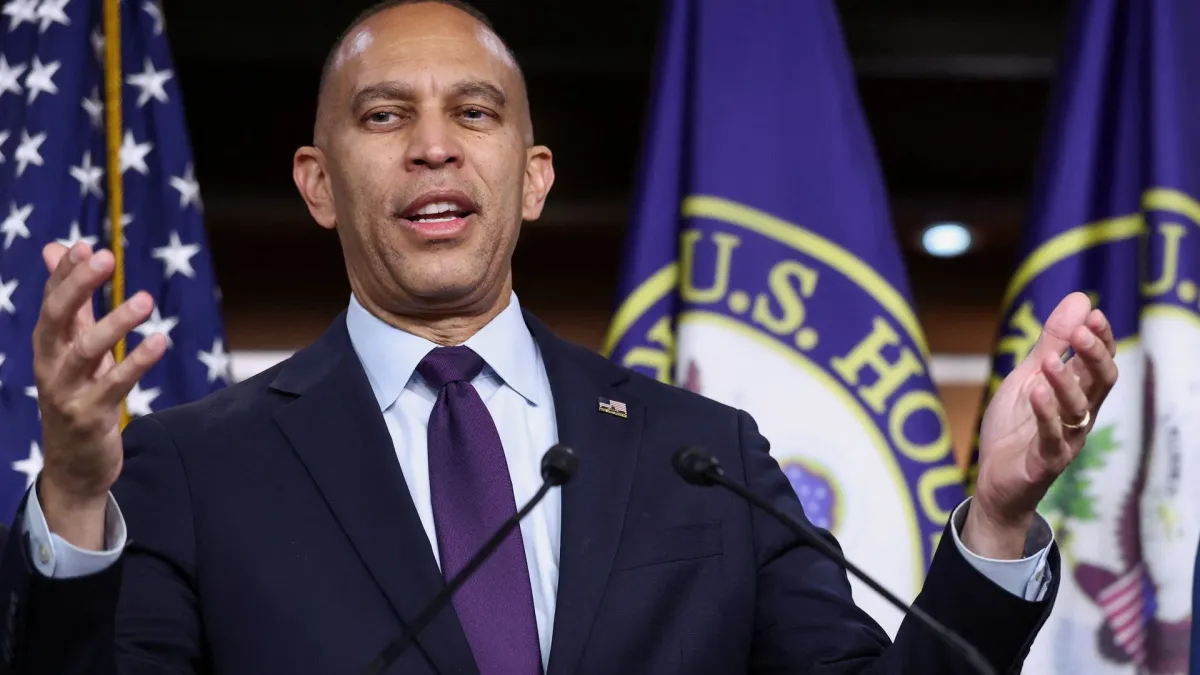
Happy Wednesday! Rep. Hakeem Jeffries took another step toward history today, as Democrats nominated him to be speaker. Among the issues he'll have to deal with: the nation's debt limit, which is on pace to be reached early next year. We've got details.
Jeffries Poised to Make History as Democrats Nominate Him for Speaker
Set to take over the House majority in January, Democrats backed Jeffries, 251-11, in secret balloting that firmly establishes him as the likely speaker when the 120th Congress convenes in early 2027. Two Democrats reportedly did not vote in balloting that also included House delegates.
Jeffries will need a simple majority of 218 votes when the whole House chooses a speaker in January.
"It is a high honor and distinct privilege to stand before the American people today as the Democratic nominee to be the next speaker of the United States House of Representatives," Jeffries said at a news conference at the Capitol. "We know the American people are struggling. We know millions of people are drowning in this failed Republican economy, and House Democrats are committed to turning things around."
A small bloc of opposition: The 56-year-old Jeffries, who joined the House in 2013 and became minority leader in 2023, said that Americans are demanding "bold, dramatic and transformational change" and that Democrats are committed to delivering that change away from an "unacceptable" status quo.
Yet Jeffries himself faces some calls for change from a restive Democratic base. A group of newly elected progressives and Democratic socialists announced that they had voted against Jeffries, even as he ran unopposed.
"Whether on Medicare for All, stopping ICE terror, getting money out of politics, or ending the genocide in Gaza, our constituents sent us to Congress with a mandate on these issues. We have worked to secure commitments from Leader Jeffries in good-faith conversations," the group said in a joint statement. "While we have seen meaningful progress, there is still work to be done to ensure that the direction our party takes this coming Congress reflects what our constituents are demanding of leadership. Those conversations are ongoing. As such, our vote in caucus today was no."
The incoming members behind that statement included Darializa Avila Chevalier of New York, Adam Hamawy of New Jersey, Melat Kiros of Colorado, Donavan McKinney of Michigan, Chris Rabb of Pennsylvania and Claire Valdez of New York. Rep.-elect Frederick Haynes of Texas, also included in the statement, said he intended to vote against Jeffries but woke up ill and missed the vote.
Two other incoming members, Angela Gonzales-Torres of California and Don Leonard of Ohio, also announced that they had opposed Jeffries as part of a push for change. Leonard cited his desire to eliminate corporate and special-interest money in politics and funding for Israel.
Despite that opposition, Wednesday's vote suggests that Jeffries and the incoming Democratic majority should be able to avoid some of the drama and disruption that has plagued a divided House Republican conference in recent years. Republicans now hold a bare 218-seat majority in the House, while Democrats are poised to have 260 seats starting next year.
Asked about the votes against him and whether he feels a need to get those opponents to yes, Jeffries said the results of today's election speak for themselves. He said it is an honor to serve with a 260-seat majority from all across the country, including people with different perspectives. He said Democrats would work together.
"Our job is to fight MAGA extremism, not each other," he said. "To fight MAGA extremism and to get big things done for the American people, and that is what we are going to accomplish together beginning on January 3rd."
Other historic firsts for House Democratic leaders: Rep. Katherine Clark of Massachusetts is set to become the first female majority leader, while Rep. Pete Aguilar of California would be the first Latino majority whip. Clark and Aguilar both ran unopposed and were elected by acclamation.
US Will Hit Debt Limit Again in Early 2027: Analysis
Congress increased the federal debt ceiling by $5 trillion in 2025, removing the issue from political combat for a couple of years as lawmakers raised the limit to $41.1 trillion. But ongoing deficit spending has eaten up most of that headroom, and new projections by the Bipartisan Policy Center indicate that the federal government is just a few months away from bumping into the congressionally mandated ceiling once again.
"The Bipartisan Policy Center now estimates that, absent congressional action, the U.S. will most likely reach the debt limit once again in February or March 2027, when large tax refunds typically produce sizable monthly cash flow deficits," the nonpartisan group said Wednesday.
When the Treasury reaches the debt limit, it resorts to a series of financial maneuvers to provide some leeway. These so-called extraordinary measures, which include delaying payments into retirement funds and delaying rollovers of certain maturing securities, are expected to provide another six to nine months of liquidity, BPC said. Once those measures are exhausted - a point in time called the X Date - the federal government will no longer be able to meet all of its obligations.
Currently, BPC estimates that the X Date will arrive in October 2027. But there is some uncertainty about the exact timing, with much depending on tax receipts and refunds in April, as well as decisions the Treasury makes as it manages its cash reserves.
Whatever the exact date, BPC called on lawmakers to address the issue as soon as possible.
"Prior debt limit episodes have demonstrated that delay carries real costs for taxpayers," the group said, citing higher interest rates, credit downgrades and reductions in fiscal space to deal with emergencies like war or economic crisis. "Addressing the debt limit well in advance of the X Date would remove that constraint and spare taxpayers the costs of another standoff."
Quote of the Day: Fed Shock Ahead?
"I'm very, very concerned about inflation. It's kind of headed in the wrong direction, and it's spreading out. It's not just concentrated in a few categories. ... If you really want to get it down, you've got to start taking more aggressive actions. ... Firms are thinking consumers are resilient, they'll pay, and we can pass through 3% [price] increases or higher. We're starting to hear some of that. ... That's when you start having problems trying to get inflation down, so you might need to, like, shock people to say, 'Wait a minute, 3% is not the number you should be thinking about going forward.'"
- Federal Reserve Governor Christopher Waller, calling for aggressive action to rein in inflation.
In an interview with CNBC on Wednesday morning, Waller said that an interest rate hike of half a percentage point is likely warranted at the Federal Open Market Committee meeting scheduled for December 8 and 9. Waller added that raising rates by a quarter point in December while signaling another quarter-point hike in January could also suffice. Fed Chair Kevin Warsh has shifted away from that kind of "forward guidance" to markets.
"If you're not going to signal this very clearly to markets, you're going in January, my view is then you have to go 50 [basis points] in December to put it in place and get it done," Waller said.
Waller also suggested that several more rate hikes might be necessary, beyond the two that many economists now forecast.
The minutes of the Fed rate-setting committee's October meeting, released Wednesday, showed that nearly all Fed officials expect a quarter-point rate hike next month, while two raised the possibility of a half-point increase.
New York Fed President John Williams told Axios on Tuesday that he doesn't see the need for a half-point hike next month. "I don't think the situation calls for dramatic action," he said, though he also noted that AI-fueled strength in the economy might require the Fed to raise rates higher.
Fiscal News Roundup
Views and Analysis
Get The Fiscal Times newsletter in your inbox
Free, every weekday.