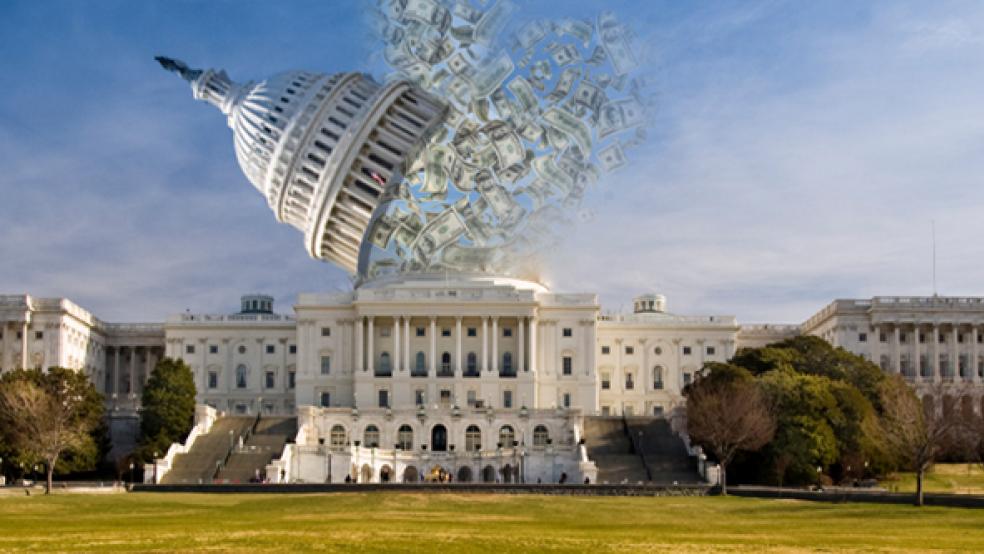
The chief architects of the $1.1 trillion spending deal unveiled late Monday vowed to limit the number of policy-oriented amendments as they rushed to meet this week’s deadline.
Sen. Barbara Mikulski (D-MD) and Rep. Harold Rogers (R-KY) whittled down hundreds of provisions, but the final 1,582-page bill is still laced with policy directives. That may have reflected the pent-up demand of rank-and-file lawmakers for real input into government policy after nearly two years of partisan gridlock over budget and spending issues.
Related: Congress Dishes Out $1.1 Trillion Spending Bill
House and Senate negotiators unveiled the major spending agreement late Monday evening that would ease sharp across-the-board spending cuts known as the sequester and boost discretionary spending for defense and domestic programs. Congress is expected to approve the bill and send it to President Obama for his signature by the end of the week to avert another government shutdown.
The Republicans. The GOP failed to block a new EPA regulation to reduce carbon dioxide emissions at new coal-fired power plants. They couldn’t scale back provisions of the Dodd-Frank financial industry regulation law. And they struck out again in their drive to torpedo funding for Obamacare.
The Democrats. Democrats lost a new standard for energy-efficient light bulbs; anti-abortion measures were reaffirmed; and strict new reporting requirements on the IRS following last summer’s scandal over the agency’s targeting of Tea Party groups’ applications for non-profit status were imposed.
House and Senate negotiators unveiled the major spending agreement late Monday evening that would ease sharp across-the-board spending cuts known as the sequester and boost discretionary spending for defense and domestic programs. Congress is expected to approve the bill and send it to President Obama for his signature by the end of the week to avert another government shutdown.
Related: Government Blatantly Wastes $30 Billion This Year
Jim Dyer, a former Republican staff director of the House Appropriations Committee, said Tuesday that members of Congress need “a comfort level” with the way government funds are spent before they finally sign off. “There has got to be a manifestation of members somehow saying, ‘Okay, here’s the money but here’s how we want it spent.’”
While Republicans fell well short of their goal of defunding the Affordable Care Act, for example, the bill’s language nonetheless holds the line on the Department of Health and Human Services’ spending for implementation and reduces funding for the Independent Payment Advisory Board (IPAB) created by Obamacare.
For another year, conservatives succeeded in prohibiting the Obama administration from transferring inmates from the military prison in Guantanamo Bay, Cuba, to the U.S. and its territories. The bill also forbids spending on modifying any facility in the U.S. to house detainees and places conditions on the release of detainees to other countries.
The spending bill also withholds additional funding for the Afghanistan government until that country agrees to a new bilateral security agreement. The measure would also ban foreign aid for Libya until Secretary of State John F. Kerry confirms its cooperation with ongoing investigations into the Sept. 11, 2012, attack at the U.S. diplomatic outpost in Benghazi.
Related: U.S. Spends Billions in World’s Most Corrupt Country
The massive spending bill would also provide new congressional backing for President Obama’s strategy of continuing aid to Egypt, despite a law that forbids U.S. military aid to governments that have taken power by military coup, as Egypt’s interim military-backed government did in July. The new bill, however, does tie the renewed funding to the Egyptian government taking steps toward restoring democracy.
Here are highlights of other policy amendments or “riders” salted throughout the spending bill:
Abortion – The bill once again bans the use of federal funding to perform most abortions; bans federal funding for abortions in the District of Columbia and for federal prisoners; and bans the use of U.S. foreign aid on abortions.
Embassy Security – Despite heightened concern about embassy security in the wake of the attack on the U.S. mission in Benghazi, the bill allocates $224 million less to embassy security, construction and maintenance than was earmarked for fiscal 2013. The bill also prohibits funding for the renovation of UN Headquarters in New York and for a new London embassy.
Gun Control – The bill bars import and export criteria related to firearms and it restricts the Departments of Justice and Homeland Security from establishing programs similar to the “Operation Fast and Furious” gun-running program. Democrats also prevented Republicans from blocking gun sellers from reporting multiple sales of rifles or shotguns to the same person.
Related: Slammed by New Taxes—Why You’re Poorer Than You Think
Nutrition Programs -- A provision requires the Department of Agriculture to submit a plan for reducing high error rates and improper payments in the National School Lunch and School Breakfast Programs. The Agriculture Secretary is also required to help weed out and eliminate waste, fraud, and abuse in the food stamp program.
U.S. Postal Service -- The bill prohibits the U.S. Postal Service from discontinuing Saturday mail deliveries as part of a cost-saving effort, or from closing remote rural post offices. Postal officials for years have been seeking to end Saturday deliveries and to close smaller, less profitable locations.
Veterans – The bill includes a major crosscutting initiative to help the VA meet its goal of ending a massive backlog of disability compensation claims by 2015. That includes additional funding for information technology upgrades at regional offices to manage the improved paperless claims processing system.
Top Reads from the Fiscal Times: