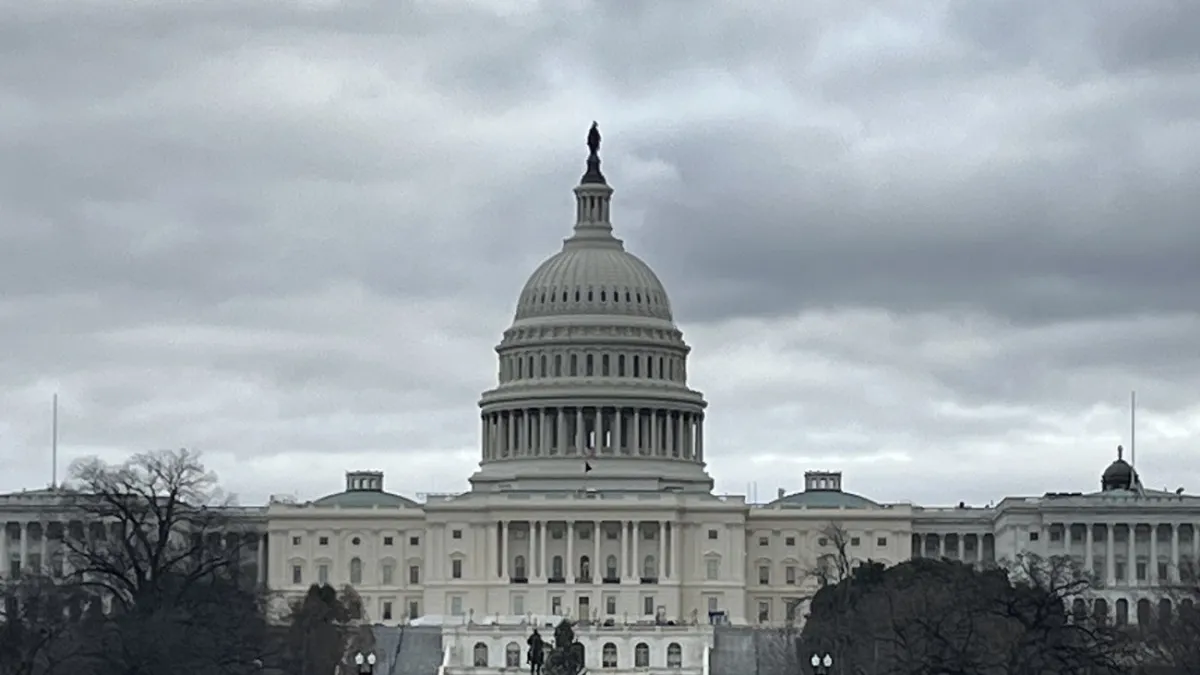
Senate leaders plan to pass the final six government funding bills for fiscal year 2026 next week, but those plans will be complicated by concerns from both Democrats and Republicans — and Mother Nature could present a major challenge, too. The House is out next week, meaning that if the Senate doesn’t pass the funding package by a January 30 deadline, parts of the federal government would shut down.
Democrats object to Homeland Security bill: The six-bill package to be considered by the Senate contains funding for the departments of State, Defense, Labor, Health and Human Services, Education, Transportation and Housing and Urban Development, among other agencies and programs. But it’s the funding for the Department of Homeland Security that is most controversial given the national firestorm over the Trump administration’s immigration enforcement tactics, most recently in Minnesota, where protests continue against the deployment of thousands of Immigration and Customs Enforcement agents.
The House voted on the DHS bill separately, and only seven Democrats supported it. But Senate Democrats won’t be able to vote against the DHS bill alone, because it is now rolled into the larger funding package. Democratic leaders have said they aren’t looking to provoke a partial shutdown, but some Senate Democrats have already said that they are prepared to vote against the entire package because of their opposition to the DHS funding.
“If the Senate were to vote on these appropriations bills individually, I would support some of them. But the House is bundling six bills into a single package a week before a budget deadline and skipping town to try and jam senators into a single up or down vote,” Sen. Tim Kaine of Virginia said in a statement released Friday. “Appropriations bills shouldn’t just fund priorities; they should also place restraints on a runaway executive. Where are the funding restrictions to stop the President from unilaterally taking our sons and daughters into illegal wars, even endless wars, even wars against allies? Or to block deploying our troops against American citizens, as he has done and is threatening to do again? Or to impose effective safeguards against ICE operations that inflame tensions within our cities, terrorize our communities, and make all of us less safe?”
Kaine also called for measures to block the firing of federal employees, prevent the administration from cancelling congressionally appropriated spending and ensure that millions of Americans don’t lose their health insurance.
“The President is acting chaotically and unlawfully and we shouldn’t give his deranged decisions the imprimatur of congressional approval by passing this legislation without significant amendment,” Kaine concluded.
Kaine’s stance is notable because he was one of eight Senate Democrats who broke ranks to allow the government to reopen after a 43-day shutdown late last year.
Sen. Chris Murphy, the top Democrat on the Senate Homeland Security Appropriations subcommittee, said he agreed with Kaine. In a Substack post Friday, he wrote that what he saw on a trip to inspect immigration operations in Texas confirmed for him that Democrats cannot fund this version of ICE. “Democrats have no obligation to vote for a budget that funds a runaway, immoral agency just because Republicans are so beholden to Trump, they refuse to agree to any reforms,” Murphy wrote. “We should demand that SOME reforms be built into the DHS budget before we vote for it. I’m not naive - I know this budget will not cure every problem or fully end the parade of horrors and lawlessness. But there are meaningful reforms we could implement.”
The funding bill needs 60 votes to pass, and there are reportedly as many as 10 Democrats who may oppose it, which would still leave a path for the package to clear the Senate and prevent a partial shutdown.
Sen. Patty Murray, the top Democrat on the Appropriations Committee, defended the package in a statement this week, arguing that appropriators had reasserted Congress’s power of the purse in the face of challenges from Trump and White House budget director Russ Vought. And she said that Democrats had managed to block many of the Trump administration’s proposed cuts to education, healthcare and medical research. She added that blocking the funding bill would do little to impede ICE’s immigration crackdown.
“ICE must be reined in, and unfortunately, neither a CR nor a shutdown would do anything to restrain it, because, thanks to Republicans, ICE is now sitting on a massive slush fund it can tap whether or not we pass a funding bill,” Murray said. “The suggestion that a shutdown in this moment might curb the lawlessness of this administration is not rooted in reality: under a CR and in a shutdown, this administration can do everything they are already doing—but without any of the critical guardrails and constraints imposed by a full-year funding bill.”
Some Republicans have concerns, too: Sen. Rand Paul of Kentucky said he opposes the spending package and is urging other Republicans to vote against it. “After the staggering level of welfare fraud exposed in Minnesota, why on Earth would ANY Republican vote to fund more refugee welfare programs?” he wrote in a post on X. And Politico reports that a group of Senate conservatives including Sen. Rick Scott of Florida is pushing for a vote to remove earmarks from the package. “Majority Leader John Thune will likely have to appease those conservatives — many of whom have been a familiar roadblock for Thune in advancing funding packages,” Politico predicts.
The snowstorm may leave the Senate with less time: With the D.C. area expected to see six to 10 inches of snow starting this weekend, senators may have a hard time traveling back to the capital, leaving less time for them to get their work done. The Senate already canceled a scheduled Monday night vote, shifting it to Tuesday. “The importance of funding the remaining portions of the government by Friday remains the same,” Ryan Wrasse, a spokesman for Senate Majority Leader John Thune, said in a post on X. “Stay safe out there.”
The bottom line: The Senate will likely have to scramble, but the funding package is expected to get done. It would complete full-year funding for fiscal year 2026, which started back in October.