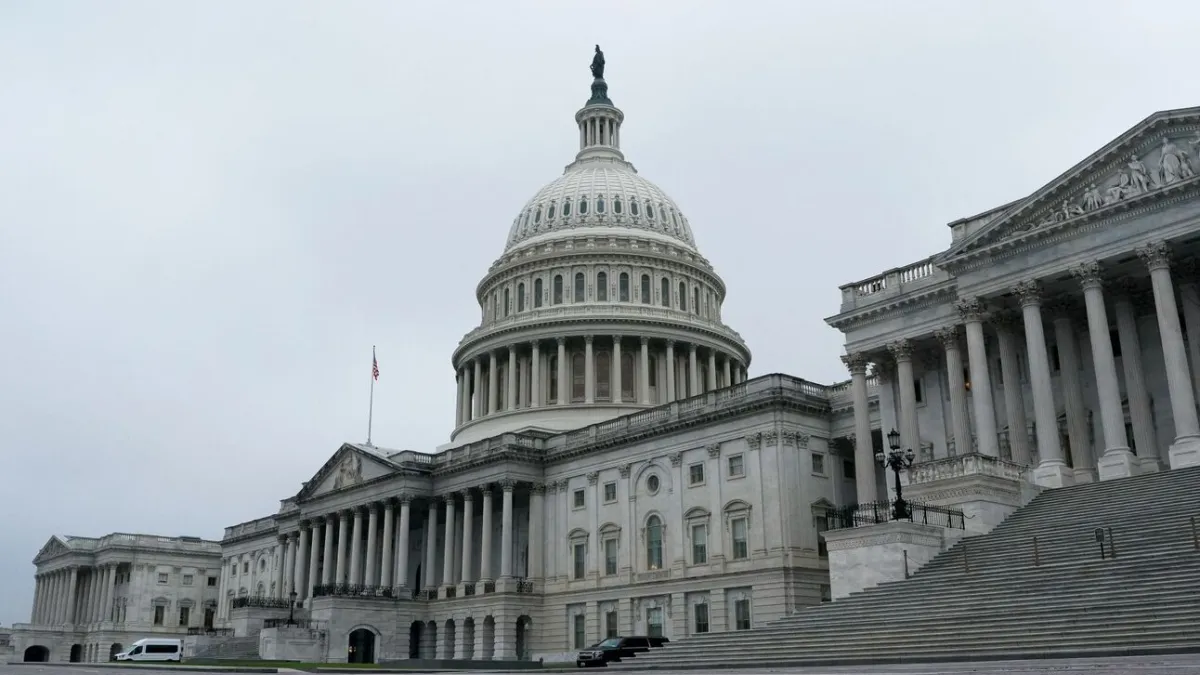
The House on Friday passed the first spending bill for fiscal year 2027, approving the Military Construction and Veterans’ Affairs funding measure in a 400-15 vote.
The bipartisan bill would provide $157 billion in discretionary funding, a roughly 3% increase over the enacted 2026 level, including $19.2 billion for military construction and family housing ($537 million below the enacted 2026 level), $137 billion for the VA (an increase of $4.1 billion) and more than $350 million for related agencies (a $5 million decrease).
Including spending on mandatory programs, the bill provides more than $469 billion, including $450 billion for the Department of Veterans Affairs, which is $83.6 billion above the 2026 enacted level, according to a GOP breakdown of the bill.
Republicans and Democrats both highlighted the bill’s inclusion of $53.7 billion in advance funding for fiscal 2028 for veterans exposed to burn pits and other toxic substances. Democrats also touted their success in ensuring that Secretary of Veterans Affairs Doug Collins would agree to testify before the Appropriations Committees.
“At a time when Americans too often only hear about division and dysfunction, this strong and bipartisan proposal demonstrates that support for our veterans, troops, and military families can still unite this institution around a common purpose,” said House Appropriations Committee Chairman Tom Cole, an Oklahoma Republican.
Democrats also celebrated the largely bipartisan nature of the bill. “Overall, this bill reflects an increasingly rare, across-the-aisle delivery of critical healthcare, services and housing our veterans and servicemembers deserve,” Rep. Debbie Wasserman Schultz, the top Democrat on the MilCon-VA Appropriations Subcommittee, said in a statement — though she noted that the bill isn’t perfect given her view that it underfunds military construction and a NATO security infrastructure program.
“We're also still passing this bill in the dark,” Wasserman Schultz said in a statement. “Both because we don't know how badly underfunded other budget bills will be that may harm veterans, or what kind of massive defense spending hikes are on the way.”
What’s next: This bill, the first of 12 needed for 2027, will head to the Senate, but while Cole suggested that it represents a strong start for the funding process ahead, that work is certain to get harder when the focus turns to measures covering the departments of Defense, Health and Human Services and Homeland Security, among others. Democrats have already put up resistance to Republicans’ proposed cuts across a broad range of programs, highlighting the challenges to come. The annual appropriations process is also likely to be complicated by Republicans’ push to pass at least one and possibly two budget reconciliation bills and enact other key pieces of legislation.