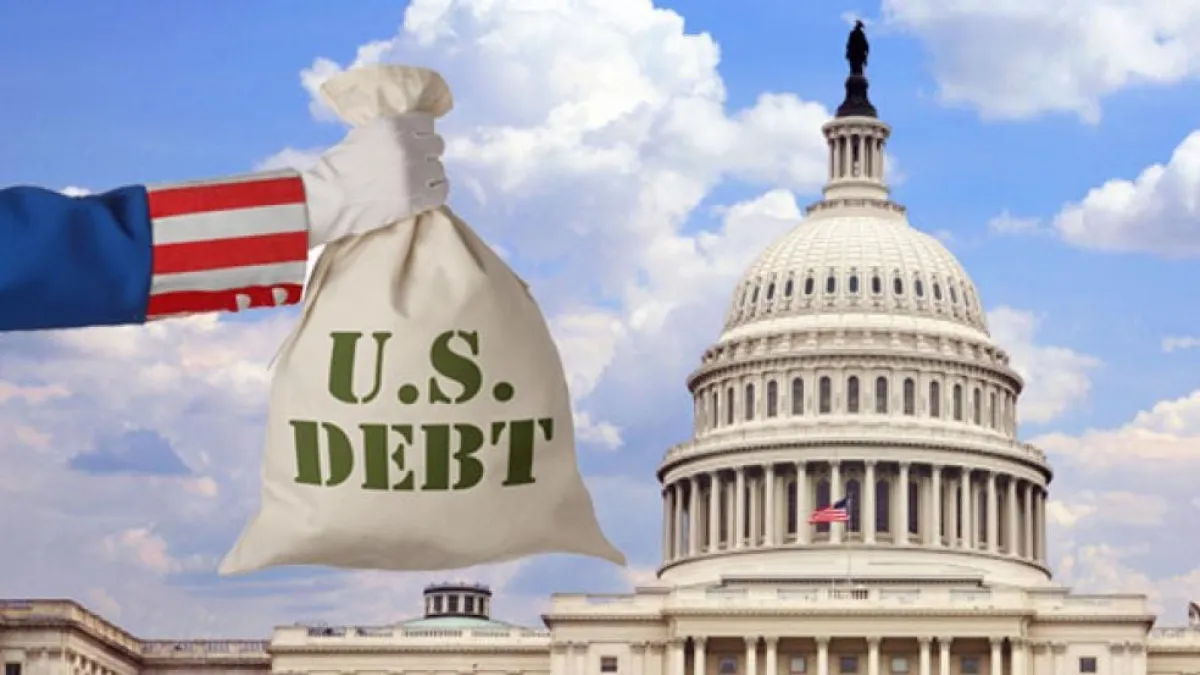
The United States’ fiscal outlook has gotten “notably worse” than it was even a decade ago — and stabilizing the debt picture is now likely to be considerably more difficult, even as Congress has been “increasingly unresponsive” to the problem, according to a new paper by economists Bobby Kogan and Jared Bernstein for the Center for American Progress, a left-leaning think tank.
How we got here: Kogan and Bernstein blame the deteriorating outlook on Republican tax cuts enacted since the turn of the century and interest rates that have rebounded from historic lows reached after the Great Recession.
“The first and second rounds of the Trump tax cuts have since significantly increased the fiscal gap and have led to historically large primary—or noninterest—deficits outside of times of war and economic recession,” they write. “With large primary deficits and higher interest rates, the debt ratio is now projected to climb indefinitely at a significantly faster pace than was previously projected. Importantly, this is now happening even during periods of low unemployment and sustained wage growth.”
What it would take to close the gap: Congress has done little in response to warnings about an unsustainable fiscal trajectory, allowing those primary deficits to reach historically high levels. “The fiscal gap—the average amount of primary deficit reduction needed to keep the debt ratio from rising—is now sufficiently large that course correction is quite difficult,” Kogan and Bernstein write.
They calculate that, if the temporary tax cuts enacted by Republicans last year are made permanent and tariff revenues decline after President Trump leaves office, primary deficits would need to be cut by an average of 2.6% of GDP to stabilize the nation’s debt ratio. In simpler terms, the economists say that deficits before interest would need to be cut by $10.5 trillion over 10 years.
That’s much harder, Kogan argues, than the cuts of roughly 1.5% of GDP that would have been needed a decade ago.
“If the country had to quickly reduce primary deficits by 2.6 percent of GDP to close the fiscal gap, it would mean deeply painful spending cuts or tax increases with negative growth impacts,” the economists write. “For example, this would mean raising taxes by 15 percent (more than $5,100 on the average employed individual if borne entirely by them) or cutting program spending by 13 percent—or 57 percent if Social Security, Medicare, Medicaid, the Supplemental Nutrition Assistance Program (SNAP), veterans spending, and defense spending are left untouched, or 23 percent if just Social Security and Medicare are left untouched.”
The authors also note that the outlook would be even worse if interest rates climb higher than projected.
A political problem: Political incentives make it challenging for lawmakers to respond to such warnings. “One problem is that policymakers heavily and increasingly discount the future,” Kogan and Bernstein write. “Given the incentives they face, it is politically rational for them to provide deficit-financed ‘goodies’ to their donor base or constituents rather than to insist they accept cuts to services or higher taxes to stave off higher interest rates and debt-service crowding out down the road.”
The authors suggest that discussing the debt picture in more concrete terms — for example, by highlighting the link between a higher debt-to-GDP ratio and higher rates for mortgages — might help shift the political considerations involved. They also float the idea that a more gradual approach to stabilizing the long-term debt might be more manageable: “When in a deep hole, the first thing one should do is stop digging, even if that requires a substantial redefinition of the hole!” But they conclude that Congress should look for ways to reduce primary deficits — but only if it’s done responsibly.
“Congress should ensure that any deficit reduction does not harm the poorest or vital public services on which Americans rely,” Kogan and Bernstein write. “Irresponsible deficit reduction is significantly worse than doing nothing, but doing nothing is worse than responsible deficit reduction. Congress should look first and foremost to undo some of the many tax cuts significantly tilted toward the wealthy, which are responsible for the fiscal gap in the first place.”