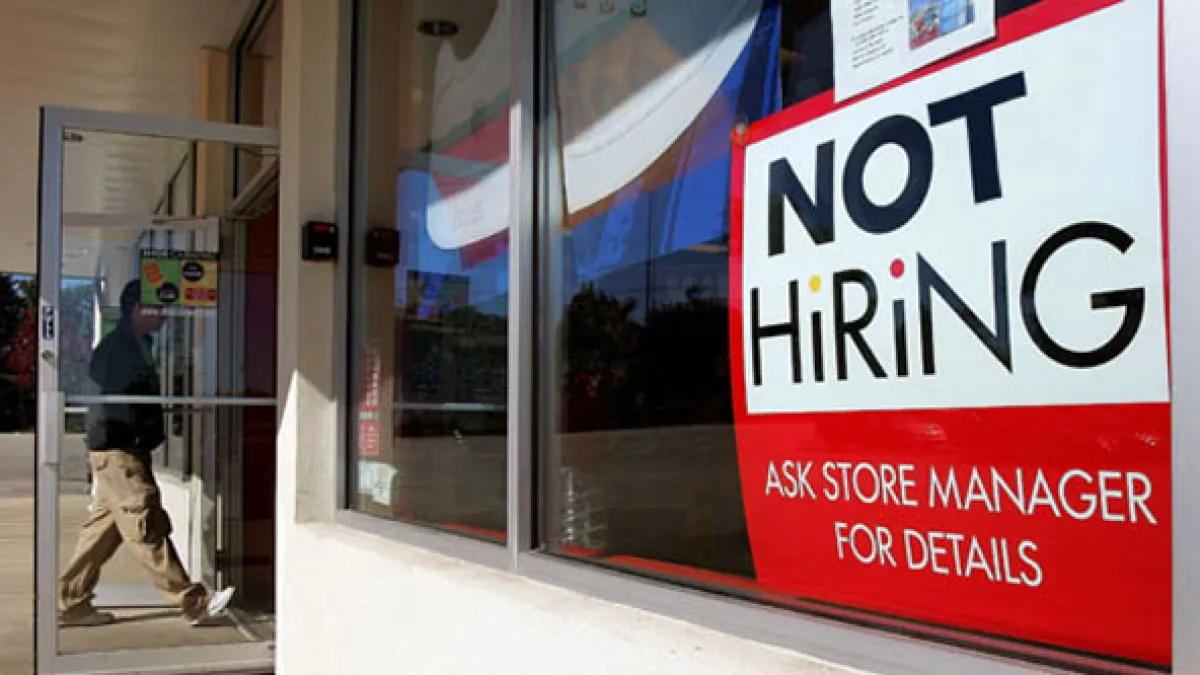
U.S. employers reduced payrolls by 23,000 in July, the Labor Department reported Friday. The net loss came as a surprise, with analysts expecting to see an increase of roughly 85,000 for the month. Job growth in previous months was revised lower, as well, reducing the tally for May and June by a combined 103,000.
At the same time, the unemployment rate fell from 4.2% to 4.1%. The reason for the decline, though, was people dropping out of the labor market rather than finding jobs — something economists refer to as unemployment falling “for the wrong reason.” Over the last two months, the labor force has declined by nearly a million workers, and the labor force participation rate has fallen to 61.4%, the lowest since the 1970s outside the pandemic.
Employment in local government education dropped by 50,000, likely driven by summertime teacher layoffs, pulling the net jobs number into negative territory. But private hiring was weak, as well, with a net gain of just 30,000. Healthcare employment rose by 22,000, construction firms added 22,000 jobs and manufacturers hired 5,000 workers. Retail shed 19,000 jobs, while leisure and hospitality employment fell by 40,000.
Average hourly wages were little changed in July and were up 3.2% over the last 12 months — the slowest annual pace in almost five years, and below the annual inflation rate.
What the analysts are saying: Overall, the jobs report suggests that the labor market has been weakening.
“We can’t really put lipstick on a pig here,’' Daniel Zhao, chief economist at the employment website Glassdoor, told the Associated Press. “This is not a great report for July.’'
University of Michigan economist Justin Wolfers noted that the labor market has created 200,000 fewer jobs over the last three months than expected, writing on social media that “July’s new number is downright concerning.”
The decline in employment among immigrants is playing a role, said Bill Adams, chief U.S. economist at Fifth Third Commercial Bank. “While the unemployment rate is falling, that is mostly for the wrong reason—not enough workers,” he said, per CNBC. “Immigration compensated for the aging of the workforce in the first few years of the post-pandemic expansion, but that’s not happening anymore.”
The Trump administration’s take: National Economic Council Director Kevin Hassett blamed the poor July numbers largely on a quirk of the weather and the calendar, arguing that a snowy winter extended the school year, pushing annual teacher layoffs into July. He also cited the end of the World Cup as an important factor affecting leisure and hospitality employment, and mass deportations carried out by the Trump administration as a factor lowering hiring levels.
Hassett told Fox News that if you ignore the sectors that lost jobs, the economy actually added jobs.
Navy Federal Credit Union Chief Economist Heather Long had a more pessimistic interpretation, arguing that recent jobs data indicates that the labor market is stalling. “The strong jobs reports earlier this year have now faded,” Long said on social media. “A ‘no hire’ job market is one with few opportunities and little dynamism.”
Complicating the picture: The jobs report complicates the picture for the Federal Reserve, which is facing pressure to raise interest rates in the face of persistent inflation. A weaker labor market makes that choice more difficult, since raising rates typically acts as a burden on employers.
“This morning’s report is a game changer in the sense that all of the recent focus has been on inflation and this report highlights the risks that are embedded in the labor market as well,” said Chris Zaccarelli, chief investment officer for Northlight Asset Management, per CNBC. “Before today, many were expecting that the Fed had no choice but to raise rates in order to fight stubbornly high inflation, because the job market was so strong, but this report shows that isn’t the case.”
Where bad news is good news: Stocks rose Friday as investors bet that the dismal jobs report would lead the Fed to hold off on interest rate hikes. The S&P 500 closed at a record high of 7,757.64.