Plus, 5 Democratic tax plans
Trump Blows Up Infrastructure Meeting with Pelosi, Schumer
Infrastructure was supposed to be one of the few areas with some potential for bipartisan action before the 2020 election. So much for that.
Any potential now appears to be all but extinguished after President Trump abruptly blew up a White House meeting with Democratic congressional leaders on infrastructure funding after just a few minutes — reportedly before the parties had even been seated — insisting that he could not work with them until they stopped investigating him.
House Speaker Nancy Pelosi earlier in the morning told reporters that lawmakers in her party believe the president “is engaged in a cover-up” with respect to the Russia investigation.
Pelosi faces pressure from some members of her caucus to begin impeachment proceedings against Trump and made her comments after a closed-door meeting with House Democrats to discuss the ongoing probes into the president and his administration. Democrats have grown increasingly frustrated by what they see as efforts by the administration to stonewall their investigations, though Pelosi and her leadership team have mostly cautioned against impeachment.
In an unscheduled speech from the White House Rose Garden, albeit with printed signs about the Mueller report that were prepared after Pelosi made her comments, Trump angrily lashed out at the speaker, Senate Minority Leader Chuck Schumer and the Democrats.
“I said, Let’s have the meeting on infrastructure. We’ll get that done easily — that’s one of the easy ones. And instead of walking in happily into a meeting, I walk in to look at people who had just said that I was doing a cover-up. I don’t do cover-ups,” Trump said, again referring to the Russia investigation as a hoax and a witch hunt. "I walked into the room and I told Senator Schumer, Speaker Pelosi, I want to do infrastructure. I want to do it more than you want to do it. I’d be really good at that — that’s what I do. But, you know what? You can’t do it under these circumstances, so get these phony investigations over with."
Democrats insisted that, contrary to Trump’s claims, they were committed to working together on infrastructure and argued that it was clear the president had no intention of working with them and that his walking out of Wednesday’s meeting was a pre-planned stunt. They also pointed to a letter Trump sent to Pelosi and Schumer Tuesday night, in which he said that Congress should pass his administration’s renegotiated trade deal with Canada and Mexico before moving on to infrastructure.
“We are interested in doing infrastructure. It’s clear the president isn’t. He is looking for every excuse,” Schumer said. “Hello! There were investigations going on three weeks ago when we met, and he still met with us. But now, when he was forced to say how he would pay for it, he had to run away. And he came up with this preplanned excuse.”
The bottom line: The odds of an infrastructure deal happening this year were likely slim, since it would have been difficult, if not impossible, to reach bipartisan agreement on the details of a plan and how to pay for it. But, if it wasn’t clear before, Wednesday’s blow-up illustrates just how the ongoing investigations into the president will overshadow everything else — and how acrimonious even seemingly bipartisan efforts could get.
Still, Trump is clearly choosing where and how to invoke the idea that “you can’t investigate and legislate simultaneously”; CNBC reported Wednesday that, according to a senior White House official, must-pass pieces of legislation, including spending bills and a debt ceiling increase, will not be held up because of the investigations.
$1.5 Billion for Border Has Produced 1.7 Miles of Fence: Report
Congress appropriated $1.57 billion to build barriers along the border with Mexico in 2018, and according to a recent court filing, that money has produced a total of 1.7 miles of fencing so far.
The data emerged from a court case in Oakland, California, in which 20 states are seeking to block the Trump administration’s effort to shift federal funds to build the wall. Douglas Letter, an attorney representing the U.S. House of Representatives, said that the administration updated Congress on April 30 as to how much border fencing has been built this year, Bloomberg News reported. The administration said that three-quarters of a mile had been built since the last update in February, for a total of 1.7 miles.
Earlier this week, a U.S. Customs and Border Protection report said that the 2018 money was being used to build 80 miles of border barrier, including 27 miles of new construction near San Diego and in the Rio Grande Valley. But the report did not specify which portions of the wall have actually been built, or which are expected to be finished.
Trump pushed back against the Bloomberg story Wednesday. “Much of the Wall being built at the Southern Border is a complete demolition and rebuilding of old and worthless barriers with a brand new Wall and footings,” the president tweeted. “Problem is, the Haters say that is not a new Wall, but rather a renovation. Wrong, and we must build where most needed….”
Trump then admitted that there may be some truth to the story that little new has been built, adding, “Also, tremendous work is being done on pure renovation - fixing existing Walls that are in bad condition and ineffective, and bringing them to a very high standard!”
Democrats’ Tax Plans Would Do More for the Middle Class: Study
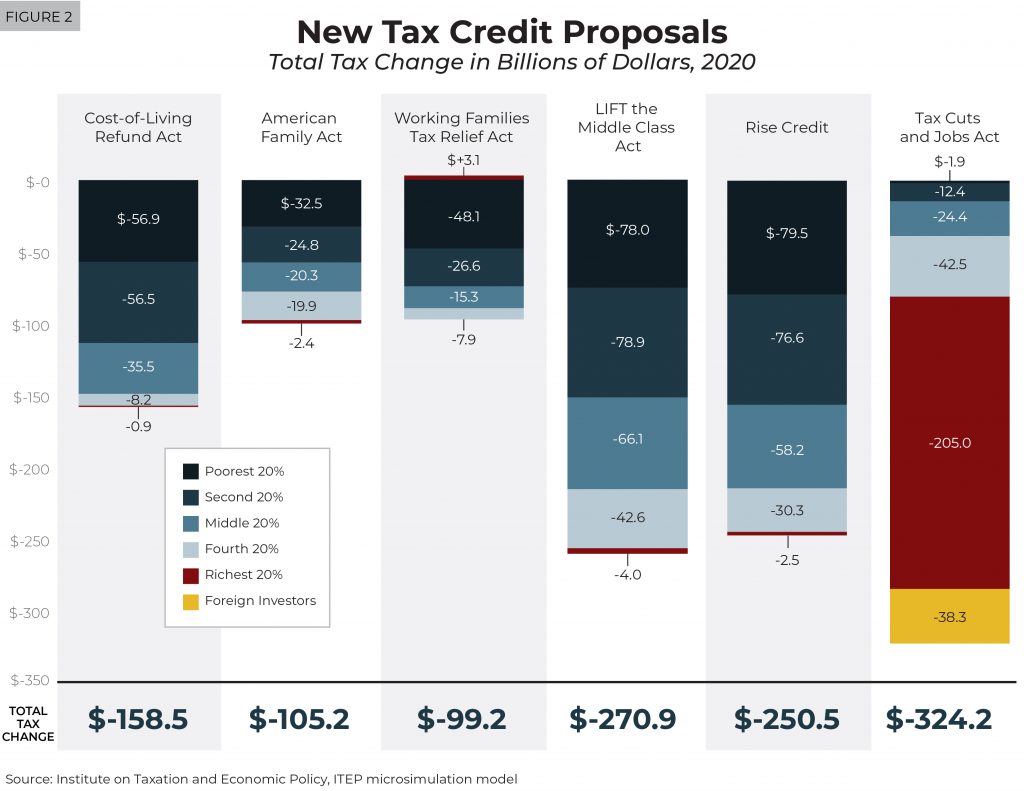
Tax proposals from several Democratic lawmakers focus their benefits more on lower- and middle-income households and would cost less than the Republican tax bill passed in 2017, according to a new analysis by the Institute on Taxation and Economic Policy, a liberal think tank.
ITEP reviewed five proposals from Democrats — Sens. Kamala Harris, Cory Booker and Sherrod Brown and Reps. Ro Khanna and Rosa DeLauro — and found that the majority of benefits flowed to the bottom 60% of Americans. By comparison, the majority of benefits in the Republican tax cuts were claimed by the top 20% of earners.
The proposals include Brown’s Working Families Tax Relief Act, which would expand the Earned Income Tax Credit and Child Tax Credit while delivering 91% of its benefits to households in the bottom 60%, at a cost of about $100 billion in 2020, ITEP said. The average income boost would be $610. At the opposite end of the cost spectrum, Harris’s LIFT the Middle Class Act would expand existing tax credits and create new ones at a cost of $270 billion in 2020, with 86% of the benefits flowing to the bottom 60% and an average income boost of $1,660, according to ITEP’s analysis.
ITEP’s Steve Wamhoff said that the Democratic proposals were essentially the opposite of President Trump’s tax overhaul. “There’s nothing in here for investors,” Wamhoff told The New York Times’ Jim Tankersley. “There’s not anything in here for high-income people.”
Tankersley tweeted that, “The plans, quite plainly, reflect very different theories of the economy. Trump cuts took supply-side view that best way to help low/middle-income workers is to cut biz taxes to stoke econ growth.” The Democratic plans, by contrast, use tax credits to directly boost incomes for lower- and middle-income workers.
See the chart below, which is available on ITEP’s site here, for a comparison of how the five Democratic plans, along with the 2017 GOP tax overhaul, benefit different income groups. And read the full ITEP analysis here.
Would Elizabeth Warren’s Wealth Tax Work?
Sen. Elizabeth Warren (D-MA) has laid out an ambitious slate of proposals as a candidate for the 2020 Democratic presidential nomination: universal childcare and pre-K, free college tuition and student debt relief, building affordable housing, combating the opioid crisis and more. Her plans would involve some $3 trillion in spending over 10 years, according to estimates by her campaign cited by The Washington Post — and they would all be paid for by higher taxes on the wealthy and corporations.
But, the Post’s Toluse Olorunnipa reports, “Warren’s ambitious agenda relies on two assumptions that defy a long history of U.S. policymaking: First, that the country’s wealthiest taxpayers won’t find ways to evade the targeted tax hike she proposes; and second, that new entitlement programs won’t result in ballooning costs that plunge the federal government deeper into debt.”
Olorunnipa notes that a recent poll of about 40 economists by the University of Chicago Booth School of Business found that 73% agreed or strongly agreed that Warren’s proposed wealth tax “would be much more difficult to enforce than existing federal taxes because of difficulties of valuation and the ways by which the wealthy can under-report their true wealth.”
One of the economists behind Warren’s wealth tax plan, Gabriel Zucman of the University of California at Berkeley, told the Post that Warren’s plan is designed to limit tax evasion and that the estimate that it could raise $2.75 trillion over 10 years factors in 15% tax avoidance. “If it’s properly enforced, and there’s a serious effort at having no exemptions and enforcing it strongly, then it can collect a lot of tax revenue,” he said.
Read the full piece at The Washington Post.
-->
Harriet Tubman won't be on the $20 bill next year as originally planned. Treasury Secretary Steven Mnuchin said Wednesday that the design process had been delayed and the redesigned $20 won't be issued until 2028.
Send your tips and feedback to yrosenberg@thefiscaltimes.com. Follow us on Twitter: @yuvalrosenberg, @mdrainey and @TheFiscalTimes. And please encourage your friends to sign up today for their own copy of this newsletter.
-->
Number of the Day: $102 Million
President Trump’s golf playing has cost taxpayers $102 million in extra travel and security expenses, according to an analysis by the left-leaning HuffPost news site.
“The $102 million total to date spent on Trump’s presidential golfing represents 255 times the annual presidential salary he volunteered not to take. It is more than three times the cost of special counsel Robert Mueller’s investigation that Trump continually complains about. It would fund for six years the Special Olympics program that Trump’s proposed budget had originally cut to save money,” HuffPost’s S.V. Date writes.
Date says the White House did not respond to HuffPost’s requests for comment.
What Do Maine and Florida Have in Common? Lots of Social Security Recipients
More than 17% of Maine residents received Social Security retiree benefits in 2018, the highest proportion in the country, Bloomberg’s Marie Patino reports. Other states with a high percentage of retired Social Security beneficiaries include Vermont (16.98%), Florida (16.71%) and Montana (16.68%). Only two states come in under 10% — Utah and Alaska — with Texas rounding out the bottom three at 10.33%.
The numbers have changed significantly in the last few years, Patino says, as the Baby Boom generation enters retirement at a steady clip. In 2009, no state had more than 15% of its population receiving Social Security retiree benefits, while in 2018, 14 states did. The trend is expected to continue, with the number of retirees receiving payments growing at a 3% clip in 2018, compared to a workforce that grew 1.9%.
News
- Federal Money Hasn’t Reached Disaster Victims – Roll Call
- Republicans Reviewing Democrats’ Latest Disaster Aid Offer – Roll Call
- Senate, House Start to Chip Away at ‘Kiddie Tax’ Hike – Roll Call
- Democrats Defy Trump on Agricultural Spending – The Hill
- ‘Medicare for All’ Falters as Top Democrats Fret Over Backlash – Bloomberg
- Mnuchin Warns of ‘Late Summer’ Default If No Debt-Limit Increase – Bloomberg
- Lilly Selling Half-Price Version of Popular Humalog Insulin – Associated Press
- Hospitals Are Swimming in Cash – Axios
- Obama Budget Official: ‘Medicare for All’ Is Democrat Version of GOP’s ‘Repeal and Replace’ – CNBC
- Senate Chairman Says Bipartisan Health Care Package Coming Thursday – The Hill
- Federal Judge Signals Reluctance to Block Short-Term Plans – Modern Healthcare
- Trump Officials Struggle to Fight the Fentanyl Crisis – Washington Post
- Comcast Is Working on an In-Home Device to Track People’s Health – CNBC
- Military Pay Raise and Troop Increase Endorsed by Senate Panel – Roll Call
- Trump Wants to Cut Payments to California for Fighting Wildfires on Federal Land – Los Angeles Times
Views and Analysis
- What Happened to All of Trump’s ‘Infrastructure Weeks'? Trump Happened. – JM Rieger, Washington Post
- We Need Action on Infrastructure, Not More Talk – Thomas J. Donohoe and Richard Trumka, Washington Post
- Trump’s Family Separation 2.0 Comes at a Cost to Immigrants and the Government – Washington Post Editorial Board
- For Most Taxpayers, Filing Should Be Free and Easy – Bloomberg Editorial Board
- Poverty Line Proposal Would Cut Medicaid, Medicare, and Premium Tax Credits, Causing Millions to Lose or See Reduced Benefits Over Time – Center on Budget and Policy Priorities
- How Inflation Could Return – Mohamed A. El-Erian, Project Syndicate
- How Telehealth-Based Physical Therapy Can Save Lives and Money – Nikesh Patel, Morning Consult
- Did the ACA Create Preexisting Condition Protections for People in Employer Plans? – Julie Rovner, Kaiser Health News
- How Julian Castro’s Student Debt Forgiveness Proposal Stacks Up Against Elizabeth Warren’s – Danielle Douglas-Gabriel, Washington Post
- Equal Justice Depends on Properly Funding Public Defenders – Pamela Metzger, The Hill