Plus, why Washington can't tackle the deficit
Republicans Understand ‘Medicare for All’ Better Than Democrats: Poll
The 2020 elections are still more than 500 days away, but the first Democratic debates of the presidential campaign are fast approaching. When the candidates gather on June 26 and 27, it’s clear what voters want them to address: health care. More specifically, bringing down health care costs.
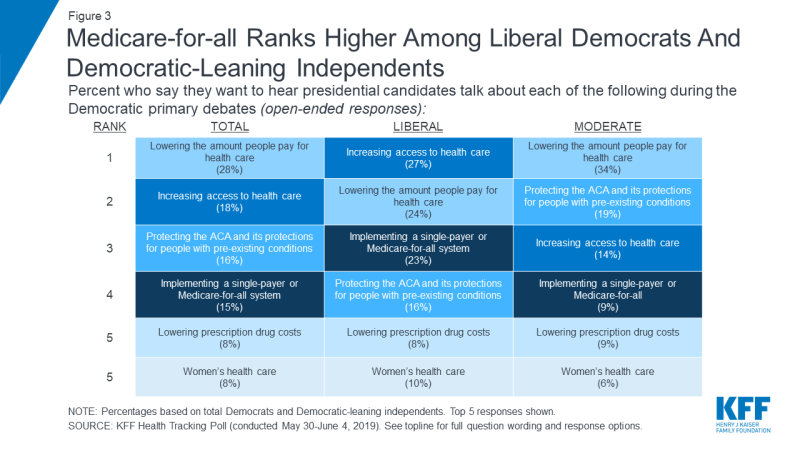
The latest tracking poll from the Kaiser Family Foundation finds that 87% of Democratic and Democratic-leaning voters say it’s very important for candidates to talk about health care at the debate. When asked to describe in their own words which health care issues they want addresses, more than one in four pointed to the affordability of care while another 8% said lowering prescription drug prices. Increasing access to care was cited by 18% of respondents, and protecting the Affordable Care Act and protections for people with pre-existing medical conditions was mentioned by 16%.
Another 15% mentioned implementing a single-payer or Medicare-for-all system.
The priorities differed among liberals and moderates, with liberals more likely to mention increased access to health care and implementing Medicare for All.
The Kaiser poll also found that many Americans, especially Democrats, remain confused about just what a single-payer Medicare for All system would entail. The poll finds that most voters believe that taxes would rise for most people under a Medicare for All system. That’s true. But most voters also believe that Americans would have the option of keeping their private insurance plans and would continue to pay premiums, deductibles and co-pays.
By contrast, the Medicare for All overhaul proposed by Sen. Bernie Sanders (I-VT) or in a similar House bill forth by Rep. Pramila Jayapal (D-WA) would have a government-run system replace most private insurance and provide comprehensive health care benefits without any premiums, deductibles or co-pays. (To be fair, other Democrats have spoken in favor of a hybrid system that allows private insurance to continue to operate alongside a public option.)
The Kaiser poll results are similar to those of a Navigator Research poll we told you about yesterday, which found that 60% of voters, including 73% of Democrats, said that “Medicare for All” means a health care system “that lets anyone buy Medicare instead of their private insurance, if they want to.”
This Axios chart breaks down the Kaiser Family Foundation voters’ conceptions:
The disconnect between American’s perceptions of Medicare for All and the flagship legislation proposed under that name may stem from voters not understanding or knowing the details of the proposals, a Kaiser Family Foundation polling expert told Kaiser Health News — or it could be the result of public skepticism about how much lawmakers would change the existing system.
“It’s not terribly surprising that Americans would have differing ideas of what Medicare-for-all would mean,” The Washington Post’s Paige Winfield Cunningham writes. “Such a sweeping overhaul of the country’s patchwork health insurance system hasn’t been attempted before — and even though the 2020 contenders frequently mention it, they tend to shy away from details on exactly how the whole thing would work.”
Why it matters: Americans’ perception of Medicare for All hews more closely to plans offering a public option than to the Sanders vision.
At the same time, Eric Levitz of New York magazine notes that “the polls also suggest that voters are unaware of single-payer’s most popular features. When Navigator asked respondents to pick their top three priorities for health-care policy, reducing out-of-pocket costs, premiums, deductibles, and drug prices were by far the most commonly cited. Meanwhile, ‘ensuring that you can keep your existing insurance coverage’ ranked next to last.”
That suggests that the Sanders version of Medicare for All would be more popular “if voters understood that it would abolish premiums and deductibles and bring down overall health-care costs,” Levitz suggests. On the other hand, support for a public option might be even higher than it is if voters knew that such a plan wouldn’t necessarily require significant middle-class tax increases.
The bottom line: The upcoming debates will be a great opportunity for candidates to explain what they envision for the health care system. Also, it’s a good thing we still have 500 days until the election.
Quotes of the Day
“All the members of Congress thought it had subsided and hope that it continues to be subsided. … We don’t actually agree with each other on what replacement should be, which means we don’t have a replacement that Republicans can unite around.”
– An unnamed “senior GOP aide,” as quoted by The Hill in a piece describing how President Trump’s promise to unveil a “terrific” health care plan in the coming weeks has Republicans worried about the risks of putting the issue front and center in an election campaign. Republican lawmakers have made clear they have no intention of acting on a large-scale health care reform before the 2020 election.
“You think he would be focused on the economy. Republicans have no credibility when it comes to health care.”
– John Weaver, a GOP strategist who previously worked for former Ohio Gov. John Kasich and Sen. John McCain, in that same piece at The Hill.
Democrats More Likely to Chip Away at the GOP Tax Cuts Than Repeal Them: Report
While some Democratic presidential candidates have talked about repealing the Tax Cuts and Jobs Act in full, Bloomberg’s Laura Davison says that if the balance of power in Washington shifts in 2020, the more likely course of events would be a slow but steady rolling back of the 2017 tax law’s provisions.
Democrats are debating ambitious policies that call for significant new funding sources, and the tax cuts are being treated as a piggy bank of sorts that could help pay for everything from efforts to fight climate change to new tax credits for low-income workers, Davison reports. One of the prime targets is the corporate tax rate, which Republicans lowered to 21% and many Democrats would like to raise to 28%. The top individual tax rate is another focus, with some Democrats talking about raising it from 37% to 39.6%, where it was before the tax new law, and others proposing much higher tax rates for the wealthiest.
Speaking to a clergy-led led group Monday, former Vice President Joe Biden said he would like to roll back parts of the GOP tax law to pay for free community college and universal access to Medicaid. “We have the greatest income inequality in the ... United States of America since 1902. The fact here is, there is plenty of money to go around,” Biden said, according to Roll Call. “This isn’t about punishment ... this is just plain fairness. Simple, basic fairness and we have all the money we need to do it.”
Why Washington Can’t Rein In the Deficit
With seemingly permanent $1 trillion annual deficits on the horizon, America desperately needs to make another “grand deal” to get revenues and spending under control, says Brian Riedl of the conservative Manhattan Institute. However, making that deal will be all but impossible under current conditions, Riedl warns, since many of the conditions necessary to reach an agreement are currently absent in Washington.
Reviewing 14 major deficit-reduction efforts since 1980, Riedl found three variables that determined the success or failure of each attempt. In the six negotiations that succeeded, at least of two of the variables were satisfied, which Riedl says point to some minimum level that must be present to make a deal possible. The three variables are:
1. An automatic penalty. Riedl says that a “painful policy” that goes into effect in the absence of a deal brings negotiators to the table and forces them to come up with an agreement. Examples from the past include potential cuts to Social Security and the threat of default on federal obligations.
2. An involved public. Voters voiced concerns about fiscal issues in the 1980s and 1990s, pressuring politicians to reach deals that eventually led to a balanced budget.
3. Good-faith negotiations. Reidl says that in past successful negotiations, “[e]ach side honestly laid out their priorities, made generous concessions, avoided hardball tactics, and worked towards a deal in which both sides could claim victory. Neither side relied on leaking to the media or publicly bullying the other.”
None of the three variables are in place right now, Riedl says, suggesting that Washington is unlikely to turn its attention to the growing deficit any time soon.
Read Riedl’s full analysis here, or a summary op-ed at The Hill.
-->
President Trump is officially launching his 2020 campaign at a rally tonight. We'll say it again: We're more than 500 days away from the election. Send your tips and feedback to yrosenberg@thefiscaltimes.com. Or connect with us on Twitter: @yuvalrosenberg, @mdrainey and @TheFiscalTimes. And please tell your friends they can sign up here to get their own copy of this newsletter.
-->
Donations to Charities Drop After Trump Tax Law
Americans gave less money to charity in 2018 and some experts think the GOP tax overhaul is to blame.
Total donations fell 1.7% in inflation adjusted terms to $427.7 billion last year, according to Giving USA’s annual report released Tuesday. By comparison, charitable donations grew 3% the year before.
By doubling the standard deduction, the Tax Cuts and Jobs Act eliminated the benefit of the tax deduction for charitable donations for millions of Americans. About 88% of taxpayers took the standard deduction for 2018, with the number of filers itemizing their deductions falling from 46.5 million in 2017 to 18 million in 2018. As many charities warned might happen, the change appears to have had a significant negative effect on individual giving, which dropped 3.4% in 2018.
Some types of organizations were hit harder than others. While environmental and animal-related organizations recorded a 1.2% increase in donations, religious organizations saw 3.9% decrease and public-society benefit organizations such as the United Way saw a 6% drop.
Some experts say that instability in the stock market at the end of 2018 could have played a role in the drop, but Steve Taylor, a vice president at United Way Worldwide, told the Washington Post that “[t]here really is no other explanation for these numbers than changes to the tax law,” adding that he expects the downward trend to continue as more potential donors take the new tax rules into account.
News
- Acting Defense Secretary Bows Out of Running to Be Confirmed as Pentagon Chief – Washington Post
- On Eve of Critical Fed Meeting, Trump Suggests He Might Remove Chair Powell – Washington Post
- Trump Says US Will Begin Deporting Millions – Associated Press
- As Promised, Trump Slashes Aid to Central America Over Migrants – Reuters
- Trump's Order to Trim Science Advisory Panels Sparks Outrage – The Hill
- McConnell on Reparations for Slavery: Not a ‘Good Idea’ – Washington Post
- Biden: Eliminate Tax Loopholes to Address Poverty, Expand Health Care – The Hill
- Klobuchar Details Raft of Policy Plans for First 100 Days – Politico
- Humana Asked Experts to Define 'Value-Based Care.' They Couldn't Do It – Fierce Healthcare
- Moderate Democrats Would Rather Talk About Health Care Than Impeachment – Bloomberg
- Drugmakers' Lawsuit Ramps Up Fight with Trump – The Hill
- Texas Is Latest State to Attack Surprise Medical Bills – Kaiser Health News
- Trump’s Praise Put Drug for Vets on Fast Track, but Experts Aren’t Sure It Works – Center for Public Integrity
- ‘I’m Not American’: How a Complicated Trump Tax Law Created Huge Bills for Foreign Citizens – Washington Post
- Government Bonds Are Now the ‘Most Crowded’ Market Trade, More Popular Than Technology Stocks – CNBC
Views and Analysis
- Democrats Should Heed This Warning on Health Care – Jennifer Rubin, Washington Post
- Why Isn’t Trump a Real Populist? – Paul Krugman, New York Times
- Trump May Be About to Face His Biggest Test Yet on the Economy – Damian Paletta and Heather Long, Washington Post
- A Caravan for Insulin Demonstrates How the American Health-Care System Is Failing Us – Helaine Olen, Washington Post
- House Democrats Want to Kill This More Useable Nuke. They’re Right – Caroline Dorminey and Kingston Reif, Defense One
- Wealth Isn't the Problem – Karl W. Smith, Bloomberg
- Getting To Yes: A History Of Why Budget Negotiations Succeed, And Why They Fail – Brian Riedl, Manhattan Institute
- Single-Payer Health Care Will Increase Fraud, Corruption – Chris Jacobs, RealClear Politics
- As CMS Mitigates Medicaid ‘Spread Pricing’ Abuse, Time to Address Medicare Abuses – Alan G. Rosenbloom, Morning Consult
- We Must Prepare for the Next Pandemic – Bruce Schneier, New York Times