Plus, Elizabeth Warren’s daring bet on Medicare for All
Pelosi Yields in Standoff with GOP, Allowing $4.6 Billion Border Bill to Pass
House Speaker Nancy Pelosi had little choice. In a standoff with Senate Majority Leader Mitch McConnell and the White House over a bill to provide billions in emergency funding to address the humanitarian crisis at the southern border, Pelosi and Democratic leaders yielded on Thursday and allowed the House to vote on a Senate-passed version of the legislation.
The $4.6 billion measure passed Thursday afternoon, and will now head to President Trump’s desk for his signature.
Pelosi’s decision followed what The Washington Post described as “hours of frantic maneuvering” during which the speaker tried to round up support for a revised version of the bill that added protections for unaccompanied minors and restrictions on how the administration could use the money.
“Pelosi had hoped to amend the Senate bill with changes that included a 90-day limit for how long children can spend in holding facilities; less funding for the Immigration and Customs Enforcement agency; and a provision to ensure lawmakers could visit facilities that hold children without prior notice,” the Post reported.
But moderate House Democrats joined with House Republicans to push Pelosi to take up the bipartisan Senate bill, which includes fewer restrictions than a version passed this week by the House. Nearly two dozen moderates threatened to vote against Pelosi’s changes, Bloomberg reported. The White House also opposed the changes and McConnell said he would not consider them.
“The children come first,” Pelosi said in a letter to colleagues. “In order to get resources to the children fastest, we will reluctantly pass the Senate bill.”
With time running short before lawmakers leave Washington for their July 4 recess — and with bipartisan pressure to take up the Senate bill — Pelosi had little leverage to get changes sought by her progressive members enacted.
Pelosi spoke with Vice President Mike Pence Thursday afternoon, and he agreed to make administrative improvements to the migrant shelters, according to reports. But that did little to mollify progressives.
“I will NOT be voting for a bill that gives unrestricted money to a rogue and cruel agency and doesn’t guarantee that the funds will go towards helping these children,” Rep. Pramila Jayapal, chair of the Progressive Caucus, tweeted Thursday afternoon.
Abolish Private Insurance? Why Elizabeth Warren Said Yes
Wednesday night’s initial Democratic primary debate provided Americans with a pretty clear sense of what kind of health-care reforms most of the candidates on stage prefer — and, in most cases, it isn’t the immediate establishment of a single-payer Medicare-for-All system. NBC moderator Lester Holt asked the candidates to raise their hands if they would abolish private health insurance in favor of a government-run system. Only Sen. Elizabeth Warren and New York Mayor Bill de Blasio signaled they would.
Warren, who is a co-sponsor of Sen. Bernie Sanders’ single-payer bill, had in the past left herself some wiggle room, suggesting that there are “a lot of different pathways” to make sure every person gets covered. This time, she was unequivocal in her support for a single-payer system. “Yes, I’m with Bernie on Medicare for All,” she said. Then she added:
“Look at the business model of an insurance company. It's to bring in as many dollars as they can in premiums and to pay out as few dollars as possible for your health care. That leaves families with rising premiums, rising copays, and fighting with insurance companies to try to get the health care that their doctors say that they and their children need. Medicare for all solves that problem.
“And I understand. There are a lot of politicians who say, oh, it's just not possible, we just can't do it, have a lot of political reasons for this. What they're really telling you is they just won't fight for it. Well, health care is a basic human right, and I will fight for basic human rights.”
Other candidates were more cautious.
“I am just simply concerned about kicking half of America off of their health insurance in four years, which is exactly what this bill says,” Sen. Amy Klobuchar said, explaining why she prefers a public option.
“I think we should be the party that keeps what's working and fixes what's broken,” former Maryland Rep. John Delaney said. “Why do we have to stand for taking away something from people?”
Why Warren went all in: “It’s not hard to see why Warren has decided to join Sanders on this issue,” Slate’s Jordan Weissmann said. “The senator is running for the hearts and minds of the left by combining wonkishness and truly populist politics. But until now, Sanders has continued to outflank her on health care. And her squishiness on the topic—Democrats’ most potent policy issue—has been especially conspicuous, given that her entire campaign theme is about how she Has a Plan for That. Taking a firm, clear stance on it makes political sense as she battles for the progressive mantle.”
How it could backfire: The idea of replacing private insurance with a single government plan doesn’t poll as well as a public option, and a Kaiser Family Foundation tracking poll conducted in January found that support for Medicare for All dropped from 56% to 37% when the idea of eliminating private insurance is raised.
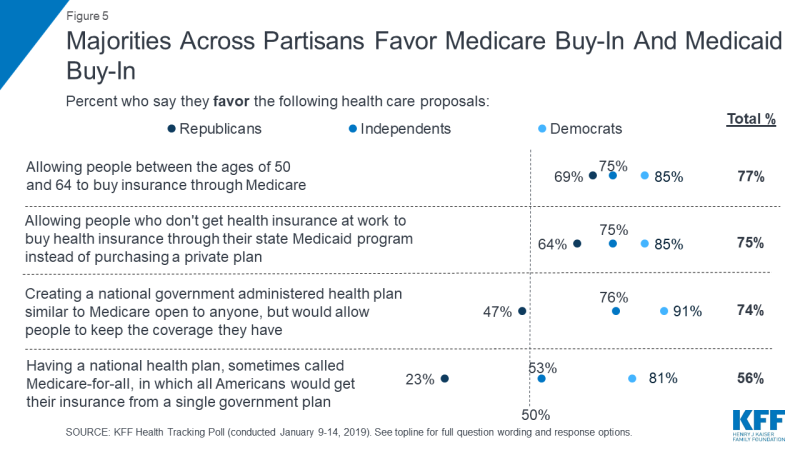
“Warren might think she can talk the public into it, but the other side gets a chance to talk too, and the history of using the bully pulpit to move public opinion is short and discouraging,” New York’s Jonathan Chait wrote. “Warren ventured boldly, perhaps foolishly, onto a shaky limb. She may have just filmed the most effective attack ad against herself.”
Similarly, The Washington Post’s Jennifer Rubin called Warren’s position a gift to her opponents: “You can hear Republicans giggling in the background. If she is the nominee, they get to talk about her taking away your doctor and health-care plan and about how rural hospitals will close (due to low reimbursement rates).”
The bottom line: As we’ve pointed out before, the debate, while important, isn’t likely to translate to policy changes in the near term. Democrats would need to win both the White House and the Senate to push for health care reform in 2021.
Even so, the raised and unraised hands still revealed something significant. The 10 candidates on stage Wednesday night made their positions clear, and the 10 debating Thursday night likely will as well. And though news coverage and analyses of the debate have played up the Democratic Party’s shift to the left, that shift in most cases means an embrace of a “public option” that would let people sign up for a government insurance plan or stick with a private one if they prefer.
Now Democratic primary voters can decide which position they favor. Based on polling data so far, Warren and Sanders will have a tough fight ahead of them.
Court Raises New Threat to Obamacare
A federal court on Wednesday added a new and potentially disruptive wrinkle to the ongoing lawsuit that seeks to overturn the Affordable Care Act.
The suit, initiated last year by a group of Republican governors and state attorneys general, claims that the ACA became invalid once Congress zeroed out the penalty for not buying health insurance. A U.S. district court judge in Texas ruled in the plaintiffs’ favor in December, declaring the ACA unconstitutional, and the Trump administration in March announced that it supported the lawsuit — leaving only House Democrats and more than a dozen blue state attorneys general led by California to appeal the ruling.
Now an appeals court is questioning whether the Democratic lawmakers are legitimate participants in the case. Ahead of a July 9 hearing, a Fifth Circuit panel asked the parties appealing the case to defend their standing to intervene and whether their intervention was timely. The filing also raised the question of whether there is a legitimate “live case or controversy” at stake, and what would happen if it were determined that no party had legal standing to appeal the ruling.
What’s next: The request raises the possibility that the appeal of the ruling in Texas could be tossed out on procedural grounds, leaving the judge’s declaration that the ACA is unconstitutional in place — and potentially causing chaos in the U.S. health care system. “The odds that the Fifth Circuit does something nasty to the health-reform law have gone up,” University of Michigan law professor Nicholas Bagley said. But that outcome is still unlikely, most legal experts say, and the case is expected to ultimately end up before the Supreme Court.
Column of the Day: Zero Interest Rates Ahead?
Reflecting on the latest budget projections from the Congressional Budget Office, which show relentlessly rising debt and interest costs over the next 30 years, Bloomberg’s Noah Smith says that one possible response to the problem involves a policy economists call “fiscal dominance.” Here’s how it would work:
“The government … has a good reason not to let debt spiral out of control. And the easiest way to keep that from happening is for the Federal Reserve to cut interest rates to zero and keep them there. As the government replaces its old, higher-interest debt with new, lower-interest debt, its yearly interest payments would go down, until finally they dwindle to nothing at all. Doing this would stabilize the deficit, and even open up fiscal space for big new spending initiatives on issues like climate change.”
Japan has been using this approach for years, Smith says, as the country deals with a national debt more than twice as large as its economy. While the policy may not work the same way in the U.S. and necessarily creates its own set of risks, the Japanese case suggests that “fiscal dominance” may be an attractive and perhaps necessary option at some point over the next few decades.
-->
Round 2 of the Democratic debates is tonight. Will it be the “Slow Joe’s Mo Show,” with Sen. Bernie Sanders and others trying to take down Joe Biden, the perceived front-runner? Send your thoughts and tips to yrosenberg@thefiscaltimes.com. And please tell your friends they can sign up here to get their own copy of this newsletter.
-->
Chart of the Day: Offshore Profits Continue to Rise
Brad Setser, a former U.S. Treasury economist now with the Council on Foreign Relations, added another detail to his assessment of the foreign provisions of the Tax Cuts and Jobs Act: “A bit more evidence that Trump's tax reform didn't change incentives to offshore profits: the enormous profits that U.S. firms report in low tax jurisdictions continues to rise,” Setser wrote. “In fact, there was a bit of a jump up over the course of 2018.”
News
- Supreme Court Bars Challenges to Partisan Gerrymandering – New York Times
- Supreme Court Puts Census Citizenship Question on Hold – Washington Post
- Senate Passes Defense Policy Bill 86-8, Setting up Fight with House – Defense News
- McConnell Dismisses One-Year Stopgap Bill Floated by White House – The Hill
- White House Considers Capital Gains Tax Break That Would Benefit Wealthy – Bloomberg
- House Democrats Launch Investigation into Trump Administration's Medicaid Changes – The Hill
- Democrats Search for the Holy Grail of Health Care – The Atlantic
- GOP Sen: Democrats Talking About 'Medicare for All' Shows They're Unhappy with Obamacare – The Hill
- The Demographics of Medicare for All Fans – Axios
- Democrats Plot Strategy to Win Back Senate – The Hill
- Conservatives Unhappy with Surprise Billing Approach – Axios
- After Legally Receiving Food Stamps, This Millionaire Is Trying to Change the System – Daily Signal
- Sanders Stimulus Plan: Cancel Student Debt to Boost Economy – Bloomberg
- The Data Behind the First Democratic Presidential Debate – Bloomberg
Views and Analysis
- Why Only 2 of 10 Democrats Raised Their Hands to Say They’d Abolish Private Insurance – Dylan Scott, Vox
- The Land Mine that Just Got Laid for Elizabeth Warren – Jeff Greenfield, Politico
- Democrats’ Intense Debate on Medicare for All Revealed Two Important Things – Amanda Michelle Gomez, ThinkProgress
- Can Biden Make the Democratic Party Safe for Moderates? – Karl W. Smith, Bloomberg
- High Tax States Are Practicing Financial Destruction – Jared Dillian, Bloomberg
- A Postmortem of the Fed's Failed Attempt to Normalize – Douglas Carr, The Hill
- Be Serious, Donald Trump Doesn't Prefer "Low Interest Rates" – John Tamny, RealClear Markets
- America’s Child Care Crisis Is an Economic Crisis – Bryce Covert, New York Times
- It’s Time We Tear Up Our Economics Textbooks and Start Over – Robert J. Samuelson, Washington Post
- If the Economy's So Good, Why Is GDP So Low? – Bob Sellers, Fortune