
Lame-Duck Congress Faces a Shutdown Deadline
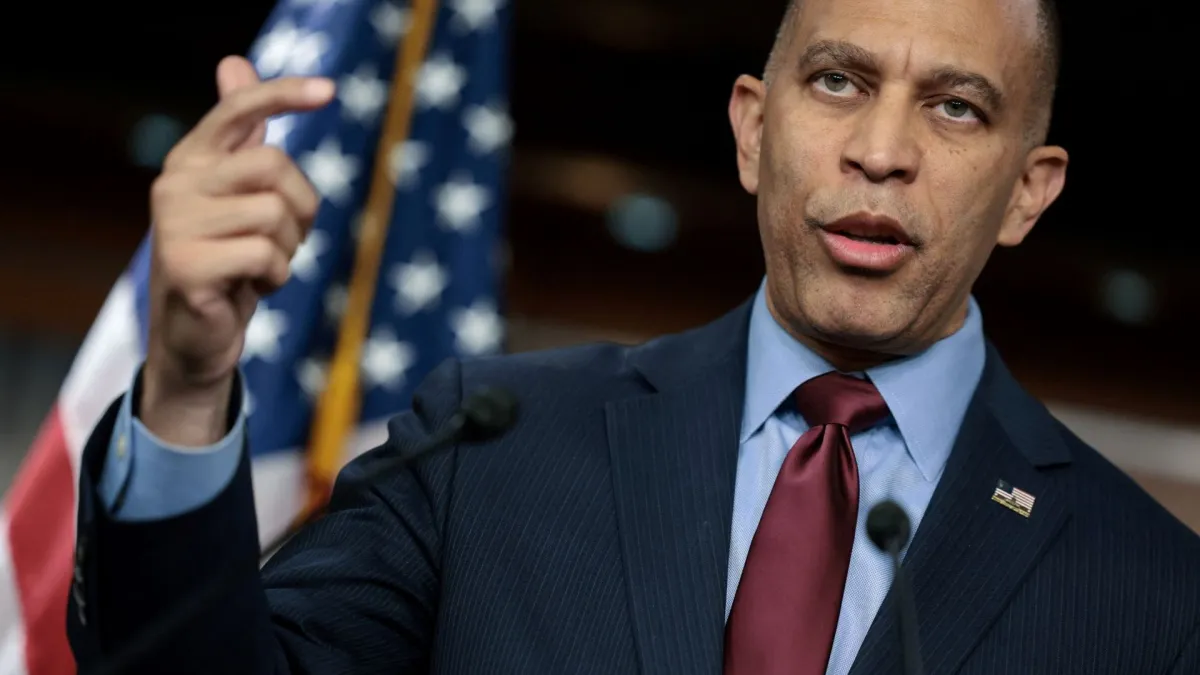
Happy Monday! Congress is back for a lame-duck session after Democrats' decisive election victories. As lawmakers lay the groundwork for 2027, Republicans are set to hold leadership elections on Tuesday, with a heated battle brewing in the House between current House Majority Leader Steve Scalise and Rep. Jim Jordan. A handful of Senate conservatives are pushing to postpone the leadership vote in that chamber, but no one has announced a challenge to Sen. John Thune, who is still favored to become minority leader next year (though the prediction market odds on that have fallen).
Here's what else is happening.
Lame-Duck Congress Returns to Face a Shutdown Deadline
The old Congress is back today to face a new political reality - and deal with some unfinished business. Democrats don't take power until January, but they are already working on their agenda, deciding which priorities to pursue first. And while the new members of Congress attend their orientation sessions in preparation for 2027, it's already Miller time at the White House, as President Trump's new chief of staff, Stephen Miller, officially begins his new job.
Democrats must decide just how much they want to work with Trump and Miller. When asked today if Miller can be a viable partner for his party, House Democratic Leader Hakeem Jeffries was quick to say no. "Stephen Miller is a stone-cold racist," Jeffries told reporters at an afternoon news conference. "His track record speaks for itself, and I've got zero interest in working with that kind of individual."
Jeffries has said repeatedly that Democrats will be focused on reversing the Republican cuts to Medicaid, ending the Iran war, ending Trump's tariffs and renewing expired Affordable Care Act tax credits.
A looming shutdown deadline: Lawmakers will also quickly have to address several must-pass items, including a December 11 deadline to fund the government. With just four weeks to go before the deadline to avoid a government shutdown, Democrats have to decide if they want to pursue a long-term spending deal now and clear the decks for the incoming Congress or, seemingly more likely, enact a short-term fix that punts a full-year deal until after they control the House and Senate. Jeffries told reports that the strategy on a spending deal is in the hands of the top Democrats on the appropriations committees, Sen. Patty Murray and Rep. Rosa DeLauro.
A key issue in any funding fight will be the administration's push for a massive defense budget and additional money for the Iran war. The annual defense policy bill, passed for 65 straight years, remains unfinished as well. Both of those items are complicated by the massive unpopularity of the Iran war - and perhaps by the impending impeachment of defense secretary Pete Hegseth.
Hegseth faces impeachment: Outgoing Republican Rep. Thomas Massie filed articles of impeachment against Hegseth on Monday, including eight charges related to the Iran war and other military actions taken during his time at the Pentagon. Republican leaders will have to bring it to a floor vote within two legislative days or pursue a motion to kill the resolution, which would require a majority vote that would likely be hard to achieve.
House Minority Leader Hakeem Jeffries said in a Sunday interview on ABC's "This Week" and again today that he is a "hard yes" on impeaching Hegseth. "Pete Hegseth, the most unqualified secretary of defense in American history, has got to go," he said. "Hopefully, this can come to an end - the national nightmare that has been Pete Hegseth can end this week, if the president doesn't make the decision on his own to terminate him."
Some Republicans likely share that sentiment. Republican Rep. James Comer, the chair of the House Oversight and Government Reform Committee, told NewsNation in an interview on Friday that members of the GOP have questions about Hegseth. "We have no idea what the strategy is moving forward in Iran," Comer said. "No one's happy about Iran, and I think the Republican voters are more upset about what's going on in Iran than the Democrat voters."
Republican Hardliners Call for GOP-Only Spending Package
The far-right Freedom Caucus on Monday urged Republican leaders in Congress to pass a reconciliation bill and other conservative priorities before Democrats take over in January.
In a letter sent to Speaker Mike Johnson and Senate Majority Leader John Thune, the caucus said there is "an enormous amount of unfinished business" to address by the end of the year, including what they see as defending the country from a "party hell-bent on radically changing it."
"We must deny them every legislative leverage point possible," the hardliners said.
The caucus listed their priorities, including a reconciliation package that funds "defense modernization," provides "significant tax relief for families," and cuts at least $1 trillion in spending.
Other priority items include freezing spending for three years; banning sanctuary cities; passing the permitting bill; banning stock trading by members of Congress and the executive and judicial branches; passing term limits; and passing a bill that would require voter ID in federal elections.
The letter called on lawmakers to remain in Washington until the priorities are passed. "Every one of us - including those leaving Congress on January 3rd - should be committed to finishing the job," the group said.
The bottom line: The lame-duck session probably isn't long enough for Republicans to tackle this whole wish list. It's not clear yet if they'll do any of it. The Senate started its lame-duck session today by advancing an energy permitting reform bill.
Number of the Day: 261
Democrats have won 254 House races and are poised to pick up as many as seven more win, as 17 elections have yet to be called, according to the Associated Press. A 261-seat majority would top the 257 seats Democrats won in 2008 and would be the largest for either party since Democrats won 267 seats in 1990.
Budget Deficit Tops $400 Billion in First Month of New Fiscal Year: CBO
The federal budget deficit was an estimated $409 billion in October, the first month of fiscal year 2027, the Congressional Budget Office said Monday.
The monthly deficit was $125 billion larger than the deficit recorded in October 2025. Revenues were $36 billion lower, while outlays were $89 billion higher compared to last year. (Standardizing for the timing of weekends and holidays, the deficit would have been $95 billion larger, year over year.)
The budget hawks at the Committee for a Responsible Federal Budget, which advocates for smaller deficits, noted the increase in the shortfall. "We are just one month into the new fiscal year, and astonishingly we have already borrowed $409 billion," the group's leader, Maya MacGuineas, said in a statement. "These monthly numbers from CBO come on the heels of the end of a Fiscal Year that was plagued with unfortunate fiscal milestones including the gross national debt reaching a whopping $40 trillion, debt held by the public surpassing our entire economy, and interest exceeding defense spending."
Ahead of the December 11 deadline to fund the government, MacGuineas called on Congress to avoid any new deficit spending. Looking beyond that immediate fiscal hurdle, she called on lawmakers to come up with a plan to cut federal deficits roughly in half, while finding ways to ensure that the Social Security and Medicare trust funds remain solvent in the long run.
Fiscal News Roundup
- Trump Says Iran War Is Militarily 'Effectively Over' as House Moves to Vote on Impeaching Hegseth – Associated Press
- Shutdown Risks Emerge as Democrats Consider Ways to End Iran War – Bloomberg
- Congress Returns to a Changed Washington After GOP's Election Wipeout – Associated Press
- After Losing Congress, Republicans Have One Last Shot to Pass Their Agenda – Washington Post
- House Freedom Caucus Urges Rapid Action on New Reconciliation Package – The Hill
- The House May Impeach Hegseth - but Mike Johnson Could Force It Into the Next Congress – Politico
- Trump Veers Back Into Claims of Rigged Election – New York Times
- Senate Republicans Return to Capitol Furious With Trump After Big Losses – The Hill
- Wyden Pushes for Raising Social Security Tax Cap – The Hill
- USDA Policy Shift Would Cut Millions of People off Food Aid Program – Politico
- Congress Faces an Especially Lame Lame-Duck Session – Axios
- States Get Another $10B for Rural Health as Far Bigger Medicaid Cuts Loom – Politico
- Supreme Court Lets Trump Build Border Wall in Big Bend Park – Bloomberg
- Gas Is About to Drop Below $4 for the First Time Since July – CNN
- Joe Biden, in White House Memoir, Says Trump Should Carry the Weight of Jan. 6 Riots 'to His Grave' – Associated Press
Views and Analysis
- Hakeem Jeffries Has a Choice to Make: Will He Work With Trump? – Riley Rogerson, Politico
- Jeffries' Challenge: Don't Overpromise, Don't Overreach – Nia-Malika Henderson, Bloomberg
- Democrats Are Inheriting a Brutal Fiscal Reality. Here's How They Should Confront It – Ben Ritz, PPI
- Funding Crunch Begins – Aidan Quigley, Paul M. Krawzak and David Lerman, Roll Call (podcast)
- Hegseth Impeachment Headlines a Messy Lame-Duck Session – Ed Kilgore, Intelligencer
- Democrats Won Big. Can They Lower Your Grocery Bill? – Joe Hernandez, NPR
- Democrats Won Big on Issues Like Immigration. But ICE Still Has the Money – Jasmine Garsd and Sergio Martínez-Beltrán, NPR
- This Winning Combination Is the Future of American Politics – New York Times Editorial Board
- 'Russ Vought's Gonna Meet His Match': What Murkowski's Ascension Means for the White House – Jennifer Scholtes and Katherine Tully-McManus, Politico
- Get Ready for an Even Trumpier Republican Congress – Dan Merica, Washington Post
- Trump's Congeniality Didn't Last the Weekend. Buckle Up – Timothy L. O'Brien, Bloomberg
- Democrats Won the Midterms. Republicans May Have Won Something Bigger – Megan McArdle, Washington Post
- Affordability or Accountability? Dear God, Democrats. Do Both-and More – Michael Tomasky, New Republic
- There's a New Roy Cohn in Town – Kai Bird and Susan Goldmark, New York Times
Get The Fiscal Times newsletter in your inbox
Free, every weekday.