
House Republicans Elect a New Fighter to Lead Them
Good evening! House Republicans just beat back an effort to impeach Defense Secretary Pete Hegseth. In a 211-204 vote, Republicans blocked the impeachment resolution brought by Kentucky Republican Thomas Massie and supported by Democrats. Republicans today also chose their leaders for the next Congress, and we got another hot inflation report. Here's what you should know.
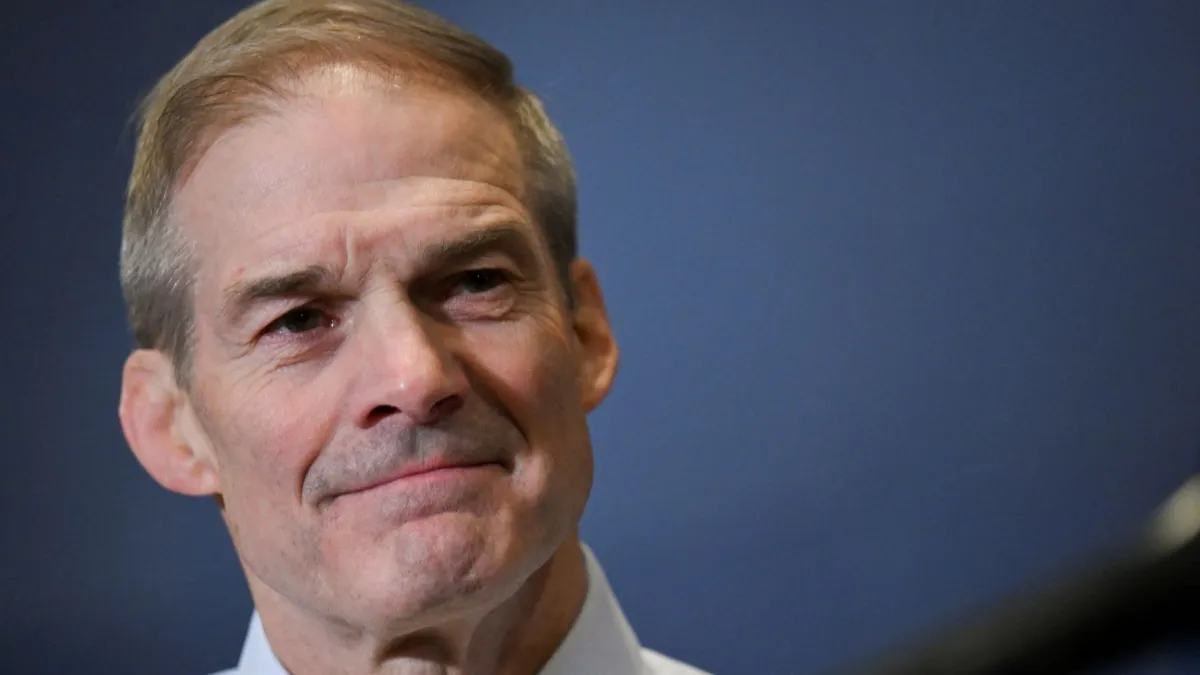
House Republicans Elect Jim Jordan to Lead Their Fight in Next Congress
As they seek to chart a course back to electoral power, House Republicans today elected Rep. Jim Jordan of Ohio to be their leader in the next Congress, while Senate Republicans chose to have Sen. John Thune of South Dakota continue to lead them in the minority.
Jordan, who currently chairs the Judiciary Committee, defeated current House Majority Leader Steve Scalise of Louisiana in a secret ballot. The vote reportedly was 106 to 73.
The result was a sign that many House Republicans are prepared to move away from some of outgoing Speaker Mike Johnson's leadership team that steered the party before its staggering losses in last week's elections - but not from the combativeness that has been a hallmark of recent GOP and MAGA politics.
The 62-year-old Jordan is known as a firebrand and a fierce defender of President Trump.
"Over the next two years, House Republicans will fight for American families," Jordan told reporters after being elected. "When Democrats offer more government, we'll offer more freedom, and we will bring that fight in committee, on the floor and on the stump every single day."
A confrontational former wrestler and co-founder of the far-right House Freedom Caucus, Jordan was first elected to Congress in 2006. He had come up short in two prior bids to lead House Republicans. This time, he pitched himself in a letter to colleagues last week as "battle-tested on the oversight front" and promised to fight aggressively to win back voters and fend off Democratic investigations.
"In these next two years, our job cannot be merely to spotlight how radical this new Democrat party is-offense, not defense, wins elections," Jordan wrote. "Republican policies prioritize making Americans' neighborhoods safer, keeping more money in their pockets, and protecting enduring American values and freedoms. To restore our majority, we must restore voters' faith in our ability to deliver on these principles."
Outgoing Speaker Mike Johnson said Republicans under Jordan will be prepared to push back against the new Democratic majority. "He's a fighter, and I think that's the signal that is being sent here," Johnson told reporters. "We are ready to dig in for the fight, and I think Jim can do a great job."
Thune faces questions, but no challenger: The 65-year-old Thune was not challenged for the Senate GOP leadership post, though some conservatives pushed unsuccessfully to delay Tuesday's vote and argued that the GOP's historic election losses, including at least seven flipped Senate seats, called for further reflection on the party's next steps.
Thune said in a statement that Republicans "remain united in our commitment to advancing conservative priorities, working with President Trump and our colleagues in the House, and holding the line against Democrats' efforts to enact their far-left, liberal agenda."
Schumer confident despite defections: On the Democratic side, with leadership elections set for next week, House Minority Leader Hakeem Jeffries is expected to be chosen to continue as Democratic leader in the next Congress, with broad - albeit not universal - support from his caucus.
Senate Minority Leader Chuck Schumer is also expected to continue leading Senate Democrats next year, though he faces continued calls for him to step aside in favor of a new generation.
Maryland Sen. Chris Van Hollen, 67, told reporters Monday evening that he "hasn't shut the door" on a potential challenge to the 75-year-old Schumer. On Tuesday, Sen. Bernie Sanders of Vermont announced that he won't back Schumer's bid to stay on as Democratic leader. "In my view, the time is now for change, and I will not be supporting Chuck to be re-elected as the Democratic leader," Sanders told reporters.
Sen. Elissa Slotkin of Michigan also called for change and insisted that Democratic leaders demonstrate a plan for their first 100 days. "I think whoever wants to run this caucus should come forward with a plan on how they're going to govern differently, what they're going to do in the first 100 days to put money in people's pockets and in particular how they're going to communicate differently."
Slotkin said she is not actively seeking the leader's job but, like Sanders, is seeking change.
Brian Bryant, president of the 600,000-member International Association of Machinists and Aerospace Workers, sent Schumer a letter on Monday thanking him for his years of leadership and support for organized labor - and calling for "fresh ideas, new energy and a new generation of leadership" in the Democratic Party. "With the utmost respect and appreciation for your service, we respectfully urge you not to seek another term as Senate Democratic Leader," the letter said.
Schumer told reporters he remains confident that he will be elected majority leader.
Quote of the Day: California's Billionaire Tax Fails
"The outcome is a stark setback for a progressive political project aimed at fundamentally changing taxation in the United States. Even in an election cycle when Democrats surged to huge victories across the country, a policy idea at the heart of the progressive agenda could not muster a bare majority in one of the country's most liberal states."
− New York Times tax policy reporter Andrew Duehren, in an article looking at the implications of California voters' rejection of a proposed one-time 5% tax on the wealth of billionaires in the state.
The failure of the ballot measure could affect how Democrats and progressives pursue new tax plans, including those targeting the wealthiest. On the other hand, taxing the rich has generally proved to be popular in polls, and the California proposal was designed in an unusual way and faced other challenges - and political pushback - that might not apply in all cases.
"I think we need to be careful about over indexing on this one result," David Mitchell, senior fellow at the liberal Washington Center for Equitable Growth, told The Times. "Voters rejected one specific wealth tax, but they support taxes on the wealthy generally."
Mitchell added that it may be "that the voters are more comfortable with a more traditional income tax approach, and that could serve as lesson for policymakers going forward."
In any case, some proponents of a wealth tax have made clear that they are prepared to continue their campaign, and key lawmakers in the incoming Democratic Congress are already considering ways to tax the super-rich.
Inflation Rate Flirts With 4% as Prices Keep Climbing
In a sign that inflation remains a serious problem for the U.S. economy, consumer prices rose more quickly than expected in October, according to data released Tuesday by the Bureau of Labor Statistics.
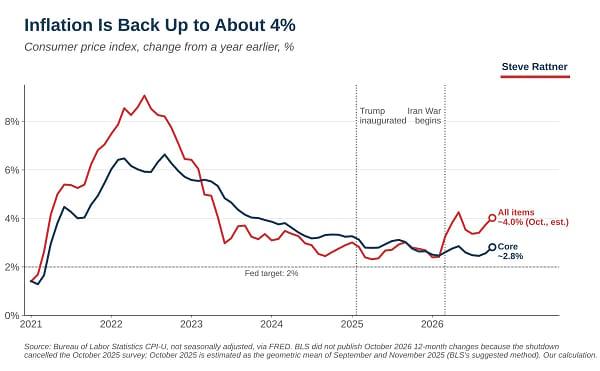
The consumer price index increased 0.4% from September to October, exceeding analyst expectations of a 0.3% rise. No annual inflation number was released, due to the lack of data from October 2025, when the federal government was shut down during a funding dispute, but estimates by various analysts put the annual inflation rate at about 4%. (See the chart below from former Obama official and "Morning Joe" regular Steven Rattner.)
The core inflation rate, which factors out volatile food and fuel prices, also came in hotter than expected, up 0.3% on a monthly basis.
Energy prices were a major contributor to the top-line inflation number, with the energy index increasing 0.7% and the gasoline index rising 1%. Food costs jumped 0.5%, transportation services jumped 0.8%, new cars rose 0.2% and shelter costs were up 0.3%.
Fed expected to hike: The latest inflation data ramps up pressure on the Federal Reserve to raise interest rates at its final meeting of the year in December, and the increase could be larger than the quarter-point hike seen in September (which was followed by a hold in October). Ahead of the report, Fed Governor Christopher Waller said if CPI rose by "around 0.3," he would consider advocating for a 0.5 percentage point increase in the federal funds rate.
Analysts at Bank of America said they still expect to see a quarter-point rate hike, but warned that "the Fed seems to be falling behind the curve on inflation," which could force the central bank to raise rates again in January.
As stocks fell and Treasury yields jumped after the release of the data, Karen Manna, fixed income investment strategist at Federated Hermes, said investors were adjusting their outlook for higher interest rates. "A hotter inflation print raises fresh questions about whether the Fed has done enough to contain price pressures and reinforces the risk that interest rates need to move higher and stay there for longer," she said, per CNBC.
Heather Long, chief economist at Navy Federal Credit Union, linked the data to the stunning election results last week. "The October inflation report underscores why so many Americans voted the way they did in the mid-term elections," she wrote on X. "Inflation in past year (~4%) wiping out wage gains of 3.1% in past year," she added. "Grocery prices rising, Electricity prices rising, Medical care rising, Rent rising. A lot of fun stuff - airfares, restaurant prices - rising. Gas price highest ever on Election Day."
Some analysts tried to find a silver lining in the report, noting that the monthly CPI increase was lower in October than in September, indicating a decline in inflationary pressure. But Mike Konczal of the Economic Security Project emphasized how disappointing the report was. "Food and energy came in hot," he wrote on social media. "But if you exclude that, goods came in hot. But if you exclude that, shelter came in hot. But if you exclude that, the rest of core non-housing services came in hot. If you exclude that, then, well, there's nothing left."
Fiscal News Roundup
Views and Analysis
Get The Fiscal Times newsletter in your inbox
Free, every weekday.