
Trump Renews Push for Massive Defense Funding Boost
Happy Thursday from New York City! It's raining, it's pouring and we are imploring ... Microsoft to fix it's Outlook outage. Here's what we're watching today.
Trump Renews Push for $350 Billion Defense Funding Boost
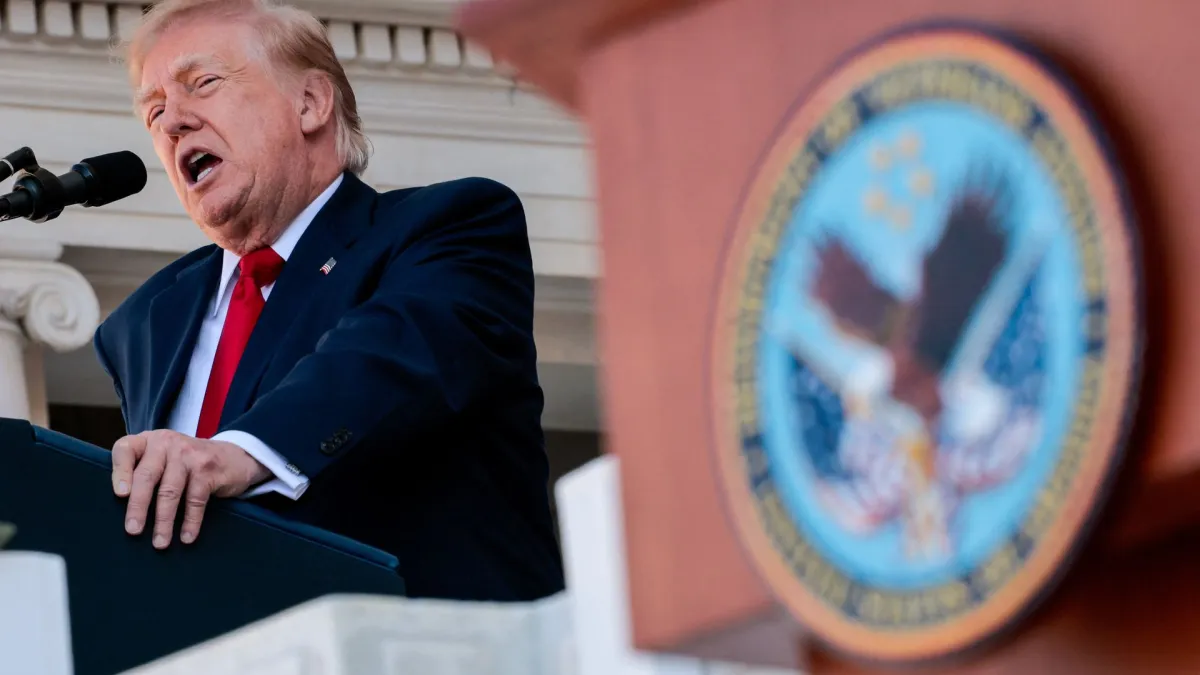
As Republicans and Democrats head toward a clash over military spending and Iran war funding, President Trump on Thursday renewed his call for lawmakers in his party to use the reconciliation process to pass a $350 billion spending package for the Department of Defense.
"Our Military must be strong, powerful, and respected," Trump said on his social media platform. "Republicans must deliver for our Warriors. The Democrats never will. The time is NOW."
The proposed $350 billion would come in addition to a $1.15 trillion base budget he requested for the Pentagon, pushing defense spending up to about $1.5 trillion in 2027. However, some lawmakers have expressed concerns about the overall cost and it's not clear if there is enough support among Republicans to pass the $350 billion supplemental at this point. Senate Republicans had dramatically scaled back their plan for a reconciliation package prior to the elections.
Interest remains: The Pentagon continues to lobby for the extra funding package, with Defense Secretary Pete Hegseth calling on lawmakers this week to pass it. Speaking to reporters, Hegseth said that "this lame-duck period is critically important for funding of our department; $350 billion at a minimum for reconciliation is what we believe is needed to make a generational and historic investment in this department."
As Air & Space Forces magazine reported this week, one of the top noncommissioned officers in the Air Force recently told a military support group that the funding increase is essential. "I can't stress to you enough how important it is for Congress to pass this budget this year," Chief Master Sergeant of the Air Force David R. Wolfe told the Airlift/Tanker Association. "We need the entire budget."
Still, the full $1.5 trillion request is seen as a long shot, and some Pentagon officials are reportedly working with congressional committees on a smaller budget. In addition, some outside defense experts are working on alternatives for the base budget. The Center for Strategic and Budgetary Assessments, an independent nonprofit focused on defense policy, recently released a "Plan B" budget request that laid out four options, with topline spending totals ranging from $1.05 trillion to $1.15 trillion. Defense analysts at the American Enterprise Institute have also defined a range of budget options, with toplines ranging from $1 trillion to $1.25 trillion.
The reconciliation option: Several Republican lawmakers have called on their caucus to pass the reconciliation bill that includes the $350 billion for the Pentagon, along with other GOP priorities, during their final weeks in control of Congress. Earlier this week, Sen. Tom Cotton, who leads the Senate Republican Conference, said Republicans had committed themselves "to do everything humanly possible to pass a reconciliation bill" before the Democrats take over in January.
Whether Republicans can maintain enough discipline and unity to pass a reconciliation bill remains to be seen. In a speech on the Senate floor Wednesday, Sen. John Kennedy urged his fellow Republicans to try. "I'm for spending the time, effort and energy to put together a reconciliation bill," Kennedy said. "I would start with extra money for the military, and then I'm open to other ideas, and I would begin the process next week. And if we fail, we fail, but at least we will have tried."
Trump Asks Vance to Turn Focus From Iran to Democratic Cities and States
President Trump said in a post on his social media site Thursday that the United States does not need a deal with Iran and that Vice President JD Vance, who had publicly blamed the GOP's losses on the war, will instead turn his attention to investigating American cities led by Democrats.
"I have asked Vice President Vance to focus his complete and total attention on the Massive Corruption and Crime taking place in Democrat run Cities and States throughout the U.S.," Trump wrote. "The Blue States, such as Minnesota, California, Illinois, and many more, are all poorly run, corrupt disasters. Billions of Dollars is being stolen each and every month. Our Budget could be quickly BALANCED with the correction of this large scale criminal activity. CORRUPTION is in the Democrat Leadership's blood! We don't need a deal with Iran. Those days have long since passed. We've got their money, Hundreds of Billions of Dollars, and we've got their Strait! Thank you for your attention to this matter."
Why it matters: "Trump's move is a sudden reversal," The Wall Street Journal's Natalie Andrews and Alexander Ward note. "In recent days, the president had told top aides and counterparts that he was open to Vance restarting talks with Iran and had empowered him to negotiate."
Trump on Wednesday had again claimed victory in the Iran war, and the White House this week preemptively pushed back on Democratic investigations of his administration, warning that they could cross the line into "blatant criminality" and could invite scrutiny by the Justice Department.
Trump's wild budget claim: Trump's claim about quickly balancing the budget is the latest in a long series of fantastical assertions along those lines. As a reminder, the federal budget deficit for fiscal year 2026 was nearly $2 trillion, up 12% from the prior year. That means that Vance would need to find about $167 billion a month in fraud against the federal government in the targeted cities and states.
The Government Accountability Office has estimated that the federal government loses between $223 billion and $521 billion a year to fraud, based on data from fiscal years 2018 through 2022.
An online White House "Fraud Ledger" claims that the administration's "Task Force to Eliminate Fraud" has uncovered more than $260 billion in fraud since January 2025. But a New York Times fact-check from late September found that the White House data is difficult to verify and relies on "questionable numbers," some of which "are overstated or lack specificity, and rely on temporary pauses in funding as well as cases and actions that long predated President Trump's second term."
The Times also reported Thursday that "federal data does not support the president's suggestion that fraud is more prevalent under Democrats than Republicans." It adds, perhaps pointedly, that Trump "also has granted clemency to more than 70 allies, donors and others convicted in fraud cases, often involving high-dollar totals."
Quote of the Day: Watchdog Watch
"This is clearly a sham to enable President Trump to appoint a handpicked nominee to lead Congress' watchdog. We cannot allow President Trump to install a fox in the henhouse at an agency Congress relies on to provide independent, nonpartisan oversight, and expose waste, fraud, and abuse across the Trump Administration."
- Congressional Democratic leaders, in a statement released Wednesday night that said that Senate Republicans are trying to install a Trump ally as the federal government's top watchdog before Democrats take control of Congress.
Senate Democratic Leader Chuck Schumer, House Democratic Leader Hakeem Jeffries, Sen. Gary Peters and Rep. Robert Garcia said in a joint statement that Homeland Security and Governmental Affairs Committee Chair Rand Paul's office had given them less than 24 hours to submit candidates to be the next comptroller general of the GAO. Peters and Garcia are the top Democrats on the Senate Homeland Security and Governmental Affairs Committee and the House Committee on Oversight and Government Reform, respectively.
The comptroller general, who serves a 15-year term as head of the GAO, is supposed to be picked by the president from at least three candidates recommended by a bipartisan, 10-member congressional commission. The last comptroller general, Gene Dodaro, retired last December, and Orice Williams Brown has been serving in the role in an acting capacity since then. Lawmakers in both parties have pressured GAO recently to sue the administration over its failure to properly spend congressionally appropriated funds.
Democrats now say that Republicans never convened the commission despite repeated requests and are now trying to ram through a pick that will be friendly to the administration: "Every Member of Congress who values independent oversight and good stewardship of taxpayer dollars should call this out for what it is - a transparent effort to ram through another Trump crony at the 11th hour, and undercut Congress' ability to conduct effective oversight of the Trump Administration."
Paul's committee is scheduled to hold a hearing next Thursday on a list of nominations that includes "a nominee to be Comptroller General."
Fiscal News Roundup
Views and Analysis
Get The Fiscal Times newsletter in your inbox
Free, every weekday.