
Schumer Gets a Challenger as Dems Plot Strategy
TGIF! Here's your update as we head into a welcome weekend.
Schumer Gets a Challenger as Dems Plot 2027 Strategy
Senate Democrats this week began discussing and debating their agenda for their first days in the majority next year - but before they can dive into their legislative priorities, they'll first have to get through a pressure-packed and potentially divisive leadership contest.
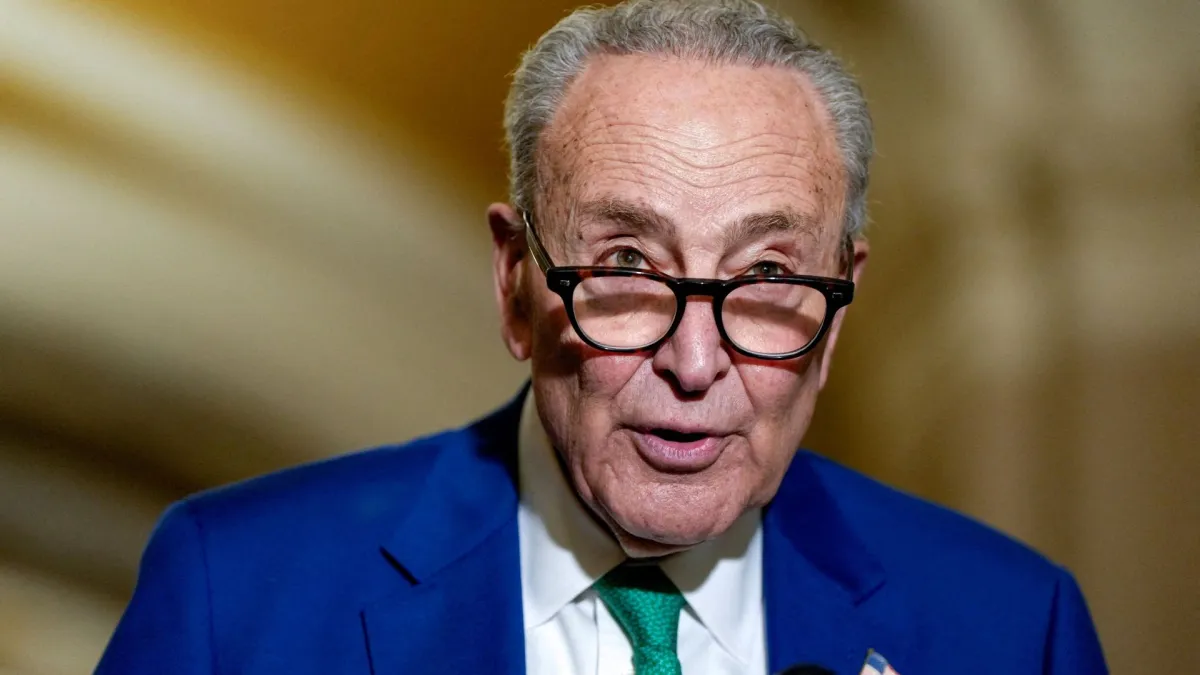
Maryland Sen. Chris Van Hollen announced Thursday night that he will run for Senate majority leader, challenging longtime Senate Democratic Leader Chuck Schumer.
"In this election, the American people called for change. They called for a change from Donald Trump's disastrous policies - but even bigger than that, a change from the status quo that isn't working for working people," Van Hollen said. "It's now on us to meet this moment, and to do that we need new leadership. This is not about any one person - it's about answering the call of the American people."
Van Hollen has won the support of a faction of Democrats eager to see the party move further left and push more aggressively to check President Trump and advance progressive priorities. But Van Hollen, 67, isn't necessarily a prototypical change agent; he's been in Congress since 2003, first in the House for 14 years and then in the Senate since 2017. He has chaired both the Democratic Congressional Campaign Committee and the Democratic Senatorial Campaign Committee.
Van Hollen's leadership bid, by all accounts, faces long odds, but it is a blow to the 75-year-old Schumer, who has faced frequent criticism from the party's progressive base and calls to cede power to a new generation of Democrats. Schumer welcomed the challenge and repeated his prediction that he has the votes to win. "I welcome any discussion about the future of our caucus and the important work ahead," Schumer wrote on social media. "I'm proud of what we've accomplished together-55 seats and counting is an amazing result-and I have the votes to continue serving as Democratic Leader. I look forward to leading our new Democratic majority and delivering for the American people."
Some senators lined up to defend Schumer after Democrats' sweeping election wins and Schumer's record of recruiting and funding many of the candidates who won.
"Chuck Schumer is one of the principal architects of the most successful election in modern history, and I see no reason to change the leadership that helped make that success possible," said Sen. Angus King of Maine, an independent who caucuses with Democrats. "Chuck has outlined an aggressive plan for the new Democratic majority which is directly responsive to the message we heard from the voters, and he has the experience and unique mastery of the Senate process to make it happen. Why would you fire the manager when you just won the World Series?"
Barring a change, the Senate Democratic leadership elections are still weeks away, though, potentially leaving time for support to shift as Democrats plan their agenda for early 2027.
What's on Dems' agenda: Democrats have made clear they intend to focus on ending the Iran war, stopping Trump's tariffs, restoring more generous Affordable Care Act tax credits and reversing Republican cuts to Medicaid and SNAP food aid. They've also promised ethics reforms, including a bill to prohibit stock trading by members of Congress.
If and how those things get done could depend on the approach Democrats take. Schumer has been pitching a plan to address healthcare, affordability and other top priorities in a series of individual bills rather than one megabill. The idea is "to put single, rifle-shot measures on the floor week-by-week and dare Republicans to filibuster or Donald Trump to veto," according to Igor Bobic and Oriana González of the Washington Sun.
That approach would require the help of at least four Senate Republicans - and, if those votes aren't forthcoming, Democrats would then turn to budget reconciliation to pass their agenda on a party-line basis.
Some progressives are reportedly already pushing for a sweeping bill along those lines.
"They're floating the idea even though they know there's no chance it will become law," Politico's Brian Faler reports, "but that's not the point. Rather, the purpose is to pick a big, showy fight with the president, and put a spotlight on the Democratic platform ahead of the 2028 presidential election."
Van Hollen reportedly favors a reconciliation bill, though he also said that the Democratic caucus needs to discuss the options.
Other Democrats counter that they should be more focused on concrete achievements and delivering on promises than political messaging and 2028 positioning. And, Faler notes, a reconciliation fight carries other risks - it involves a more complicated process, for example, and "could spark a big, embarrassing internal fight over what ought to go into a bill." It would likely also carry a big price tag that would either be offset by politically perilous tax hikes or "would antagonize the party's fiscal hawks and give Republicans a fat target to criticize."
The bottom line: Democrats may be riding high on their election wins, but they still face internal divisions and their process of building consensus - to the extent possible - about the party's goals and tactics in the majority is just getting started.
Trump Admin Allows States to Delay Medicaid Work Requirements
The Trump administration said Friday that states can delay the enforcement of new work requirements for Medicaid participants until July 2027 in order to give state agencies more time to develop the necessary reporting and management infrastructure.
The Centers for Medicare & Medicaid Services announced an "optional hold harmless period" for states lasting until June 30, 2027. States are still free to start enforcing the work requirements on January 1, 2027, as previously scheduled.
CMS said states opting to use the delay can use the six-month period "to further modernize systems, improve processes, and streamline the applicant and beneficiary experience." During that time, states are required to assess whether Medicaid participants are meeting the work requirements but may not "deny applications or disenroll otherwise eligible individuals solely for failure to meet the requirement."
The new work requirements were enacted through the One Big Beautiful Bill Act that Republicans passed on a party-line basis in the summer of 2025. Overall, according to the Congressional Budget Office, the law is expected to cut Medicaid spending by nearly $1 trillion over 10 years; the work requirement provision will account for about $326 billion of that reduction.
In its press release Friday, CMS summarized the work requirement provision: "Beginning Jan. 1, 2027, certain Medicaid applicants and beneficiaries ages 19 to 64 must meet a statutory work requirement, unless excluded. CMS' June 2026 interim final rule outlines qualifying activities, including 80 hours per month of work, community service, or participation in a work program; enrollment in an educational program at least half-time; a combination of qualifying activities totaling at least 80 hours per month; or meeting the specified monthly income threshold."
Chart of the Day: Still More Inflation Ahead?
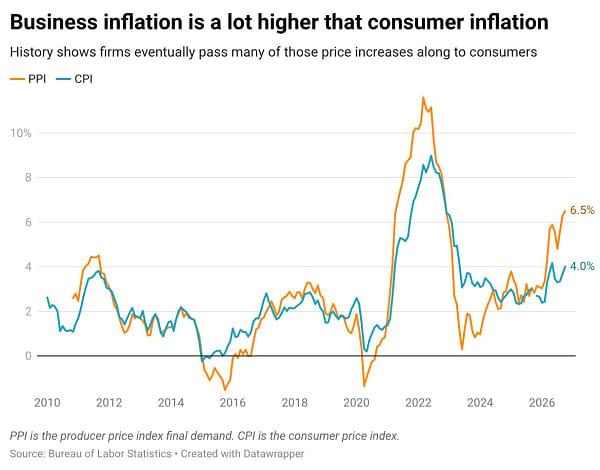
The producer price index surged 6.5% on an annual basis in October as wholesale prices rose at the fastest pace since November 2022, the Bureau of Labor Statistics reported Friday. On a monthly basis, producer prices rose 0.3%, slightly better than expected, though still elevated. Core producer prices, which factor out volatile food and energy costs, also rose 0.3%, matching expectations.
A big jump in wholesale prices usually means that retail prices are headed higher, too, as firms scramble to maintain profit margins. "Another day, another worrying US inflation statistic," said Heather Long, chief economist at Navy Federal Credit Union. "Businesses are almost certainly going to pass some of those higher costs onto consumers. It's yet another worrisome inflation risk heading into 2027."
Chicago Federal Reserve President Austan Goolsbee told CNBC that prices are rising in multiple sectors, suggesting that inflation is becoming more entrenched. "We've had some signs of trouble now for several months in a row," he said. "If you look at how broad-based the inflation is, it's not just that we're above the target and have been for some time. It's that in categories that are not driven by oil prices and not driven by tariffs, you're still seeing stalled progress and in some cases, going the wrong way."
"We've been above 2% for almost six years," Goolsbee added. "Inflation is rising; it's proved far more persistent than we predicted at the beginning from the supply shocks."
Fiscal News Roundup
Views and Analysis
Get The Fiscal Times newsletter in your inbox
Free, every weekday.