
GOP Hopes Fade for Major Lame-Duck Agenda
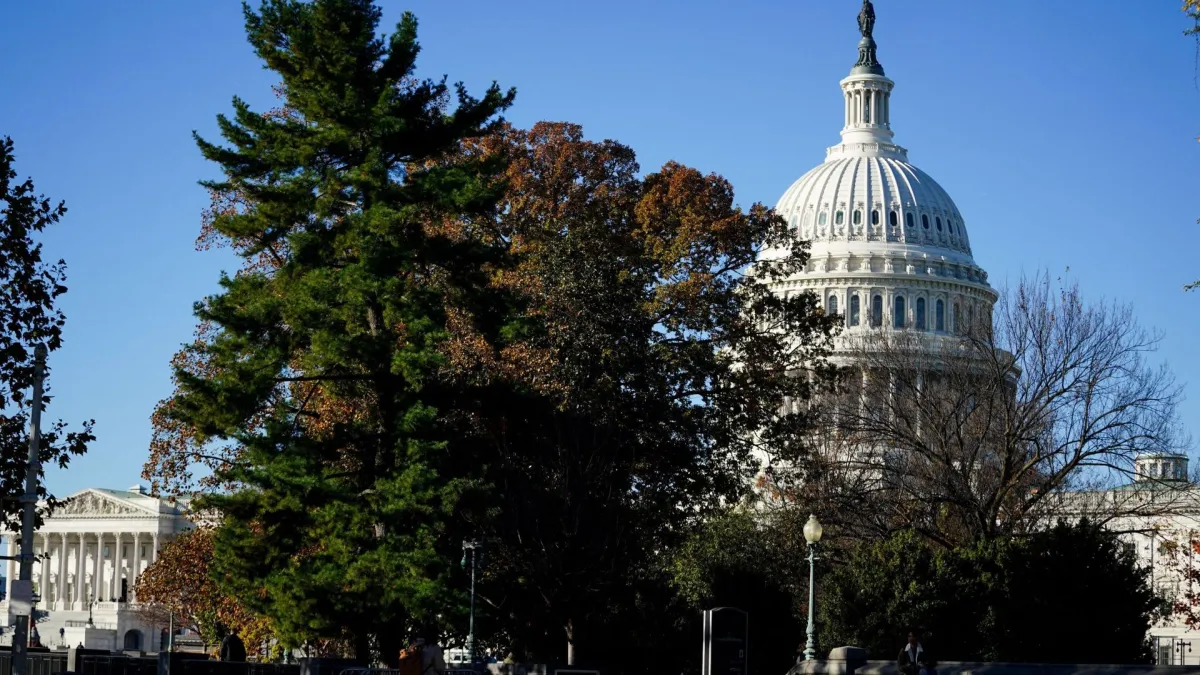
President Trump today concluded his historic trilateral talks with Chinese President Xi Jinping and Russian President Vladimir Putin in China. In a social media post, Trump called it a "Great and Highly Consequential Trip," though no diplomatic breakthroughs were announced. The meeting did serve to elevate and legitimize Putin on the global stage - and it allowed both Russia and China to talk of an emerging world order in which both countries stand alongside the United States as major powers. Reinforcing that perception and raising some eyebrows, Trump described both Xi and Putin as "friends." Polish Prime Minister Donald Tusk responded in posts on X that said, "God, protect us from such friends" and "Putin is not and never will be our friend."
GOP Hopes Fade for Passing Major Lame-Duck Agenda
House lawmakers voted this morning to pass a bill that would modify how Congress estimates the long-term savings from preventive healthcare. Well, 401 House members voted unanimously to pass that bill, while 32 others missed the vote. Then, once the vote was done, the House adjourned until November 30, after the Thanksgiving break.
After Republicans lost their House and Senate majorities in this month's election drubbing, many in the party sought to close out their final days in power by ramming through a host of unfinished agenda items, from confirming Trump judicial and executive branch appointees to enacting a third party-line spending bill. The judicial confirmations are happening. The rest of the program is not.
While some in the party had talked about working through weekends and holidays to fulfill remaining promises to conservative voters, House lawmakers can't even finish out a normal week, let alone put in extra hours.
"The Republican trifecta is sputtering in its final days," a Politico headline declared Thursday.
Attendance issues have plagued the GOP majority in its waning days. As veteran congressional reporter Jamie Dupree noted in a post on X, nine Republicans missed every House vote this week, while three Democrats did the same. That meant Republicans didn't actually have a majority for floor votes. House GOP leaders had to cancel a planned procedural vote on two Republican-led bills yesterday after 14 of their members didn't show.
"Attendance is a great frustration for me right now," House Speaker Mike Johnson told reporters. "We'll be addressing that with members."
Running out of time on reconciliation: On the Senate side, Republicans have struggled to find consensus about a plan of action for their final days in control. Hours of GOP meetings on Wednesday reportedly failed to produce a clear plan for one last, long-shot reconciliation package that could deliver the $350 billion in extra defense funding that President Trump requested. Budget hawks are unlikely to support that request - and even if Senate Republicans could somehow manage to push through some sort of reconciliation bill, House Republicans would be unlikely to have enough votes to adopt it.
Outgoing House Budget Committee Chair Jodey Arrington reportedly told Axios that a Senate reconciliation package with $350 billion for defense would be dead on arrival in his chamber if it didn't also include spending cuts. But any push for offsetting cuts would likely invite renewed infighting that could derail the package.
"My concern is we squander these very few days we have left on something that won't get out of the House," Arrington told Axios.
Arrington reportedly also said that GOP senators fear that additional healthcare cuts could open the door to amendment votes that reverse their 2025 Medicaid cuts.
"Some Republican members of the Senate might go rogue and might decide to, I don't know, repeal some of the reforms that we put in the 'Big Beautiful Bill.' Maybe they do it out of spite for President Trump," he said.
A push to negotiate on government funding: Republican appropriators reportedly urged their colleagues yesterday to hold off on a reconciliation package to allow them time to pursue bipartisan talks on government funding plans ahead of a December 11 shutdown deadline.
Problems with Trump picks: Senate Republicans have also run into trouble in trying to approve some of the president's nominees, including Eric Ueland, the White House loyalist who Trump picked to run the Government Accountability Office, Congress's independent watchdog agency. Democrats have hammered Trump's choice as well as the president's bypassing the normal process for selecting a new GAO leader.
Those criticisms continued at a confirmation hearing on Thursday. "American taxpayers deserve an independent, nonpartisan watchdog at GAO, which is why Congress put in place a nonpartisan selection process that the White House has chosen to flout in jamming your nomination through the Senate," Democratic Sen. Maggie Hassan reportedly told Ueland Thursday. "It is deeply, deeply concerning."
Several Republicans, including Sens. Susan Collins of Maine, John Curtis of Utah and Thom Tillis of North Carolina, have raised concerns about the nomination, too, leaving Ueland's fate in doubt.
The bottom line: Another Republican reconciliation bill isn't entirely out of the question, but it's looking increasingly unlikely. More than two weeks after the election, it's still not clear how much Republicans will be able to accomplish in their final days in control of the House and Senate.
Quotes of the Day
"I have a feeling that this is going to be an unbelievably productive two years. They'll send me ... a bill on healthcare, and I'll say, 'No way,' and I'll veto it. And then they'll call me and they'll say - and we'll sit down. And that's what I do."
- President Donald Trump, speaking to Jacqui Heinrich of Fox News early Thursday during his trip to Shenzhen, China.
Trump said that he respects Democrats in Congress and is sure he can work with them once they take control of Congress in January. "They won," he said. "Politics is a nasty game and they won. And I don't agree with everything, but I will say this: I think I can do, in many ways, better now."
"At this point, the entire fiscal conservative movement in the Senate is only me."
- Sen. Rand Paul, speaking to the Washington Examiner on Wednesday.
Paul, a conservative libertarian who has long called for reducing spending and balancing the federal budget, said he agrees with critics who argue that the Republican Party needs a complete overhaul. "Instead," he said, "the message of the election, as transmitted to the Republicans in the Senate, is: spend more money, without any offsets, add to the deficit and fund the Iran war."
Republican Senator Floats Social Security Fix: Pay Benefits Out of General Funds
In an interview with Fox Business on Wednesday, Senate Budget Committee Chair Ron Johnson called Social Security "grotesque" and a "scam" that needs to come to an end.
"At this point, there's really no way to fix Social Security," he said. "It's a Ponzi scheme. You can't fix it; you just shut it down and hope that you can recover some of your money."
Later in the day, during a committee hearing examining Social Security, Johnson distanced himself from the statement, saying his remarks had been "imprecise." He claimed that he had been discussing Ponzi schemes in general and was not proposing to shut down the popular retirement program.
On Thursday, though, he doubled down on his critique, some version of which he has been offering since at least 2010. "Social Security IS a legal Ponzi scheme," he wrote on X.
To address the problem that inspired Johnson's claim - a looming shortfall in revenues when the Social Security system's trust funds run dry as soon as 2032, which could result in a 22% cut in benefits - Johnson has now offered a simple fix: Use general tax revenues to pay full benefits.
Sketching out the proposal, Johnson released the text of the Stop Scaring Seniors Act, which is intended to "ensure full payment of Social Security benefits" by transferring money from the general fund of the Treasury to the old-age program as needed.
Not a Ponzi, but financing remains a challenge: Although the accusation that Social Security is a Ponzi scheme remains popular in some precincts of the political right, experts generally reject the claim. While Social Security is indeed self-funded through a steady inflow of tax receipts, which are then transferred to beneficiaries, everyone is aware of the structure, which can be adjusted to maintain solvency at any time that Congress sees fit.
The problem, however, is that Congress has failed to act on the looming threat. Covering shortfalls from general funds seems like an easy fix, but fiscal experts warn that it would come at a high price.
"Paying for Social Security out of the general fund would absolutely explode the national debt, costing a whopping 165% of GDP over 75 years before even considering the economic implications," the budget hawks at the Committee for a Responsible Federal Budget said in response to Johnson's proposal. "This would bring us to a totally untenable level of borrowing that would almost certainly spark a crisis."
A self-proclaimed fiscal hawk, Johnson is likely aware of the problem. But in a memo submitted to the Budget Committee this week, he explained his larger purpose: drawing attention to the nation's persistent budget deficit.
"By fixating on Social Security, not acknowledging the multi-decade deception, and not focusing on the larger problem - a 10-year projected deficit of $24.4 trillion - we will be doing a huge disservice to future generations and in the end, fix nothing," Johnson said. "A better solution would be to repeal that portion of the law that reduces Social Security benefits and quit scaring seniors. We should then roll up our sleeves and begin seriously addressing the main problem - our massive debt and deficits."
Fiscal News Roundup
Views and Analysis
Get The Fiscal Times newsletter in your inbox
Free, every weekday.