
Trump Readies New Tariff Hikes for Dozens of Countries
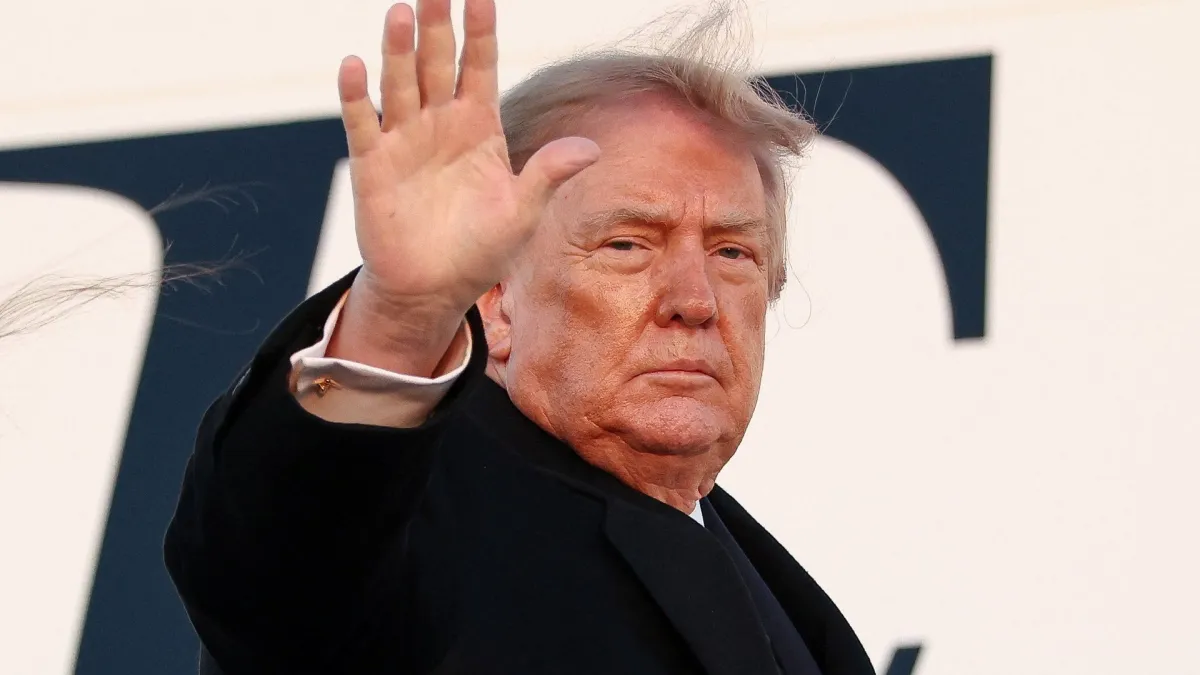
It doesn't quite compare with getting Jensen Huang reinstated as CEO of Nvidia, but President Trump today pardoned a pair of turkeys for Thanksgiving. Trump said the turkeys, named Freedom and Feathers, will now live out their days at Texas A&M. Trump also gave the Medal of Freedom, the nation's highest civilian honor, to Rudy Giuliani, the former New York mayor who went on to serve as Trump's personal lawyer before being sanctioned and disbarred for repeatedly making false statements about the 2020 election.\n\nHappy Thanksgiving! We will be back in your inbox next week.
Trump Readies New Tariff Hikes for Dozens of Countries
U.S. Trade Representative Jamieson Greer is expected to announce new tariffs as soon as Tuesday evening aimed at dozens of major trading partners, including the European Union, China, Mexico and Japan.
Greer has been looking for ways to reinstate a slew of President Trump's "Liberation Day" tariffs from April 2025 that the Supreme Court invalidated earlier this year. The new tariffs are expected to be based on a different legal authority, Section 301 of the Trade Act of 1974, which empowers the U.S. trade representative to retaliate against unfair trade practices.
In this case, Greer is expected to say that he has determined that the 16 trading partners covered by the new tariffs - including the EU, which comprises 27 member nations - have intentionally built up excess industrial capacity, enabling them to flood the global economy with cheap goods, thereby harming U.S. producers.
The tariff roller coaster: Trump has long argued that tariffs are an essential tool for rebuilding American industrial capacity, as well as a way to punish powerful competitors and ungrateful allies while raising new revenues. Most economists say the use of tariffs is far more complicated and fraught, and all but guarantees increased prices for domestic producers and consumers. Still, Trump persists, even after Republicans' election losses that reflected voter dissatisfaction with economic conditions.
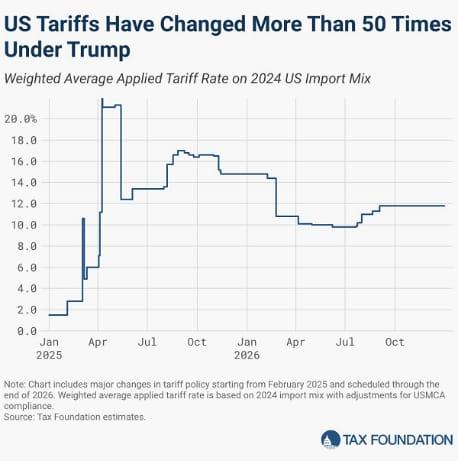
As the chart below from Erica York of the conservative-leaning Tax Foundation noted today, Trump has been both aggressive and inconsistent in his approach, having changed what had been a relatively stable tariff system more than 50 times in his second term. York said she expects the new round of import levies to push the average tariff rate back to where it was before the Supreme Court intervened, moving it from the current 12% closer to the previous average above 14%.
Some countries will be faced with higher tariffs on average, likely including China, which Trump has cited as a particularly aggressive manipulator of global commerce. At the same time, the new tariffs are expected to exclude certain goods, such as steel and aluminum, that are covered by an alternative set of rules.
White House Seeks Golden Dome, Trump Battleship Funding 'Anomalies'
As lawmakers discuss a stopgap spending bill to avoid a government shutdown next month, the White House on Monday sent a list of funding boosts that it would want to see, including billions of dollars for the military.
A continuing resolution that keeps federal agencies running beyond the current December 11 funding expiration date would, by default, also keep most funding at existing levels and would exclude money for new programs. The administration's requests represent areas where it wants to spend more or launch a new program.
Among the notable requests on the 12-page "anomalies" list obtained by Politico is $5 billion for President Trump's Golden Dome missile defense program, which the White House says would otherwise be unable to continue production started under the GOP's 2025 reconciliation bill.
The White House list also seeks spending authority for various missile and counter-drone programs. It says that the Army and Navy could face a cancellation charge of up to $4.4 billion if the Tomahawk missile production program isn't funded by June 2027, for one example of the risks of a funding lapse.
The anomalies requests also include more than $21 billion for two Navy submarine programs and procurement authority for shipbuilding programs, including the new Trump-class battleship. "Without this anomaly material delays would impact cost and on-time delivery of the Battleship," the list says.
In all, the White House is seeking anomalies for 22 Pentagon programs in a stopgap spending bill. The document also says that "Additional Department of War anomalies are forthcoming."
Besides military funding, the White House is seeking $2 billion for NASA's Artemis program to return to the moon, over $2 billion for wildfire suppression and $70m million for biothreat and infectious disease surveillance programs at the Centers for Disease Control and Prevention.
The administration is also asking lawmakers to allow the Federal Aviation Administration to spend money faster and more flexibly as it works to address problems with the nation's air traffic control system. And it wants lawmakers to revisit the definition of certain hemp products, a contentious issue that is resurfacing now that a temporary delay of a ban on intoxicating hemp products is set to expire when funding does.
The bottom line: As Congress and the Trump administration look to avoid a pre-Christmas shutdown, numerous sticking points remain, including some items on the White House anomalies list and, of course, Iran war funding that Democrats have pledged to stop.
Number of the Day: $9.2 Billion
The Centers for Medicare & Medicaid Services (CMS) on Monday announced new negotiated Medicare prices for 13 drugs. It said that those lower prices will result in an estimated $9.2 billion in savings starting in 2028.
CMS said the chosen drugs accounted for about $22.3 billion in Medicare Part D costs in 2025, or about 6% of Part D drug costs for that year, and about $3.3 billion in Medicare Part B costs, or about 2% of that program's cost. The negotiated discounts from Medicare's 2025 cost range from 34% for Entyvio, which treats Crohn's disease and ulcerative colitis, to 84% for Type 2 diabetes drug Trulicity.
The government's drug price negotiations were established under the 2022 Inflation Reduction Act. The latest round of annual negotiations brings the total number of drugs for which the government has negotiated prices to 37, including 10 prices that took effect this year and 15 others set to take effect in 2027.
Fiscal News Roundup
Views and Analysis
Get The Fiscal Times newsletter in your inbox
Free, every weekday.