
Tequila’s Stunning Rise: How It Shot Up in U.S. Popularity

Americans are drinking more and better-quality tequila, and not only in margaritas on Cinco de Mayo.
Tequila sales have been growing at an average rate of 5.6 percent a year since 2002, according to February figures from the Distilled Spirits Council of the United States. In 2014 alone, 13.8 million nine-liter cases were sold.
Related: U.S. Surpasses France As Biggest Wine Market
The U.S. represents tequila’s largest market, with about 52 percent of global sales. America’s renewed thirst for mixed cocktails has been a boon for spirits overall, but especially for tequila. Meanwhile, sales in Mexico have remained flat largely because the market there is mature, with little room for growth.
The Distilled Spirits Council said that one of the keys to tequila’s U.S. growth has been distillers’ ability to offer a product for every budget and occasion, but the fastest growth has been in high-end and super-premium brands.
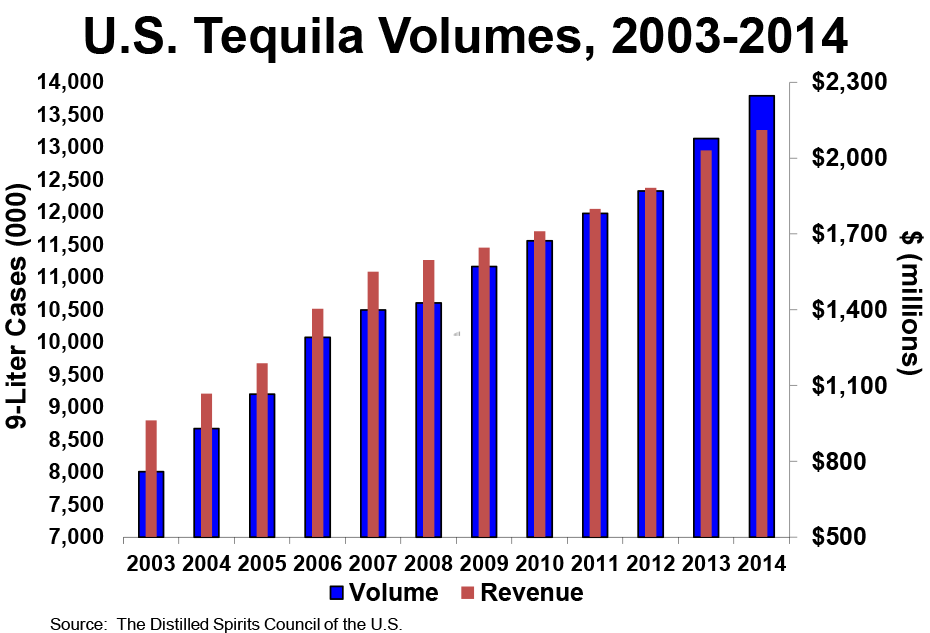
“High-end brands have grown 189 percent in volume since 2002,” it noted. “Virtually unknown in 2002, super-premium tequila volumes have skyrocketed 568 percent and today account for 2.4 million 9-liter cases.”
Celebrity endorsements may have also raised the status of tequila. George Clooney, Sean Combs and Justin Timberlake have all promoted tequila brands.
In addition, distillers are trying to boost the popularity of high-end tequilas further by offering tastings and tours — at least one of which is aimed at the super-wealthy.
Tequila Avion, an ultra-premium tequila maker, is offering a $500,000, three-day trip for 10 to Jalisco, Mexico, to taste its spirits and partake of luxury accommodations, butler service and a private dinner among other amenities.
Related: Kentucky’s McConnell and Paul Offer Tax Breaks for Bourbon
If that seems a tad pricey, Experience Tequila in Portland, Ore., offers four-day tours to Mexico for just under $1,500, and you can find tequila-tasting classes in many cities for about $100.
Number of the Day: 51%
More than half of registered voters polled by Morning Consult and Politico said they support work requirements for Medicaid recipients. Thirty-seven percent oppose such eligibility rules.
Martin Feldstein Is Optimistic About Tax Cuts, and Long-Term Deficits
In a new piece published at Project Syndicate, the conservative economist, who led President Reagan’s Council of Economic Advisers from 1982 to 1984, writes that pro-growth tax individual and corporate reform will get done — and that any resulting spike in the budget deficit will be temporary:
“Although the net tax changes may widen the budget deficit in the short term, the incentive effects of lower tax rates and the increased accumulation of capital will mean faster economic growth and higher real incomes, both of which will cause rising taxable incomes and lower long-term deficits.”
Doing tax reform through reconciliation — allowing it to be passed by a simple majority in the Senate, as long as it doesn’t add to the deficit after 10 years — is another key. “By designing the tax and spending rules accordingly and phasing in future revenue increases, the Republicans can achieve the needed long-term surpluses,” Feldstein argues.
Of course, the big questions remain whether tax and spending changes are really designed as Feldstein describes — and whether “future revenue increases” ever come to fruition. Otherwise, those “long-term surpluses” Feldstein says we need won’t ever materialize.
JP Morgan: Don’t Expect Tax Reform This Year
Gary Cohn, President Trump’s top economic adviser, seems pretty confident that Congress can produce a tax bill in a hurry. He told the Financial Times (paywall) last week that the Ways and Means Committee should be write a bill “in the next three of four weeks.” But most experts doubt that such a complicated undertaking can be accomplished so quickly. In a note to clients this week, J.P. Morgan analysts said they don’t expect to see a tax bill passed until mid-2018, following months of political wrangling:
“There will likely be months of committee hearings, lobbying by affected groups, and behind-the-scenes horse trading before final tax legislation emerges. Our baseline forecast continues to pencil in a modest, temporary, deficit-financed tax cut to be passed in 2Q2018 through the reconciliation process, avoiding the need to attract 60 votes in the Senate.”
Trump Still Has No Tax Reform Plan to Pitch
Bloomberg’s Sahil Kapur writes that, even as President Trump prepares to push tax reform thus week, basic questions about the plan have no answers: “Will the changes be permanent or temporary? How will individual tax brackets be set? What rate will corporations and small businesses pay?”
“They’re nowhere. They’re just nowhere,” Henrietta Treyz, a tax analyst with Veda Partners and former Senate tax staffer, tells Kapur. “I see them putting these ideas out as though they’re making progress, but they are the same regurgitated ideas we’ve been talking about for 20 years that have never gotten past the white-paper stage.”
The Fiscal Times Newsletter - August 28, 2017
|


