This Man Just Lost $15 Billion in a Half Hour

In the history of sudden wealth loss, Li Hejun may have set a new record.
Li, who was China's richest man until this week, saw his fortune drop by as much as $15 billion in a half-hour as the stock in his company, Hanergy Thin Film Power Group, fell by nearly half. Trading in the shares was halted Wednesday and Li didn't attend the company's annual meeting.
While plenty of billionaires have seen their fortunes cut in half over time, few if any have seen $15 billion wiped out in a half-hour. Li's total fortune was around $30 billion before the stock plunged.
Prior to the drop, the company's shares had risen by more than fivefold since September, baffling analysts. Reuters reports that Hong Kong regulators are looking at alleged market manipulation with the stock.
Related: America’s Highest Paid CEO: It’s Not Who You Think
In a similar wealth decline, Hong Kong property and electronics magnate Pan Sutong has lost more than $11 billion this week as shares of two listed companies, Goldin Financial and Goldin Property, both closed down more than 40 percent.
Pan owns around 65 percent of Goldin Property and more than 70 percent of Goldin Financial, according to filings. His fortune was listed at more than $28 billion, making him Hong Kong's second-richest man.
That means that the two men have lost more in one day that the total net worth of Carl Icahn, Steve Ballmer or Michael Dell.
Pan is known for his large lifestyle. He's a big polo supporter and has sponsored a polo event in Britain attended by Princes William and Harry. He's said that the sport "is a way of life and belief in a sense of nobility."
Pan also owns vineyards around the world, including three in France and one in California's Napa Valley, called the Sloan Estate, which he purchased in 2011 for around $40 million.
This article originally appeared on CNBC
Read more from CNBC:
Playboy keeps it's clothes on
Kickstarter darling Pebble may be in a rough patch
McDonald's CEO: Ronald is here to stay
Trump’s Cabinet Would Benefit from Tax Plan Too
“Eliminating the estate tax would save the Trump Cabinet over a billion dollars," Oliver Willis writes. "Like Mnuchin, Trump’s secretaries would make out like bandits. Commerce Secretary Wilbur Ross would get an extra $545 million. The family of Education Secretary Betsy DeVos would rake in $900 million. Linda McMahon, head of the Small Business Administration, and her husband, WWE founder Vince McMahon, would take in $250 million. Trump’s own net worth is in dispute, thanks to his failure to reveal his tax returns, but based on his estimated net worth of $3 billion, the estate tax scheme would net him $564 million.” (Shareblue Media, Bloomberg)
A Liberal Economist Shoots Down the GOP’s Fiscal Chicken Hawks
Republicans want a tax cut, but they don’t want to fully pay for it and may be willing to increase the deficit by $1.5 trillion over 10 years. This would continue a troubling cycle, economist Jared Bernstein writes, in which supposed fiscal conservatives “use the deficit argument to block spending, promote fiscal austerity, and small government, conveniently tossing deficit concerns aside when it comes to tax cuts.”
You’ll hear arguments about how increased economic growth will make up for the budgetary effects of the tax cuts, but don’t believe them. “Our fiscal history on this point is clear: Cutting taxes loses revenues, which, unless offset by higher taxes elsewhere or spending cuts, increases the budget deficit, which in turn raises the debt.” When this happens again, and the promised growth effects don’t materialize, the tax cutters will go back to pushing for spending cuts.
The country faces a number of serious challenges, including an aging population that by itself will require increased government spending, and we need a tax policy that does more than drive up the deficit. “The problem with structural deficits — ones that go up even in good times — is that they reveal that we’re unwilling to raise the necessary revenues to support the government we want and need. This enables those who whose goal is to shrink government to point to deficits and debt as their proof that we can’t afford it, whatever ‘it’ is, except when ‘it’ is tax cuts.” (New York Times)
Health Secretary Tom Price Under Fire for Use of Private Jets
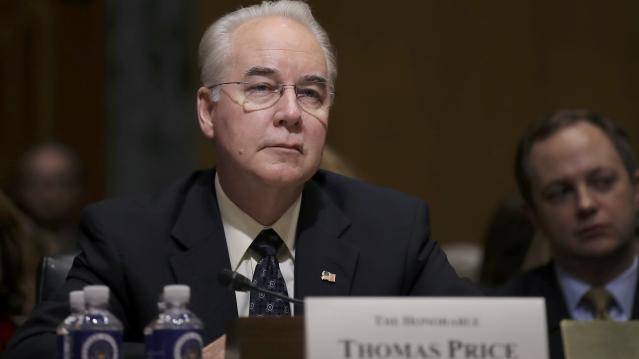
Back in 2009, Tom Price spoke out against House Democrats who wanted to spend $550 million on private jets for lawmakers to use. A Republican representative from Georgia at the time, Price told CNBC that the purchase of the jets was “another example of fiscal irresponsibility run amok.” Now Secretary of Health and Human Services, Price seems to have changed his mind about the virtue of government officials using private jets at taxpayer expense. Just last week, Price used a chartered private jet to travel to three HHS events — including one at a resort in Maine — at an estimated cost of $60,000, Politico reports.
While previous HHS secretaries typically flew commercial, reports indicate that Price has been traveling by private jet for months. “Official travel by the secretary is done in complete accordance with Federal Travel Regulations,” an HHS spokesperson told Politico.
Critics on Twitter have been harsh:
More in-your-face kleptocracy from Tom Price.Take food stamps from poor, hungry kids- spend $25k from taxpayers to charter plane to Philly
— Norman Ornstein (@NormOrnstein) September 20, 2017
1️⃣ Attack Medicaid while trading health stocks.
— Harry Stein (@HarrySteinDC) September 20, 2017
2️⃣ Spend funds that could give someone 4 years of Medicaid coverage to fly a private jet. https://t.co/GO5cfJgWgO
First Mnuchin, now Tom Price. The @realDonaldTrump Cabinet has a big problem charging taxpayers for private flights. https://t.co/th1QbGdfT7
— Ben White (@morningmoneyben) September 20, 2017
Social Security Benefits Due for a Bigger Bump in 2018
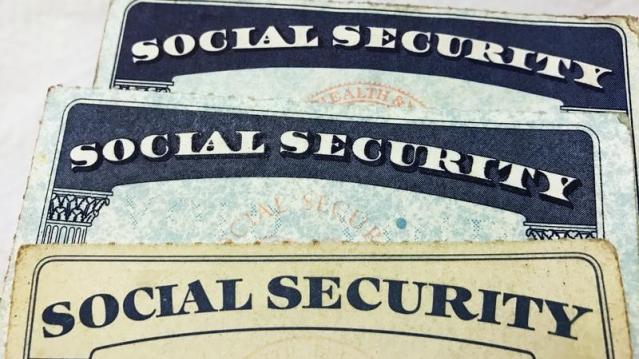
In a few weeks the Social Security Administration will announce its cost-of-living adjustment, or COLA, for 2018. Inflation data for the month of August suggests that the adjustment could be the highest in five years, possibly over 2 percent, according to the Washington Examiner. Adjustments for the past five years have been relatively small: The cost of living adjustment for 2017 (announced last October) came in at a modest 0.3 percent, and the adjustment for 2016 was zero. Some retirees have complained in the past about small COLAs, but it’s worth remembering that higher adjustments are driven by higher inflation, which is bad news for people living on fixed incomes.
Americans Are Less Satisfied with Government Now Than a Year Ago
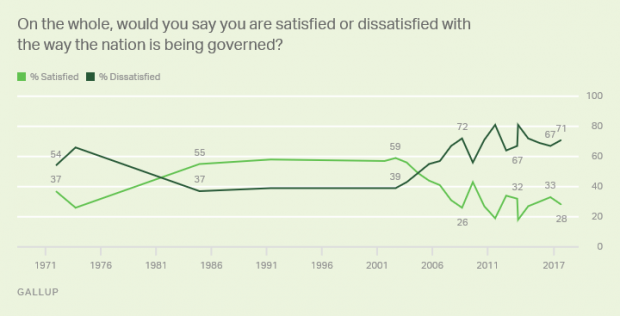
Gallup finds that just 28 percent of Americans are satisfied with the way the nation is being governed, down from 33 percent a year ago. And as we approach some potential fiscal battles, it's worth noting that the lowest satisfaction levels since Gallup started updating the measure annually in 2001 came in 2011 (19 percent) after a debt ceiling showdown that led to the U.S. credit rating being downgraded by S&P analysts and in 2013 (18 percent) during a federal government shutdown.