This Man Just Lost $15 Billion in a Half Hour

In the history of sudden wealth loss, Li Hejun may have set a new record.
Li, who was China's richest man until this week, saw his fortune drop by as much as $15 billion in a half-hour as the stock in his company, Hanergy Thin Film Power Group, fell by nearly half. Trading in the shares was halted Wednesday and Li didn't attend the company's annual meeting.
While plenty of billionaires have seen their fortunes cut in half over time, few if any have seen $15 billion wiped out in a half-hour. Li's total fortune was around $30 billion before the stock plunged.
Prior to the drop, the company's shares had risen by more than fivefold since September, baffling analysts. Reuters reports that Hong Kong regulators are looking at alleged market manipulation with the stock.
Related: America’s Highest Paid CEO: It’s Not Who You Think
In a similar wealth decline, Hong Kong property and electronics magnate Pan Sutong has lost more than $11 billion this week as shares of two listed companies, Goldin Financial and Goldin Property, both closed down more than 40 percent.
Pan owns around 65 percent of Goldin Property and more than 70 percent of Goldin Financial, according to filings. His fortune was listed at more than $28 billion, making him Hong Kong's second-richest man.
That means that the two men have lost more in one day that the total net worth of Carl Icahn, Steve Ballmer or Michael Dell.
Pan is known for his large lifestyle. He's a big polo supporter and has sponsored a polo event in Britain attended by Princes William and Harry. He's said that the sport "is a way of life and belief in a sense of nobility."
Pan also owns vineyards around the world, including three in France and one in California's Napa Valley, called the Sloan Estate, which he purchased in 2011 for around $40 million.
This article originally appeared on CNBC
Read more from CNBC:
Playboy keeps it's clothes on
Kickstarter darling Pebble may be in a rough patch
McDonald's CEO: Ronald is here to stay
Trump and Schumer Will Try to Scrap the Debt Ceiling
The president and the Senate Democratic leader agreed to seek out a more permanent debt ceiling solution that would end the perpetual cycle of fiscal standoffs. “There are a lot of good reasons to do that, so certainly that’s something that will be discussed," Trump said Thursday. It might not be easy, though, as conservatives see the borrowing limit as a way to keep government spending in check. Paul Ryan said Thursday he opposes doing away with the debt ceiling.
Is a Fix for Obamacare Taking Shape?
Senators on the Committee on Health, Education, Labor and Pensions heard from governors Thursday in the second of four scheduled hearings on stabilizing Obamacare. The common theme emerging from the testimony was flexibility: "Returning control to the states is prudent policy but also prudent politics," said Utah Gov. Gary Herbert, a Republican. He was joined by Democrat John Hickenlooper of Colorado, who said that states need room to innovate and learn from their mistakes. Much of what the governors said was in line with what the Senate panel is already considering, including the continuation of cost-sharing subsidies to insurance companies. (CBS News, Axios)
Senate Approves Trump's Deal with Dems. Will the House Go Along?
The Senate on Thursday voted to fund the government and increase the federal borrowing limit through December 8 as part of a deal that also included $15.25 billion in hurricane disaster relief funding and a short-term extension of the National Flood Insurance Program. The bill passed by a vote of 80-to-17, with only Republicans voting against the bill.
The package now goes back to the House, where it likely faces more strenuous resistance. The Republican Study Committee, a conservative caucus with more than 155 members, on Thursday announced it opposed the deal because it does not include spending cuts. Rep. Mark Walker, the group's chairman, sent a letter to House Speaker Paul Ryan listing 19 policy changes to "address the growing debt burden" or "begin draining the swamp" that could win conservative support for raising the debt ceiling. Some Democrats may also vote against the deal to signal their frustration with an agreement that they say weakened their hand in trying to protect undocumented immigrants who were brought into the country as children.
White House Backs Off Shutdown Threat…for Now
“Believe me, if we have to close down our government, we’re building that wall,” President Trump said of his planned border wall with Mexico 10 days ago. Just two days later, though, White House officials told Congress that a short-term spending bill to fund the government into December wouldn’t have to include $1.6 billion for the wall, The Washington Post reports.
Trump still wants money for the wall to be included in a December budget bill, and he could follow through on his shutdown threat at that point. For now, though, an agreement on a “continuing resolution” to keep the government running after September 30 seems likelier, allowing Congress to deal with some of the other pressing issues it faces this month.
Which Trump Agenda Items Are Companies Talking About With Wall Street?

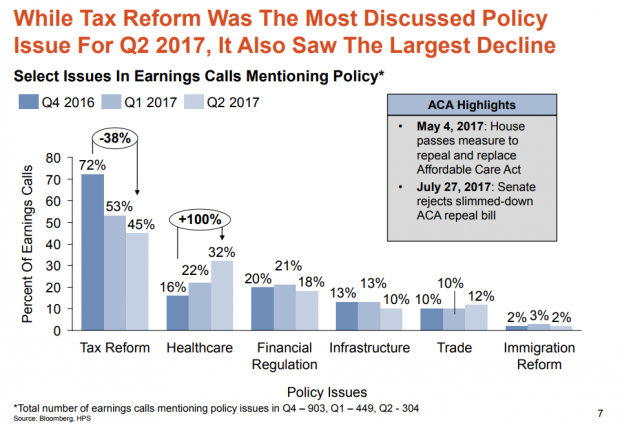
Hamilton Place Strategies, a public affairs consulting firm, analyzed transcripts of earnings calls by publicly traded U.S. companies over the last three quarters. They found that tax reform was the policy issue companies discussed most on those calls with Wall Street analysts — but that mentions of the subject dropped by 38 percent from the fourth quarter of 2016 to the second quarter of 2017. Overall, the percentage of earnings calls mentioning government or policy issues fell from 41 percent to 16 percent. Health-care reform saw the largest increase.
Does this mean that businesses have given up on tax reform this year? Perhaps. More likely, it's simply the result of a lack of action on the tax overhaul. Hamilton Place notes that mentions of tax policy peaked in February just after the Senate Finance Committee advanced Treasury Secretary Steven Mnuchin's nomination and have spiked after other tax-related announcements. So mentions of tax reform on earnings calls could surge again the fall.
One other note about what businesses have been discussing: Calls mentioning President Trump fell by 84 percent from January to late August.
08312017_HPS_Chart_of_the_day.PNG