
Your Airplane Carry-on Bag Is About to Shrink
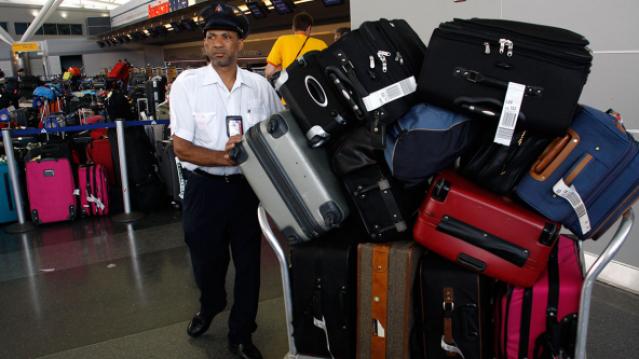
Are you one of those people who likes to brag about how you can fit a week’s worth of stuff into your carry-on suitcase? If so, your job is about to get harder.
The International Air Transport Association, a trade group representing some 250 airlines, has introduced a proposal to reduce the maximum allowable carry-on suitcase size. Under the proposed rule change, carry-on bags would have to be less than 21.5 x 13.5 x 7.5 inches. Current rules for carry-on size vary by airline, but they’re generally larger than that.
The organization claims that this would allow all passengers on a plane to store their bags in the cabin. “The development of an agreed optimal cabin bag size will bring common sense and order to the problem of differing sizes for carry-on bags,” IATA Senior Vice President for Airport, Passenger and Cargo Security said in a statement. “We know the current situation can be frustrating for passengers.
Related: 6 Sneaky Fees That Are Making Airlines a Bundle
Several major airlines have signaled interest in introducing the guidelines, according to IATA. Luggage manufacturers will start labeling bags that meet the new criteria as “IATA Cabin OK.”
The rule change may force more consumers to check luggage and pay the checked-bag fees many airlines have introduced in the past few years. Airlines typically charge $25 for the first bag, $35 for the second, and more than $100 for a third bag.
Some airlines, including Spirit, Allegiant and Frontier, also charge passengers for carry-on bags.
Budget ‘Chaos’ Threatens Army Reset: Retired General
One thing is standing in the way of a major ongoing effort to reset the U.S. Army, writes Carter Ham, a retired four-star general who’s now president and CEO of the Association of the U.S. Army, at Defense One. “The problem is the Washington, D.C., budget quagmire.”
The issue is more than just a matter of funding levels. “What hurts more is the erratic, unreliable and downright harmful federal budget process,” which has forced the Army to plan based on stopgap “continuing resolutions” instead of approved budgets for nine straight fiscal years. “A slowdown in combat-related training, production delays in new weapons, and a postponement of increases in Army troop levels are among the immediate impacts of operating under this ill-named continuing resolution. It’s not continuous and it certainly doesn’t display resolve.”
Pentagon Pushes for Faster F-35 Cost Cuts
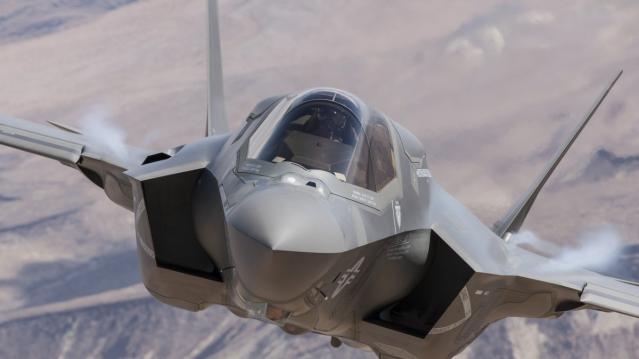
The Pentagon has taken over cost-cutting efforts for the F-35 program, which has been plagued by years of cost overruns, production delays and technical problems. The Defense Department rejected a cost-saving plan proposed by contractors including principal manufacturer Lockheed Martin as being too slow to produce substantial savings. Instead, it gave Lockheed a $60 million contract “to pursue further efficiency measures, with more oversight of how the money was spent,” The Wall Street Journal’s Doug Cameron reports. F-35 program leaders “say they want more of the cost-saving effort directed at smaller suppliers that haven’t been pressured enough.” The Pentagon plans to cut the price of the F-35A model used by the Air Force from a recent $94.6 million each to around $80 million by 2020. Overall, the price of developing the F-35 has climbed above $400 billion, with the total program cost now projected at $1.53 trillion. (Wall Street Journal, CNBC)

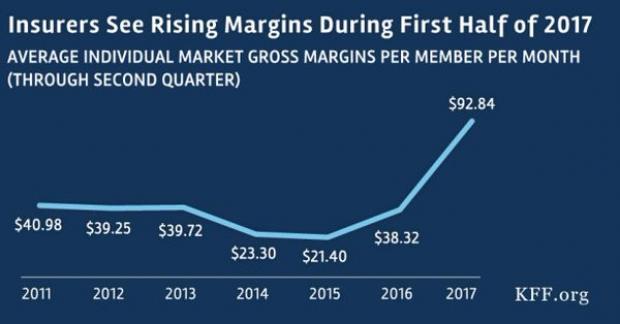
Chart of the Day - October 6, 2017
Financial performance for insurers in the individual Obamacare markets is improving, driven by higher premiums and slower growth in claims. This suggests that the market is stabilizing. (Kaiser Family Foundation)
Quote of the Day - October 5, 2017
"The train's left the station, and if you're a budget hawk, you were left at the station." -- Rep. Mark Sanford, R-S.C.