The 10 Friendliest Cities in the U.S.

The friendliest city for visitors is Honolulu, according to more than 6,400 respondents in a newly released poll by Travelzoo.
Survey takers were asked to pick the cities, states and countries where they felt the most welcome, could easily ask for directions, and get dining recommendations. New York City came in second, followed by New Orleans.
Last year was a record-breaking year for tourism, and the numbers confirm the popularity of these destinations for travelers. In 2014, 8.3 million visitors came to the Aloha State, with total visitor expenditures estimated at $14.7 billion. On average, 205,044 visitors are in the state of Hawaii on any given day.
Related: They’re Leaving Las Vegas: Fewer I Do’s in Last Decade
New York City, where tourism also hit a record high in 2014 with 56.4 million visitors streaming into the Big Apple, claimed the second spot in the poll.
Third place New Orleans has 9.52 million visitors and tourism spending of $6.81 billion in 2014. Fourth place Las Vegas also broke tourism records with 40 million visitors last year, thanks to renovated and rebranded resorts and direct flights from Canada and Mexico. Boston rounded out the top five, with a total of 16,250,000 international and domestic visitors in 2014.
Here are the top 10 friendly cities:
- Honolulu
- New York
- New Orleans
- Las Vegas
- Boston
- San Diego
- San Francisco
- Charleston, S.C.
- Chicago
- Seattle
Travelzoo also ranked states for friendliness, with warm climes dominating the list. In the top spot was Florida, followed by California and Hawaii. New York and Maine were the only states from the Northeast to make the list.
- Florida
- California
- Hawaii
- New York
- Texas
- South Carolina
- Maine
- Georgia
- Washington
- Arizona
In Europe, Amsterdam, London, and Dublin were considered the friendliest cities to visit, with Italy and Ireland seen as the friendliest countries.
Trump and Schumer Will Try to Scrap the Debt Ceiling
The president and the Senate Democratic leader agreed to seek out a more permanent debt ceiling solution that would end the perpetual cycle of fiscal standoffs. “There are a lot of good reasons to do that, so certainly that’s something that will be discussed," Trump said Thursday. It might not be easy, though, as conservatives see the borrowing limit as a way to keep government spending in check. Paul Ryan said Thursday he opposes doing away with the debt ceiling.
Is a Fix for Obamacare Taking Shape?
Senators on the Committee on Health, Education, Labor and Pensions heard from governors Thursday in the second of four scheduled hearings on stabilizing Obamacare. The common theme emerging from the testimony was flexibility: "Returning control to the states is prudent policy but also prudent politics," said Utah Gov. Gary Herbert, a Republican. He was joined by Democrat John Hickenlooper of Colorado, who said that states need room to innovate and learn from their mistakes. Much of what the governors said was in line with what the Senate panel is already considering, including the continuation of cost-sharing subsidies to insurance companies. (CBS News, Axios)
Senate Approves Trump's Deal with Dems. Will the House Go Along?
The Senate on Thursday voted to fund the government and increase the federal borrowing limit through December 8 as part of a deal that also included $15.25 billion in hurricane disaster relief funding and a short-term extension of the National Flood Insurance Program. The bill passed by a vote of 80-to-17, with only Republicans voting against the bill.
The package now goes back to the House, where it likely faces more strenuous resistance. The Republican Study Committee, a conservative caucus with more than 155 members, on Thursday announced it opposed the deal because it does not include spending cuts. Rep. Mark Walker, the group's chairman, sent a letter to House Speaker Paul Ryan listing 19 policy changes to "address the growing debt burden" or "begin draining the swamp" that could win conservative support for raising the debt ceiling. Some Democrats may also vote against the deal to signal their frustration with an agreement that they say weakened their hand in trying to protect undocumented immigrants who were brought into the country as children.
White House Backs Off Shutdown Threat…for Now
“Believe me, if we have to close down our government, we’re building that wall,” President Trump said of his planned border wall with Mexico 10 days ago. Just two days later, though, White House officials told Congress that a short-term spending bill to fund the government into December wouldn’t have to include $1.6 billion for the wall, The Washington Post reports.
Trump still wants money for the wall to be included in a December budget bill, and he could follow through on his shutdown threat at that point. For now, though, an agreement on a “continuing resolution” to keep the government running after September 30 seems likelier, allowing Congress to deal with some of the other pressing issues it faces this month.
Which Trump Agenda Items Are Companies Talking About With Wall Street?

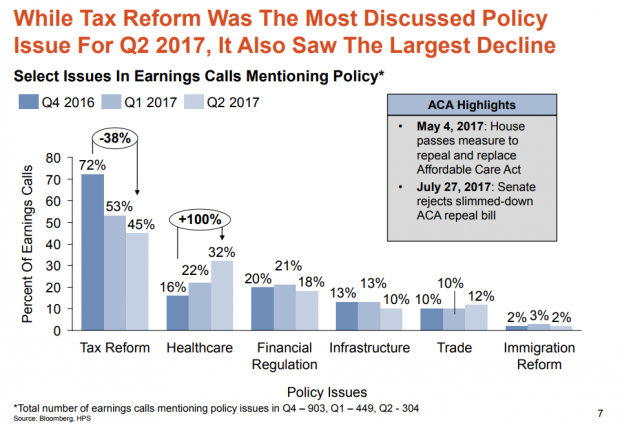
Hamilton Place Strategies, a public affairs consulting firm, analyzed transcripts of earnings calls by publicly traded U.S. companies over the last three quarters. They found that tax reform was the policy issue companies discussed most on those calls with Wall Street analysts — but that mentions of the subject dropped by 38 percent from the fourth quarter of 2016 to the second quarter of 2017. Overall, the percentage of earnings calls mentioning government or policy issues fell from 41 percent to 16 percent. Health-care reform saw the largest increase.
Does this mean that businesses have given up on tax reform this year? Perhaps. More likely, it's simply the result of a lack of action on the tax overhaul. Hamilton Place notes that mentions of tax policy peaked in February just after the Senate Finance Committee advanced Treasury Secretary Steven Mnuchin's nomination and have spiked after other tax-related announcements. So mentions of tax reform on earnings calls could surge again the fall.
One other note about what businesses have been discussing: Calls mentioning President Trump fell by 84 percent from January to late August.
08312017_HPS_Chart_of_the_day.PNG