
Why Believing Donald Trump Will Be the GOP Nominee Is Delusional
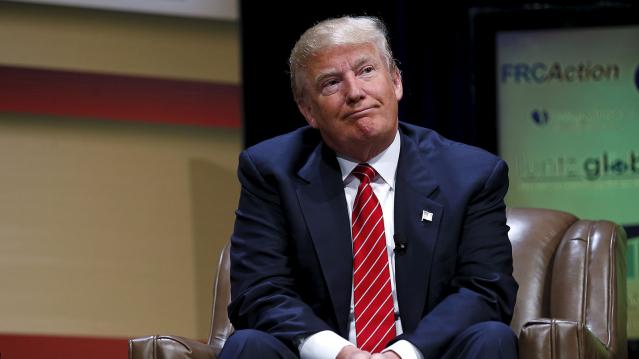
Despite his commanding lead at this early stage among GOP candidates, the 2016 nomination is anyone’s game.
It is risky to put too much stock in the latest findings, including the NBC/Wall Street Journal poll released Sunday. That’s because the national telephone survey of 1,000 adults included only 252 registered voters who said they would vote for a Republican, and the poll has a margin of error of plus or minus 6.17 points.
Related: Why Jeb Bush’s Pragmatic Immigration Plan Has No Chance of Passing in the House
There are plenty of downsides to Trump’s candidacy – including his threat to mount a third-party campaign if he is denied the Republican nomination -- which has alarmed GOP leaders who are looking down the road to the general election.
Trump has the highest negatives of any of the top tier candidates, and a majority of Americans in the survey said they think Trump is hurting the Republican Party. Not surprisingly, the vast majority of Democrats interviewed said Trump was harming his party’s image, but nearly half the Republicans interviewed said the same thing.
Political analyst Nate Silver notes that Trump ranks just 13th in overall favorability among Republicans in a series of national polls. “If you’re going to imply that a candidate is popular based on their receiving 20 percent of the vote, you ought to consider what the other 80 percent thinks about him,” Silver wrote recently in his FiveThirtyEight blog. “Most Republicans who don’t plan to vote for Trump are skeptical of him instead.”
Related: Donald Trump Just Showed Why His Campaign Is Doomed
What’s more, about three in four Latinos said they have a negative view of Trump – and that more than half consider his comments about lawless Mexican immigrants to be racist or highly inappropriate, according to a separate NBC News/Wall Street Journal Telemundo poll released today.
The survey of 250 Hispanic-American voters revealed widespread hostility towards Trump, with only 13 percent saying they have a positive view of him.
The Republican presidential frontrunner has said repeatedly that many Latino voters “love” and support him, and that he would win the majority of that vote if he ends up as his party’s nominee. There is little evidence in this poll to suggest Trump is dealing with reality.
Top Reads from The Fiscal Times:
- Clinton Tries to Change the Narrative with First Two Campaign Ads
- Super PAC or Not-so-Super PAC? The Difference Between Jeb and Bernie
- States Are Finally Overcoming the Fiscal Headwinds
Comcast to Cut the Cord with Time Warner
Comcast is dropping its merger with Time Warner after a year of regulatory pushback, according to Bloomberg. The news wire's unnamed sources say there will be an announcement tomorrow.
In today's changing media landscape it is not really clear what the preemptive breakup of a media megacorp (formed from mere media titans) will mean for consumers, especially in the face of Verizon's push to slim down its bundled offerings, the new ala carte service from HBO and the continued expansion of Netflix's original programming. As more and more people cut the cord, the market for traditional cable TV is eroding, and more consumers opt simply for an Internet connection.
Even without that, Comcast dropping its deal probably will have no impact at all for the average cable subscriber, given the already segregated monopolies allowed individual cable companies. So, unless you own stock in either of these companies, this is pretty much just more status quo in a rapidly changing market.
Can Low Self-Control Turn You Into Edward Snowden?

Be very wary if your employer asks you to take a test and then says please put on this cap. The cap could have sensors measuring your “self-control,” which researchers at Iowa State University have connected to—cybersecurity.
Yup—this wasn’t about eating the last cookie, having sex with a stranger, or taking a hit from some unknown new drug just because your friend said it was an amazing experience. The test measures how long someone hesitates before doing something risky or wrong.
Hmm. Maybe I’ll wait a few seconds before robbing that jewelry store! If they waited, the researchers determined that the employees were considering the consequences of their actions and therefore had higher self-control than those who simply filled their duffle bag with whatever bling was in sight.
Those with higher self-control were deemed better cyber security risks than the low self-control group.
But who knows? Maybe the high group was just casing the joint and calculating how much they could carry without getting caught. Or maybe they were searching for the largest unflawed diamond in the case that could be hidden in their pocket!
So much for brainwaves.
These Students Are Making Even More Than They Expect After Graduation
College students who major in STEM fields generally know that they can make more money than their peers once they graduate, but they don’t know how much more.
Turns out, those students majoring in science, technology, engineering and math, actually have starting salaries that are higher than expected, according to a new report by the National Association of Colleges and Employers.
Engineering majors, for example, expect to earn $56,000, but actually receive 15.5 percent more than that, with starting salaries average nearly $65,000. Computer Science majors expect to make around $51,000, but receive 22 percent for an average starting salary of $62,000.
Chemistry majors have the largest gap between expectations and reality: They expect to earn an average of $39,000 but take home an average $58,000 in their first year, a 51 percent increase.
Related: The Closing of the Millennial Mind on Campus
The typical college graduate in 2014 received a starting salary of $48,000. Liberal arts and humanities majors had the lowest starting salary, with an average of just $39,000, according to NACE.
Not only do STEM majors enjoy higher salaries, but they can also expect more job security and better job prospects. All of the top 25 jobs recently compiled by U.S. News and World Report fell into either a science- or math-based discipline.
Still, not everyone has the interest or aptitude to excel in a STEM career. A third of those who begin their college career majoring in those fields end up transferring to a difference study area, according to a recent report by RTI International.
Will Obama Send a Smoke Signal About Weed?

The resignation of Michele M. Leonhart, chief of the Drug Enforcement Administration, just one day after 4/20 -- which is sort of Thanksgiving for stoners -- offers President Obama an opportunity to replace her with someone who shares his relatively benign view of marijuana.
The right appointment might also be a gift to Hillary Rodham Clinton since it would signal to younger voters that it's not just libertarian-leaning Republicans like Senator Rand Paul of Kentucky who want to decriminalize the use of pot.
Representative Early Blumenauer, an Oregon Democrat, told The New York Times that Obama should appoint someone who "understands the federal approach to marijuana isn't working."
Related: How to Stop Cyber Attacks: Let Workers Smoke Pot
The flashpoint that led to the departure of Leonhart after a 35-year career at the D.E.A. was a congressional hearing that revealed agency agents in Colombia had taken part in parties with prostitutes paid by drug cartels. But Leonhart, who has lumped marijuana in with crack, meth and heroin, found herself at odds with the President, who has called pot no more dangerous than alcohol.
“Hopefully this is a sign that the Reefer Madness era is coming to an end at the D.E.A.,” Mason Tvert, the director on communications at the Marijuana Policy Project, told Bloomberg Politics.
How to Stop Cyber Attacks: Let Workers Smoke Pot

What’s true for the government is true for business. FBI Director James Comey thinks you can’t hire top tech talent with a ban on weed. It all started in the Reagan administration, which imposed a no-hire policy for applicants who toked up within the past three years. Good luck with that.
In 2014, Comey raised the issue during a speech: “A lot of the nation’s top computer programmers and hacking gurus are also fond of marijuana. I have to hire a great workforce to compete with those cyber criminals and some of those kids want to smoke weed on the way to the interview.”
That’s not the only reason the government can’t hire competent programmers and white hat hackers. They come at a high price, there’s a shortage, and they hate red tape and bureaucratic annoyances. For some lawmakers, though, it’s easier to get lost in the weed than try to reform the federal hiring process. That’s why Gerry Connolly (D-VA) and Earl Blumenauer (D-OR) have two proposals in the House requiring info from the intelligence director on how classifying pot as Schedule 1 narcotic crimps the feds recruiting efforts.