
GOP Governor Asks Voters to Raise Their Own Taxes
Michigan voters go to the polls today to vote on Proposal 1, a referendum that would hike the state sales and gasoline taxes. An unexpected twist in the story, though, is who is backing the plan and why. Support for the proposal speaks to the declining state of infrastructure in the U.S. and the increasing urgency with which states are taking matters into their own hands.
Proposal 1 is a complex mix of policy changes that would raise more than a billion dollars to fund road construction and repair, plus hundreds of millions for education and other purposes. It would do so by hiking the Michigan state sales tax from 6 percent to 7 percent. That represents a 17 percent increase in total sales taxes Michiganders will face on taxable items.
Related: America’s Energy Infrastructure in Desperate Shape
However, the bill also abolishes the sales tax on gasoline – Michigan is one of the few states in which gas is not exempt from state sales tax – and would dramatically increase the wholesale gasoline tax. The net effect, according to the Detroit Free Press, would be an increase of between 7 and 9 cents per gallon in what consumers pay at the pump. The proposal would net about $1.9 billion per year for the state’s coffers, the majority of it coming out of the pockets of Michigan’s taxpayers. (A small percentage would come from out-of-state visitors paying taxes on items purchased in Michigan.)
Normally, a $2 billion tax hike – the biggest in the state in a generation – would be the sort of thing Republican politicians would attack mercilessly, but in Michigan, Republican Governor Rick Snyder is a strong proponent of the deal. And Snyder isn’t alone. Prominent Republican and Democratic lawmakers have thrown their support behind the measure.
Related: Get Ready to Pay More Tolls If Infrastructure Isn’t Funded
The move also has significant support from the business community. Unsurprisingly, the biggest backers of the deal are the construction companies and related industries. But there is also support in the general business community, even among some companies whose products would be more expensive.
Even with substantial support from legislative leaders and businesses, though, the prospects for Proposal 1 looked poor heading into the vote today Public opinion remains generally against the proposition despite a multimillion-dollar advertising campaign by supporters that has dwarfed efforts by the opposition.
Should the vote fail, though, the state’s pothole-pocked roads and crumbling bridges won’t fix themselves, so legislators will have to find the revenue somewhere, either by increasing taxes via a different route, or cutting spending from an already tight state budget.
Economists See More Growth Ahead

Most business economists in the U.S. expect the economy to keep chugging along over the next three months, with rising corporate sales driving additional hiring and wage increases for workers.
The tax cuts, however, don’t seem to be playing a role in hiring and investment plans. And the trade conflicts stirred up by the Trump administration are having a negative influence, with the majority of economists at goods-producing firms who replied to the most recent survey by the National Association for Business Economics saying that their companies were putting investments on hold as they wait to see how things play out.
New Tax on Non-Profits Hits Public Universities

The Republican tax bill signed into law late last year imposed a 21 percent tax on employees at non-profits who earn more than $1 million a year. According to data from the Chronicle of Higher Education cited by Bloomberg, there were 12 presidents of public universities who received compensation of at least $1 million in 2017, with James Ramsey of the University of Louisville topping the list at $4.3 million. Endowment managers could also get hit with the tax, as could football coaches, some of whom earn substantially more than the presidents of their institutions.
Government Revenues Drop as Tax Cuts Kick In
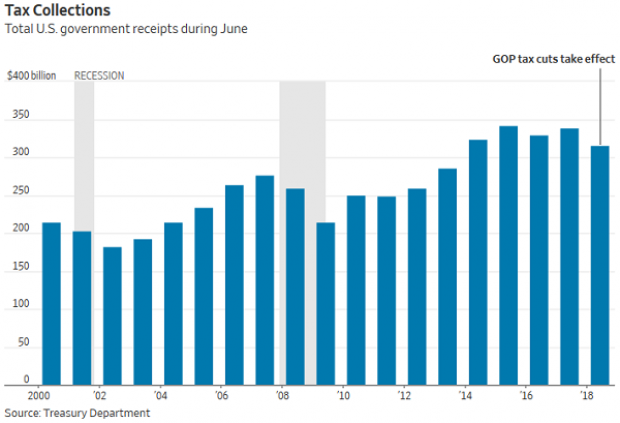
Corporate tax receipts in June were 33 percent lower than a year ago, according to data released by the Treasury Department Thursday, as companies made smaller estimated payments due to the reduction in their tax rates. Total receipts were down 7 percent, while payroll taxes were 5 percent lower compared to June 2017.
“June receipts to US government were our first mostly-clear look at the revenue effects of the new tax law, with lots of estimated payments and little noise from the 2017 tax year,” The Wall Street Journal’s Richard Rubin tweeted Friday.
Surprisingly, the deficit was smaller in June compared to a year ago, narrowing to $74.86 billion from $90.23 billion last year. The drop was driven by a 9 percent reduction in government outlays that reflected accounting changes rather than any real changes in spending, Rubin said in the Journal.
“More broadly, the federal deficit is swelling as government spending outpaces revenues,” Rubin wrote. “The budget gap totaled $607.1 billion in the first nine months of the 2018 fiscal year, 16% larger than the same point a year earlier.”
Kyle Pomerleau of the Tax Foundation pointed out that the drop in corporate tax receipts is a permanent feature of the Republican tax cuts, tweeting: “Even in a Trump dream world in which these cuts paid for themselves, corporate tax collections would remain below baseline forever. It would be higher income and payroll receipts that made up the difference.”
Deficit Jumps in Trump’s First Fiscal Year

The federal budget deficit rose by 16 percent in the first nine months of the 2018 fiscal year, which began last October. The shortfall came to $607 billion, compared to $523 billion in the same period the year before, according to a U.S. Treasury report released Thursday and reported by Bloomberg. Both revenue and spending rose, but spending rose faster. Revenues came to $2.54 trillion, up 1.3 percent from the same nine-month period in 2017, while spending came to $3.15 trillion, up 3.9 percent.
Where’s the Obamacare Navigator Funding for 2019, PA Insurance Commissioner Asks
Pennsylvania’s insurance commissioner sent a letter this week to Health and Human Services Secretary Alex Azar and Centers for Medicare and Medicaid Services (CMS) Administrator Seema Verma requesting that they “immediately release the funding details for the Navigator program for the upcoming open enrollment period for 2019.” Navigators are the state and local groups that help people sign up for Affordable Care Act plans.
“In years past, grant applications and new funding opportunities were released by CMS in April, CMS required Navigator organizations to apply by June and approved applications and new funding by late August,” Pennsylvania’s Jessica Altman wrote. “The current lack of guidance has put Navigator organizations – and states - far behind in their planning and creates an inability for the Navigator organizations to design a successful plan for helping people enroll during the 2019 open enrollment period.”