
The Rapidly Rising Death Toll of the Heroin Epidemic

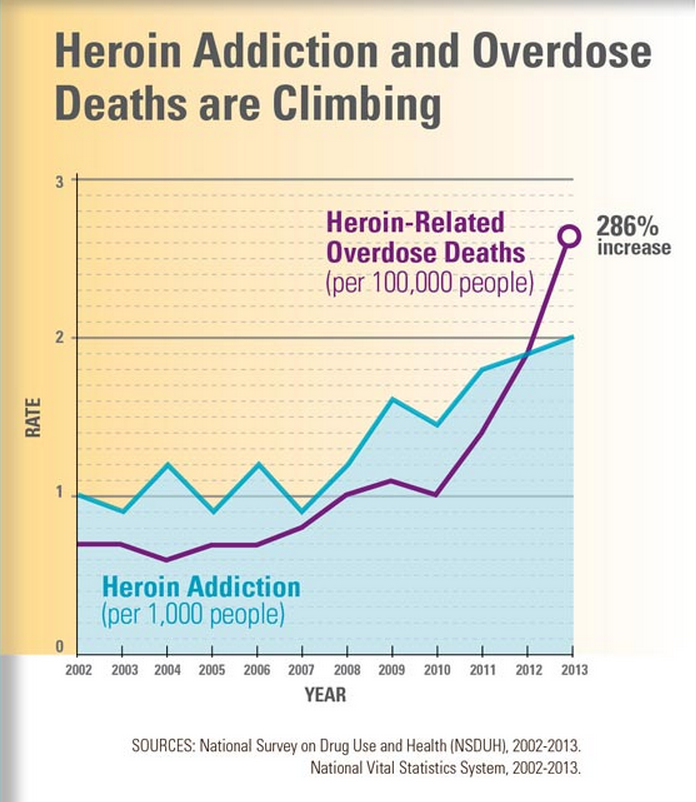
The death toll from the heroin epidemic has been climbing dramatically in recent years — and the annual rate of overdose deaths nearly doubled between 2011 and 2013, according to a new CDC study.
From 2002 through 2013, heroin use in the United States rose by 63 percent, and the rate of abuse or dependence climbed a staggering 90 percent. Deaths from heroin-related overdoses nearly quadrupled, with more than 8,200 people dying in 2013 alone.
The CDC report says that heroin use has increased across most demographic groups — men and women, most age groups, and across all income levels. Rates of heroin use are still highest among men, those ages 18 to 25, people with income less than $20,000 a year, people in urban areas, and those who do not have health insurance or are on Medicaid. But other groups are turning to the drug, too. “Some of the greatest increases occurred in demographic groups with historically low rates of heroin use: women, the privately insured and people with higher incomes,” the CDC says.
The heroin trend isn’t happening in isolation, the CDC study says. Almost all heroin users — 96 percent — also took at least one other drug, and 61 percent used at least three other drugs. Abuse or dependence on opioid painkillers is the strongest risk-factor for heroin use or addiction, the report says, with cocaine addiction also high on the list. People who are addicted to prescription opioid painkillers are 40 times more likely to use or be addicted to heroin, and 45 percent of people who used heroin were also addicted to painkillers.
Another key reason is that heroin is becoming cheaper and more widely available. According to the DEA, the increase in heroin seizures in the U.S. from 2010 and 2014 rose 81 percent, from 2,763 kilograms to 5,014 kilograms. More and more law enforcement agencies are identifying heroin as their primary drug threat, but the CDC report suggests that health care workers focus on reducing the abuse of painkillers by improving prescribing practices.
The study also recommends that states increase access to “medication-assisted treatment” programs that use methadone, buprenorphine and naltrexone along with behavioral counseling. And it says the rapid rise in heroin-related deaths highlights an “urgent need” to broaden access to naloxone, a drug that can reverse the effects of heroin and opioid overdose.
Number of the Day: 51%
More than half of registered voters polled by Morning Consult and Politico said they support work requirements for Medicaid recipients. Thirty-seven percent oppose such eligibility rules.
Martin Feldstein Is Optimistic About Tax Cuts, and Long-Term Deficits
In a new piece published at Project Syndicate, the conservative economist, who led President Reagan’s Council of Economic Advisers from 1982 to 1984, writes that pro-growth tax individual and corporate reform will get done — and that any resulting spike in the budget deficit will be temporary:
“Although the net tax changes may widen the budget deficit in the short term, the incentive effects of lower tax rates and the increased accumulation of capital will mean faster economic growth and higher real incomes, both of which will cause rising taxable incomes and lower long-term deficits.”
Doing tax reform through reconciliation — allowing it to be passed by a simple majority in the Senate, as long as it doesn’t add to the deficit after 10 years — is another key. “By designing the tax and spending rules accordingly and phasing in future revenue increases, the Republicans can achieve the needed long-term surpluses,” Feldstein argues.
Of course, the big questions remain whether tax and spending changes are really designed as Feldstein describes — and whether “future revenue increases” ever come to fruition. Otherwise, those “long-term surpluses” Feldstein says we need won’t ever materialize.
JP Morgan: Don’t Expect Tax Reform This Year
Gary Cohn, President Trump’s top economic adviser, seems pretty confident that Congress can produce a tax bill in a hurry. He told the Financial Times (paywall) last week that the Ways and Means Committee should be write a bill “in the next three of four weeks.” But most experts doubt that such a complicated undertaking can be accomplished so quickly. In a note to clients this week, J.P. Morgan analysts said they don’t expect to see a tax bill passed until mid-2018, following months of political wrangling:
“There will likely be months of committee hearings, lobbying by affected groups, and behind-the-scenes horse trading before final tax legislation emerges. Our baseline forecast continues to pencil in a modest, temporary, deficit-financed tax cut to be passed in 2Q2018 through the reconciliation process, avoiding the need to attract 60 votes in the Senate.”
Trump Still Has No Tax Reform Plan to Pitch
Bloomberg’s Sahil Kapur writes that, even as President Trump prepares to push tax reform thus week, basic questions about the plan have no answers: “Will the changes be permanent or temporary? How will individual tax brackets be set? What rate will corporations and small businesses pay?”
“They’re nowhere. They’re just nowhere,” Henrietta Treyz, a tax analyst with Veda Partners and former Senate tax staffer, tells Kapur. “I see them putting these ideas out as though they’re making progress, but they are the same regurgitated ideas we’ve been talking about for 20 years that have never gotten past the white-paper stage.”
The Fiscal Times Newsletter - August 28, 2017
|


