
The Rapidly Rising Death Toll of the Heroin Epidemic

The death toll from the heroin epidemic has been climbing dramatically in recent years — and the annual rate of overdose deaths nearly doubled between 2011 and 2013, according to a new CDC study.
From 2002 through 2013, heroin use in the United States rose by 63 percent, and the rate of abuse or dependence climbed a staggering 90 percent. Deaths from heroin-related overdoses nearly quadrupled, with more than 8,200 people dying in 2013 alone.
The CDC report says that heroin use has increased across most demographic groups — men and women, most age groups, and across all income levels. Rates of heroin use are still highest among men, those ages 18 to 25, people with income less than $20,000 a year, people in urban areas, and those who do not have health insurance or are on Medicaid. But other groups are turning to the drug, too. “Some of the greatest increases occurred in demographic groups with historically low rates of heroin use: women, the privately insured and people with higher incomes,” the CDC says.
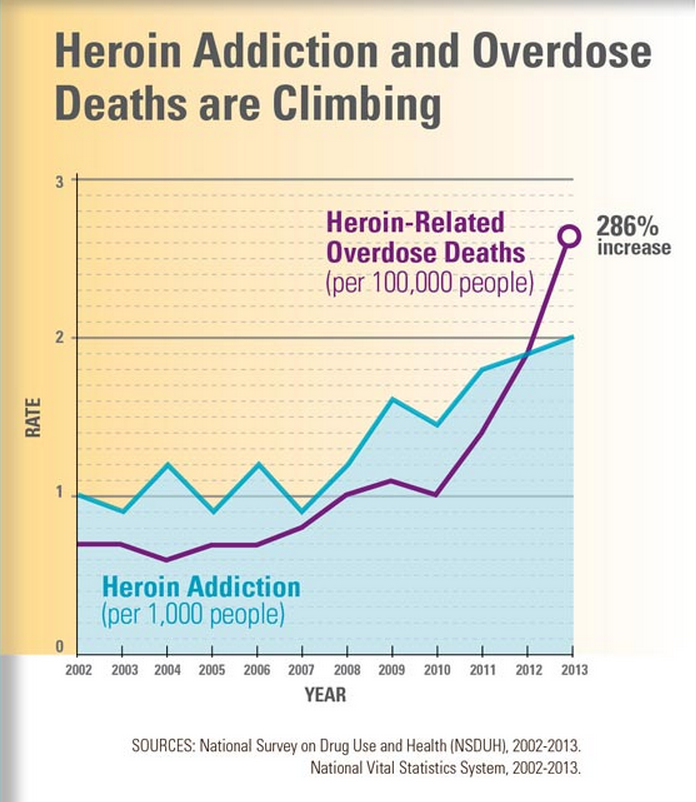
The heroin trend isn’t happening in isolation, the CDC study says. Almost all heroin users — 96 percent — also took at least one other drug, and 61 percent used at least three other drugs. Abuse or dependence on opioid painkillers is the strongest risk-factor for heroin use or addiction, the report says, with cocaine addiction also high on the list. People who are addicted to prescription opioid painkillers are 40 times more likely to use or be addicted to heroin, and 45 percent of people who used heroin were also addicted to painkillers.
Another key reason is that heroin is becoming cheaper and more widely available. According to the DEA, the increase in heroin seizures in the U.S. from 2010 and 2014 rose 81 percent, from 2,763 kilograms to 5,014 kilograms. More and more law enforcement agencies are identifying heroin as their primary drug threat, but the CDC report suggests that health care workers focus on reducing the abuse of painkillers by improving prescribing practices.
The study also recommends that states increase access to “medication-assisted treatment” programs that use methadone, buprenorphine and naltrexone along with behavioral counseling. And it says the rapid rise in heroin-related deaths highlights an “urgent need” to broaden access to naloxone, a drug that can reverse the effects of heroin and opioid overdose.
About 90% of Trump Counties Have Received Trade War Farm Aid

President Trump won more than 2,600 of the nation’s 3,000-plus counties in the 2016 election, and residents in nearly 90% of those counties – or more than 2,300 – have received some level of aid from the administration’s Market Facilitation Program, a $16 billion effort that compensates farmers for losses incurred as a result of Trump’s trade war with China.
Drawing on a new report from the Environmental Working Group, The Washington Post’s Philip Bump says the data “show the extent to which [the farm] subsidies overlap with Trump’s base of political support.”
To be fair, about 80% of the counties Hillary Clinton won also received some degree of aid, Bump says, but there are many fewer of them, given the concentration of her supporters in urban areas.
Overall, residents in more than 2,600 counties in the U.S. have received payments from the farm aid program, with the heaviest concentration in the Midwest.
Number of the Day: $1.57

A new study from the Bipartisan Policy Center says that Medicare would save $1.57 for every dollar it spends delivering healthy food to elderly beneficiaries who have recently been discharged from the hospital. The savings would come from a reduction in the rate of readmissions to the hospital for patients suffering from a wide range of common ailments, including rheumatoid arthritis, congestive heart failure, diabetes and emphysema.
“If you were going to offer meals to every Medicare beneficiary, it would be cost-prohibitive,” said BPC’s Katherine Hayes. “By targeting it to a very, very sick group of people is how we were able to show there could be savings.”
Budget Deal Moving Ahead, Despite Outrage on the Right
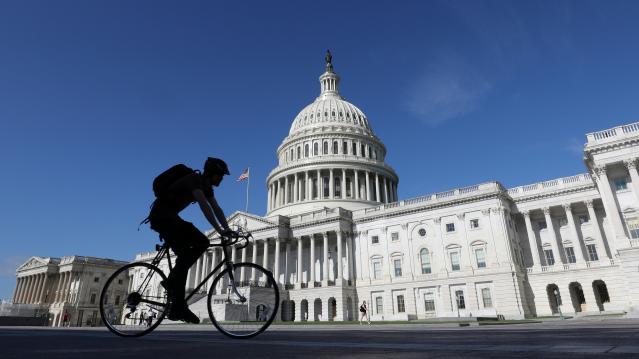
The bipartisan deal to suspend the debt ceiling and increase federal spending over the next two years will get a vote in the House on Thursday, House Majority Leader Steny Hoyer (D-MD) said late Tuesday. Leaders in both parties have expressed confidence that the bill will pass before lawmakers leave town for their August recess.
"We're gonna pass it," Hoyer told reporters. "I think we'll get a good number [of votes]. I don't know if it's gonna be huge, but we're gonna pass it."
President Trump announced that he backs the deal, removing one possible hurdle for the bill. “Budget Deal gives great victories to our Military and Vets, keeps out Democrat poison pill riders. Republicans and Democrats in Congress need to act ASAP and support this deal,” he tweeted Tuesday evening.
Despite widespread agreement that the bill will pass, however, not everyone is on board.
Grumbles from the left: Some progressive Democrats have been critical of the deal, portraying it as too easy on Republicans. Worried that the agreement could set up a budget crisis in 2021, Rep. Ro Khanna (D-CA) said he was “concerned that it was a two-year deal. Why not a one year deal?... It seems like it’s basically handcuffing the next president.” Other liberals, noting that Democratic leaders have agreed to avoid “poison pill” riders on controversial issues such as abortion and funding for the border wall in the funding bills that must pass this fall, lamented their loss of leverage in those negotiations.
Outrage on the right: Resistance to the deal was more pronounced on the right, with the hardline House Freedom Caucus announcing Tuesday that it would not support the bill due to concerns about the growing national debt. “Our country is undeniably headed down a path of fiscal insolvency and rapidly approaching $23 trillion in debt. … All sides should go back to the drawing board and work around the clock, canceling recess if necessary, on a responsible budget agreement that serves American taxpayers better—not a $323 billion spending frenzy with no serious offsets,” the 31-member group said in a statement.
The deficit hawks at the Committee for Responsible Federal published “Five Reasons to Oppose the Budget Deal,” which include its purported $1.7 trillion cost over 10 years. CRFB noted that the agreement would increase discretionary spending by 21 percent during President Trump’s first term, pushing such spending to near-record levels.
Sen. John Kennedy (R-LA) was more colorful in his criticism, saying, “You don’t have to be Euclid to understand the math here. We’re like Thelma and Louise in that car headed toward the cliff.” Nevertheless, Kennedy said he would consider supporting the deal.
Is the deficit hawk dead? The budget deal represents “the culmination of years of slipping fiscal discipline in Washington,” said Robert Costa and Mike DeBonis of The Washington Post, and it highlights the declining influence of fiscal conservatives in the capital, at least as far as policy is concerned. Sen. James Lankford (R-OK) said the Republican Party’s credibility on fiscal restraint is “long gone.”
Although it may be too early to declare the fiscal hawk extinct – plenty of critics say the bird will return as soon as there’s a Democratic president – it certainly seems to be in ill health. As the University of Virginia's Larry Sabato said Wednesday: “A battered bird has been named to the list of endangered species. The ‘deficit hawk’ is on the road to extinction. Rarely spotted around Washington, D.C., the deficit hawk’s last remaining habitat is found in some state capitals.”
Some Republicans said that fiscal conservatism was never really a core Republican value, dating back to President Reagan’s tax-cut-and-spend policies, and that Paul Ryan’s emphasis on fiscal issues was an aberration. “It was never the party of Paul Ryan,” former House Speaker Newt Gingrich told the Post. “He’s a brilliant guy, but he filled a policy gap. The reality here is that Republicans were never going to get spending cuts with Speaker Pelosi running the House, and they didn’t want an economic meltdown or shutdown this summer.”
Is the whole debate missing the point? William Gale of the Brookings Institution, who served on President George H.W. Bush’s Council of Economic Advisers, said he wasn’t sure why the budget deal was producing so much hostility, since it basically maintains the status quo and – more importantly – is focused solely on discretionary spending. “There *is* a long-term budget issue,” Gale tweeted Tuesday, “but cutting [discretionary spending] is not the way to go.”
Instead, Gale says that any serious fiscal plan must focus on the mandatory side of the ledger, where the rapidly increasing costs of health care and retirement are straining against revenues reduced by repeated rounds of tax cuts. Gale recommends a combination of entitlement reductions and revenue increases – a standard mix of policy options that faces an uncertain future, with well-entrenched interest groups standing opposed to movement in either direction.
News & Views
Here's what we have our eye on today:
- Trump Wants a ‘Phase Two’ of Tax Cuts – CNBC
- Congress Has Until March 23 to Fund the Government. Three Ways This Could Go – Vox
- The First Target on Drug Prices: Pharmacy Benefit Managers – Axios
- No One’s Sure Who Qualifies for This $415 Billion U.S. Tax Deduction – Bloomberg
- Companies Are Putting Tax Savings in the Pockets of Shareholders – CNBC
- Conservative Groups Warn Against Obamacare 'Bailout' in Spending Bill – The Hill
- Trump to Visit Boeing Plant in Missouri to Tout Impact of Tax Overhaul – Reuters
- U.S. DOT Announces TIGER Grants Totaling Nearly $500 Million – Route Fifty
- Are You Underpaid? In a First, U.S. Firms Reveal How Much They Pay Workers – Wall Street Journal
- How Much Do America’s Arms Makers Depend on Foreign Metal? No One Seems to Know – Defense One
- Fox News Launching New Ad Campaign: 'Real News. Real Honest Opinion' – The Hill
- It’s Tax Time! Here’s What to Know This Year – New York Times
VIEWS
- The G.O.P. Accidentally Replaced Obamacare Without Repealing It – Peter Suderman, New York Times
- Red-State Changes Could Strengthen ACA, Medicaid – Drew Altman, Axios
- Social Security Is Headless Because of Trump’s Inaction. Will Other Agencies Be Decapitated? – Joe Davidson, Washington Post
- Britain Has Budget Problems, and the US Can Learn from Them – Tom Rogan, Washington Examiner
- The Rich Are Happier About Their Taxes Than the Poor – Kevin Drum, Mother Jones
- Axing State Corporate Taxes Is Good Policy – Richard F. Keevey, Route Fifty
- Trump's Tariff Move Shows He Flunked Economics – Jeffrey Sachs, CNN
- Without Pressure from the Electorate, Better Infrastructure Will Just Be Talk – Mark Jamison and Jeff Lawrence, RealClear Markets
- Most Small Business Owners Say They Will Not Hire, Give Raises Because of New Tax Law – Frank Knapp, Jr. – The Hill
- Trump Administration Is Helping a Lost Generation of Workers Recover – Scott Jennings, CNN
- I Hate Trump, but I Love These Tariffs – Krystal Ball, The Hill