
The Rapidly Rising Death Toll of the Heroin Epidemic
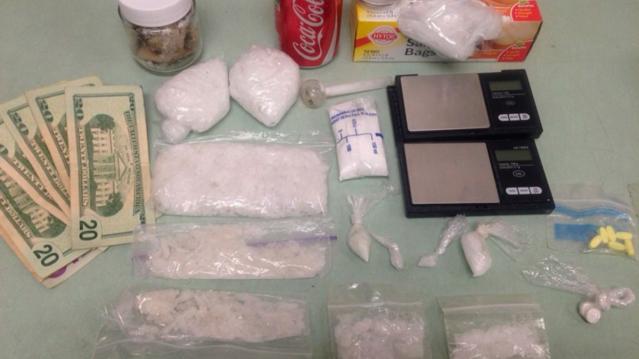
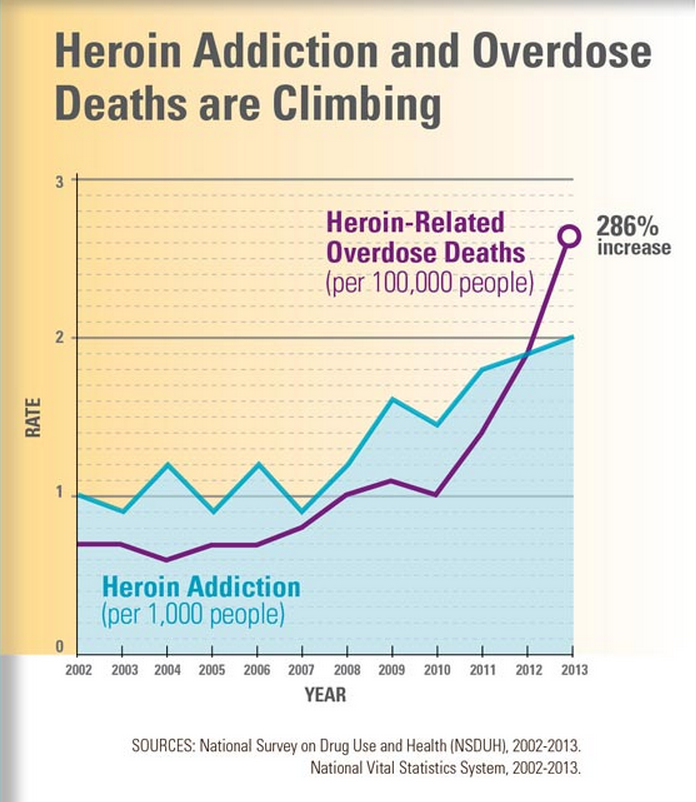
The death toll from the heroin epidemic has been climbing dramatically in recent years — and the annual rate of overdose deaths nearly doubled between 2011 and 2013, according to a new CDC study.
From 2002 through 2013, heroin use in the United States rose by 63 percent, and the rate of abuse or dependence climbed a staggering 90 percent. Deaths from heroin-related overdoses nearly quadrupled, with more than 8,200 people dying in 2013 alone.
The CDC report says that heroin use has increased across most demographic groups — men and women, most age groups, and across all income levels. Rates of heroin use are still highest among men, those ages 18 to 25, people with income less than $20,000 a year, people in urban areas, and those who do not have health insurance or are on Medicaid. But other groups are turning to the drug, too. “Some of the greatest increases occurred in demographic groups with historically low rates of heroin use: women, the privately insured and people with higher incomes,” the CDC says.
The heroin trend isn’t happening in isolation, the CDC study says. Almost all heroin users — 96 percent — also took at least one other drug, and 61 percent used at least three other drugs. Abuse or dependence on opioid painkillers is the strongest risk-factor for heroin use or addiction, the report says, with cocaine addiction also high on the list. People who are addicted to prescription opioid painkillers are 40 times more likely to use or be addicted to heroin, and 45 percent of people who used heroin were also addicted to painkillers.
Another key reason is that heroin is becoming cheaper and more widely available. According to the DEA, the increase in heroin seizures in the U.S. from 2010 and 2014 rose 81 percent, from 2,763 kilograms to 5,014 kilograms. More and more law enforcement agencies are identifying heroin as their primary drug threat, but the CDC report suggests that health care workers focus on reducing the abuse of painkillers by improving prescribing practices.
The study also recommends that states increase access to “medication-assisted treatment” programs that use methadone, buprenorphine and naltrexone along with behavioral counseling. And it says the rapid rise in heroin-related deaths highlights an “urgent need” to broaden access to naloxone, a drug that can reverse the effects of heroin and opioid overdose.
Don’t Make This Surprisingly Common Credit Mistake

Checking your credit report regularly is a basic rule of personal finance. More than one in three Americans has failed to follow that rule — they’ve never looked at their report, according to a new study from Bankrate.com.
The report finds that 35 percent of all Americans have never reviewed their credit reports, and 14 percent check less than once a year. Senior citizens are the biggest slackers, with 44 percent saying they’ve never checked their report, followed by 41 percent of millennials.
Related: 5 Easy Ways to Ruin a Perfect Credit Score
Your credit report is the foundation of your credit score, a key number that landlords, employers and lenders use to measure financial responsibility. Having a good credit score is critical for financial success because it gets you access to lenders’ best rates and terms, which can save you thousands of dollars each year.
By law you are entitled to access your credit reports from each of the three major credit-reporting companies — Experian, TransUnion and Equifax — for free once every 12 months. You can do that at AnnualCreditReport.com.
The Bankrate survey found that about half of Americans have reviewed at least one of their credit reports within the past year, and a quarter of Americans review them more than once a year.
“Monitoring your credit goes well beyond scanning a three-digit number,” Bankrate credit card analyst Jeanine Skowronski said in a statement. “Americans need to thoroughly review their credit reports for errors or signs of fraud. They also need to understand what factors, like missed payments or high debt-to-credit ratios, are driving their credit score in order to improve it.”
If you don’t know what’s on your credit reports, now is a good time to find out.
Mother’s Day: Shop Tuesday for Best Deals

Looking to get a deal on a Mother’s Day gift this year? Shop this Tuesday.
That’s the day you’ll find the most coupons and discounts, according to an analysis by Savings.com of traffic and deals for Mother’s Day over the past five years. The best part, you don’t even need a coupon for many of the bargains, which tend to be heavily promoted.
One category where you’re less likely to save: Flowers. Savings.com found that prices have been steadily increasing for Mother’s Day bouquets, but purchasing a few days early from your supermarket or local florist will yield the best value. About two-thirds of consumers who plan to spend money for Mother’s Day will buy flowers, according to the National Retail Federation.
Families are planning to spend more than ever honoring their moms this year: The average American plans to shell out $172.63, up almost $10 from last year. That’s the highest amount since the NRF began its survey in 2003.
Related: What I Really Want for Mother’s Day: Priceless
The survey found that 80 percent of consumers would buy their mother a card. Mother’s Day is the third-largest card-sending holiday in the United States, with 120 million cards exchanged each year, according to Hallmark.
About a third of shoppers said they’d buy their mom clothing or apparel, and another they’d said they’d buy jewelry, according to the NRF
When it comes to shopping venues, department stores were the most popular destinations (cited by 33 percent of consumers), followed by specialty stores (28 percent) and discount stores (25 percent). A quarter of shoppers said they’d buy gifts online, down from 29 percent last year.
4 Reasons the Fed Won’t Raise Interest Rates in June
It is no surprise that the Fed didn’t take action on interest rates at the April Federal Open Market Committee meeting. The question of interest to the market is whether the Federal Reserve has revealed some clear signal in its statement about the timing of the future rate increase. Even though the Fed did not change its forward guidance on rate increases from the March statement, we can discern what the Fed has on its plate. Four aspects of the economy stand out:
Related: Bernanke Was Right—Interest Rates Aren’t Going Anywhere
- The latest GDP data show worse-than-expected growth at an annualized 0.2 percent during the first quarter of 2015, compared to 2.2 percent in the last quarter of 2014.
- The strong U.S. dollar has continued to weigh on exports. Net exports in the first quarter stayed unchanged (0.0 percent growth) year-over-year, compared with 18.6 percent growth in the fourth quarter of 2014.
- Inflation has continued to stay way below the central bank’s 2 percent target. The price index for personal consumption expenditure (PCE), the measure of inflation preferred by the Fed, showed a 0.3 percent year-over-year increase in the first quarter, much lower than the growth rate of 1.1 percent in the fourth quarter of last year. Core PCE inflation, which excludes volatile prices of food and energy, reached 1.3 percent, compared with 1.4 percent in the last quarter.
- The improvements in the labor market, the other mandate of the Federal Reserve besides inflation, also slowed. Only 126,000 employees were added to nonfarm payrolls in March, compared to 264,000 in February and 201,000 in January.
Related: Fed’s Downgrade of Economic Outlooks Signals Later Rates Lift-Off
In all, the U.S. economy is growing more slowly than anticipated with some headwinds that may last for a while, such as the strong dollar. Both measures of the Fed’s dual mandate, price stability and maximum employment, remain below the Fed’s target. Normally this would call for an accommodative monetary policy, postponing the rate increases until later in the year. Rather than starting rate increases at the June FOMC meeting, the liftoff in September instead is more likely.
This story originally appeared at the American Institute for Economic Research.
How IRS Protects ID Thieves
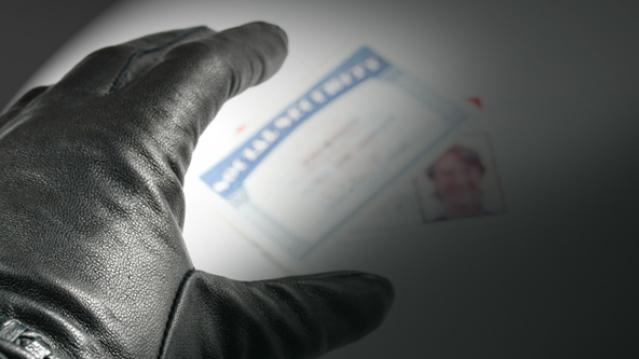
Millions of Americans have fallen victim to ID theft during tax season, when fraudsters file false returns in an attempt to steal other people’s refunds.
Victims face delays in getting their real refunds, and paperwork nightmares that can drag on for months. In an attempt to survey the damage, some have asked the IRS for a copy of the fake returns, but Bloomberg reports that the agency has denied such requests, despite consumer-protection regulations intended to help victims in these situations.
The rules protecting consumers apparently conflict with tax laws that prevent its agents from sharing bogus returns and impose a penalty of up to five years in prison and a $250,000 fine for IRS workers who violate that law. “Employees face the specter of felony charges for giving out private details — including, possibly, those of the identity thieves — to those who aren’t authorized,” according to Bloomberg.
Related: 3 Costly and Common Tax Scams to Avoid
Tax refund fraud has ballooned in recent years. While electronic filing has made the tedious process of filing taxes more bearable for consumers, it has also made it easier for criminals to scam the system by filing phony returns using stolen Social Security numbers. Scammers bilked the IRS out of $5.8 billion in fraudulent tax refunds in 2013, a number auditors expected would climb much higher in the most recent tax season. (Numbers haven’t yet been released for 2014 returns).
Electronic fraud became such a problem this year that TurboTax briefly suspended state returns for customers in February to deal with ID theft issues.
If the IRS is of limited help to victims, that’s all the more reason to make sure your information is protected. You can find some tips to reduce your risk of ID theft here.
Top Reads From The Fiscal Times:
- Found! 6,400 New Lois Lerner Emails on the IRS Targeting Scandal
- The Liberal Solution to America’s Big Spending Problem
- The Flawed F-35: Why the Pentagon Will Never Shoot It Down
DARPA Has Developed a Bullet That Can Turn in Mid-Air
The U.S. Department of Defense has developed a bullet that can change direction in mid-air to ensure it hits its targets.
DARPA’s self-steering bullet EXACTO (Extreme Accuracy Tasked Ordnance) adjust in flight to hit moving targets.
Called the Extreme Accuracy Tasked Ordnance (or EXACTO), the .50 caliber bullet is meant for use in combat in areas such as Afghanistan, where visibility and changes in wind and weather can throw bullets slightly off their course, according to an article in Popular Science.
How the ammunition works is, of course, secret. A video put out by DARPA shows the bullet adjusting its trajectory to hit a moving robot target.
"This live-fire demonstration from a standard rifle showed that EXACTO is able to hit moving and evading targets with extreme accuracy at sniper ranges unachievable with traditional rounds," said DARPA program manager Jerome Dunn, in a statement. "Fitting EXACTO's guidance capabilities into a small .50-caliber size is a major breakthrough and opens the door to what could be possible in future guided projectiles across all calibers."
Read the full article in Popular Science here.