
The Rapidly Rising Death Toll of the Heroin Epidemic

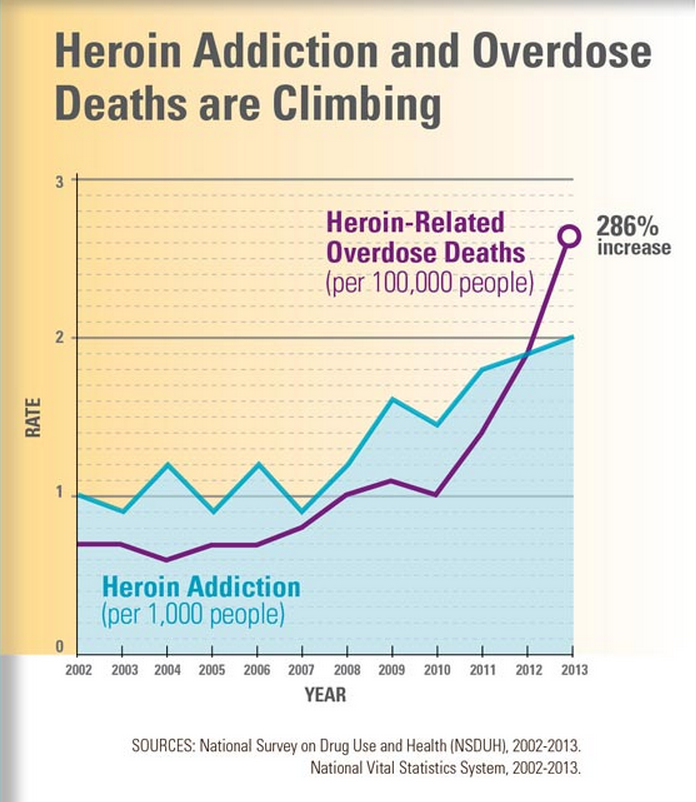
The death toll from the heroin epidemic has been climbing dramatically in recent years — and the annual rate of overdose deaths nearly doubled between 2011 and 2013, according to a new CDC study.
From 2002 through 2013, heroin use in the United States rose by 63 percent, and the rate of abuse or dependence climbed a staggering 90 percent. Deaths from heroin-related overdoses nearly quadrupled, with more than 8,200 people dying in 2013 alone.
The CDC report says that heroin use has increased across most demographic groups — men and women, most age groups, and across all income levels. Rates of heroin use are still highest among men, those ages 18 to 25, people with income less than $20,000 a year, people in urban areas, and those who do not have health insurance or are on Medicaid. But other groups are turning to the drug, too. “Some of the greatest increases occurred in demographic groups with historically low rates of heroin use: women, the privately insured and people with higher incomes,” the CDC says.
The heroin trend isn’t happening in isolation, the CDC study says. Almost all heroin users — 96 percent — also took at least one other drug, and 61 percent used at least three other drugs. Abuse or dependence on opioid painkillers is the strongest risk-factor for heroin use or addiction, the report says, with cocaine addiction also high on the list. People who are addicted to prescription opioid painkillers are 40 times more likely to use or be addicted to heroin, and 45 percent of people who used heroin were also addicted to painkillers.
Another key reason is that heroin is becoming cheaper and more widely available. According to the DEA, the increase in heroin seizures in the U.S. from 2010 and 2014 rose 81 percent, from 2,763 kilograms to 5,014 kilograms. More and more law enforcement agencies are identifying heroin as their primary drug threat, but the CDC report suggests that health care workers focus on reducing the abuse of painkillers by improving prescribing practices.
The study also recommends that states increase access to “medication-assisted treatment” programs that use methadone, buprenorphine and naltrexone along with behavioral counseling. And it says the rapid rise in heroin-related deaths highlights an “urgent need” to broaden access to naloxone, a drug that can reverse the effects of heroin and opioid overdose.
Comcast to Cut the Cord with Time Warner

Comcast is dropping its merger with Time Warner after a year of regulatory pushback, according to Bloomberg. The news wire's unnamed sources say there will be an announcement tomorrow.
In today's changing media landscape it is not really clear what the preemptive breakup of a media megacorp (formed from mere media titans) will mean for consumers, especially in the face of Verizon's push to slim down its bundled offerings, the new ala carte service from HBO and the continued expansion of Netflix's original programming. As more and more people cut the cord, the market for traditional cable TV is eroding, and more consumers opt simply for an Internet connection.
Even without that, Comcast dropping its deal probably will have no impact at all for the average cable subscriber, given the already segregated monopolies allowed individual cable companies. So, unless you own stock in either of these companies, this is pretty much just more status quo in a rapidly changing market.
Can Low Self-Control Turn You Into Edward Snowden?

Be very wary if your employer asks you to take a test and then says please put on this cap. The cap could have sensors measuring your “self-control,” which researchers at Iowa State University have connected to—cybersecurity.
Yup—this wasn’t about eating the last cookie, having sex with a stranger, or taking a hit from some unknown new drug just because your friend said it was an amazing experience. The test measures how long someone hesitates before doing something risky or wrong.
Hmm. Maybe I’ll wait a few seconds before robbing that jewelry store! If they waited, the researchers determined that the employees were considering the consequences of their actions and therefore had higher self-control than those who simply filled their duffle bag with whatever bling was in sight.
Those with higher self-control were deemed better cyber security risks than the low self-control group.
But who knows? Maybe the high group was just casing the joint and calculating how much they could carry without getting caught. Or maybe they were searching for the largest unflawed diamond in the case that could be hidden in their pocket!
So much for brainwaves.
These Students Are Making Even More Than They Expect After Graduation
College students who major in STEM fields generally know that they can make more money than their peers once they graduate, but they don’t know how much more.
Turns out, those students majoring in science, technology, engineering and math, actually have starting salaries that are higher than expected, according to a new report by the National Association of Colleges and Employers.
Engineering majors, for example, expect to earn $56,000, but actually receive 15.5 percent more than that, with starting salaries average nearly $65,000. Computer Science majors expect to make around $51,000, but receive 22 percent for an average starting salary of $62,000.
Chemistry majors have the largest gap between expectations and reality: They expect to earn an average of $39,000 but take home an average $58,000 in their first year, a 51 percent increase.
Related: The Closing of the Millennial Mind on Campus
The typical college graduate in 2014 received a starting salary of $48,000. Liberal arts and humanities majors had the lowest starting salary, with an average of just $39,000, according to NACE.
Not only do STEM majors enjoy higher salaries, but they can also expect more job security and better job prospects. All of the top 25 jobs recently compiled by U.S. News and World Report fell into either a science- or math-based discipline.
Still, not everyone has the interest or aptitude to excel in a STEM career. A third of those who begin their college career majoring in those fields end up transferring to a difference study area, according to a recent report by RTI International.
Will Obama Send a Smoke Signal About Weed?

The resignation of Michele M. Leonhart, chief of the Drug Enforcement Administration, just one day after 4/20 -- which is sort of Thanksgiving for stoners -- offers President Obama an opportunity to replace her with someone who shares his relatively benign view of marijuana.
The right appointment might also be a gift to Hillary Rodham Clinton since it would signal to younger voters that it's not just libertarian-leaning Republicans like Senator Rand Paul of Kentucky who want to decriminalize the use of pot.
Representative Early Blumenauer, an Oregon Democrat, told The New York Times that Obama should appoint someone who "understands the federal approach to marijuana isn't working."
Related: How to Stop Cyber Attacks: Let Workers Smoke Pot
The flashpoint that led to the departure of Leonhart after a 35-year career at the D.E.A. was a congressional hearing that revealed agency agents in Colombia had taken part in parties with prostitutes paid by drug cartels. But Leonhart, who has lumped marijuana in with crack, meth and heroin, found herself at odds with the President, who has called pot no more dangerous than alcohol.
“Hopefully this is a sign that the Reefer Madness era is coming to an end at the D.E.A.,” Mason Tvert, the director on communications at the Marijuana Policy Project, told Bloomberg Politics.
How to Stop Cyber Attacks: Let Workers Smoke Pot

What’s true for the government is true for business. FBI Director James Comey thinks you can’t hire top tech talent with a ban on weed. It all started in the Reagan administration, which imposed a no-hire policy for applicants who toked up within the past three years. Good luck with that.
In 2014, Comey raised the issue during a speech: “A lot of the nation’s top computer programmers and hacking gurus are also fond of marijuana. I have to hire a great workforce to compete with those cyber criminals and some of those kids want to smoke weed on the way to the interview.”
That’s not the only reason the government can’t hire competent programmers and white hat hackers. They come at a high price, there’s a shortage, and they hate red tape and bureaucratic annoyances. For some lawmakers, though, it’s easier to get lost in the weed than try to reform the federal hiring process. That’s why Gerry Connolly (D-VA) and Earl Blumenauer (D-OR) have two proposals in the House requiring info from the intelligence director on how classifying pot as Schedule 1 narcotic crimps the feds recruiting efforts.