
Get Ready for Your 'Daily Glitch'—The NYSE, WSJ and United Were Just the Beginning

“Glitch” is clearly the word of the moment, after a series of pesky little technical problems forced United Airlines to ground flights, halted New York Stock Exchange trading and took down The Wall Street Journal website homepage all on the same day. If that wasn’t enough technical trouble, Seattle’s 911 system went down briefly. And a couple of NASA spacecraft also suffered “glitches” in recent days.
We deal routinely with glitches these days — a Wi-Fi connection goes down, an app freezes, a plug-in (usually Shockwave) stops responding, an email doesn’t load properly — which may help explain why, aside from lots of grumbling from delayed airline passengers, the reaction to Wednesday’s glitches was rather muted. The NYSE problems were reportedly caused by a “configuration issue” after a software update and United blamed its problem on “degraded network connectivity.” We see those issues every day, just not on as large a scale.
But that’s the problem.
At the risk of sounding like a high school term paper, let us note that the Merriam-Webster definition of glitch is “an unexpected and usually minor problem; especially: a minor problem with a machine or device (such as a computer).” The full definition describes it as a minor problem that causes a temporary setback.
Sure, Wednesday’s setbacks were all temporary. The Wall Street Journal site came back up quickly. Seattle’s 911 service was restored. Action on the NYSE itself was stopped for nearly four hours, but even then traders were still able to buy and sell NYSE-listed stocks on other exchanges. United grounded about 3,500 flights, which meant some people missed a wedding or a crucial business meeting. That will take time to sort out, but it will get sorted out.
In aggregate, though, the problems add up — and the word “glitch” only minimizes what can be much bigger, more serious issues..
Stock exchanges have suffered from a series of stoppage-causing glitches in recent years, pointing to the value of having trading spread across numerous exchanges. United’s tech breakdown “marked the latest in a series of airline delays and cancellations in the last few years that experts blame on massive, interconnected computer systems that lack sufficient staff and financial backing,” the Los Angeles Times reports. Just ask any of the roughly 400,000 United passengers whose travel plans were messed up if this was a little glitch. Or maybe check with the engineers who had to troubleshoot and rebuild the HealthCare.gov site after its glitch-laden launch.
It may be some relief that these latest outages weren’t the result of external attacks, but as sociologist Zeynep Tufecki, an assistant professor at the School of Information at the University of North Carolina, writes at The Message, “The big problem we face isn’t coordinated cyber-terrorism, it’s that software sucks. Software sucks for many reasons, all of which go deep, are entangled, and expensive to fix.”
These foul-ups are now mundane, and to some extent they may be inevitable as we rely more and more on complicated computer systems in every aspect of our lives. That’s the real issue, and it’s a lot bigger than a glitch.
Obamacare’s Dirty Secret: 31 Million Still Can’t Afford Treatment
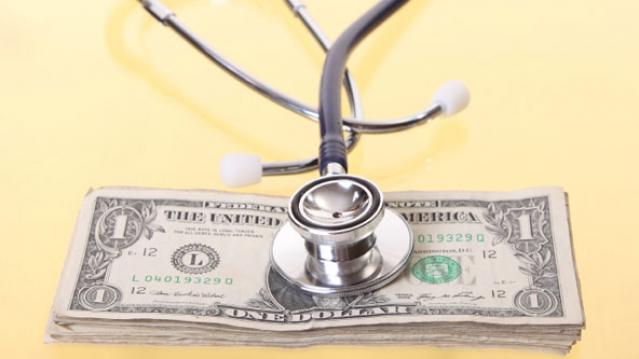
The president’s healthcare law sliced America’s uninsured rate down to historic lows by expanding coverage for tens of millions of Americans. At the same time, however, the number of insured people who still lack affordable, robust coverage is rising sharply as more people buy into high-deductible policies.
A new study from the Commonwealth Fund reveals that about 23 percent of Americans with coverage are considered underinsured—up from 12 percent in 2003. That means roughly 31 million Americans who bought health insurance still have trouble affording treatment under their policies.
The researchers at the Commonwealth Fund defined “underinsured” people as having out-of-pocket costs that total 10 percent or more of their annual income, or a deductible that is 5 percent or more of their income. The study concluded that high-deductible policies are likely the culprit behind this massive influx of underinsured people.
The findings are a huge problem for the Obama administration since the entire goal was to expand access to coverage to millions of Americans that they presumably would use instead of delaying treatment. But a handful of recent studies show that even people with health insurance are delaying treatment because they can’t afford it.
Related: High Deductible Plans Have More People Delaying Treatment
A December Gallup Poll showed at least 38 percent of insured, middle-income people, said they had delayed medical treatment because of the cost. “While many Americans have gained insurance, there has been no downturn in the percentage who say they have had to put off needed medical treatment because of cost,” Gallup’s Rebecca Riffkin wrote in a post on the pollster’s website.
The shift toward cost-sharing and high-deductible policies—defined by the Internal Revenue Service as those with annual deductibles of $1,300 or more for individuals and $2,600 for families--is widespread among exchange policies but also employer plans.
The Commonwealth Foundation’s study, unsurprisingly, reveals that low-income people with coverage are about twice as likely to be “underinsured” than people earning more than 200 percent of the poverty line.
Of course, it’s important to note that while affordability continues to be an issue, significantly more people do have health insurance because of the law.
Why That Annoying Fraud Alert Is Still a Good Thing
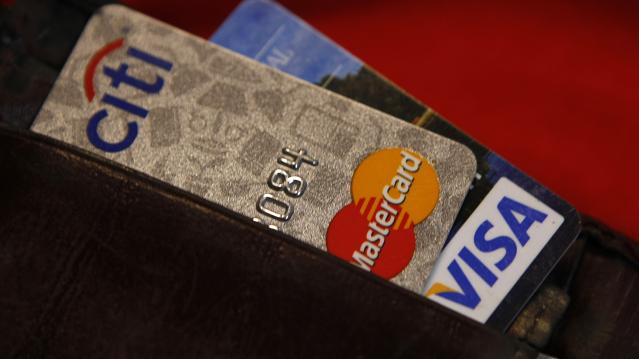
As credit card fraud has skyrocketed, issuers suspecting suspicious activity have become increasingly vigilant – sometime maybe too vigilant.
In many cases, fraud alerts are preventing consumers from making legitimate purchases. More than two-thirds of Americans who have received a fraudulent activity alert from their credit or debit card issuers have received at least one that’s inaccurate, according to a new study from CreditCards.com.
Still, card issuers have good reason to be cautious. This week, credit card scoring and analytics firm FICO said that the number of attacks on debit cards used at ATMs hit the highest level in 20 years during the first quarter of 2014
Related: How to Beat Credit and Debit Card ID Thieves
Americans remain extremely concerned about their personal data when shopping in stores, so many accept the inaccurate fraud alerts as a necessary hassle. “Most consumers we have spoken with seem to be okay with this trend,” CreditCards.com senior industry analyst Matt Schulz said in a statement.
You can avoid having your card blocked from legitimate purchases by calling your issuer or visiting their Web site to let them know you’ll be traveling, since purchases made from a new geographic area often send a red flag to card companies. Some issuers also offer text message alerts, so you can quickly and easily unblock a card for your transactions.
If you think you’ve been a victim of fraud (or if your cards have been physically lost or stolen), call your issuer immediately – most have 24/7 call centers dedicated to fraud.
Cancer Charities Exec Stole $187 Million for Personal Use
Donors who have given money to four of the largest cancer charities in the United States may have unknowingly been financing the lavish lifestyle of the C.E.O. who runs them—paying for luxury cruises, elite gym memberships instead of treatment for cancer patients.
That’s according to a suit filed Tuesday by the Federal Trade Commission as well as attorneys general in all 50 states, which alleges that James Reynolds deceived and defrauded donors out of more than $187 million between four of his charities—including the Cancer Fund of America, Cancer Support Services, Children’s Cancer Fund of America and the Breast Cancer Society.
Related: Medicare Recovers Nearly $28 Billion in Fraud Since 1997
The complaint says that the scheme started in the 1980’s. The charities told donors via telemarketing calls that their money would go toward medicine and transportation for cancer patients. However, most of the money actually went toward Reynolds’ personal indulges.
The complaint says that between 2008 and 2012, only three percent of donations actually went to cancer patients.
The FTC also accuses the organizations of cooking their books and reporting inflated revenues as well as “gifts in kind” that they said they distributed internationally.
The FTC said two of the charities—the Children’s Cancer Fund of America and the Breast Cancer Society plan to settle the charges out of court. The Associated Press reported that the Breast Cancer Society, posted a statement on its website Tuesday blaming increased government scrutiny for the charity's downfall.
"While the organization, its officers and directors have not been found guilty of any allegations of wrongdoing, and the government has not proven otherwise, our board of directors has decided that it does not help those who we seek to serve, and those who remain in need, for us to engage in a highly publicized, expensive, and distracting legal battle around our fundraising practices," the statement said.
Several executives who were also involved in the sccheme, including Reynolds’ son, have agreed to a settlement, which bans them from working in fundraising or charities. The two charities that settled, Breast Cancer Society and the Children’ Cancer Fund of America will be dissolved.
The settlement also orders a $65,664,360 judgment, which is the amount consumers donated between 2008 and 2012. Reynolds junior’s judgment will be for suspended once he pays $75,000. Meanwhile the legal proceedings for Reynolds’ senior and the two remaining charities are ongoing.
Former CBO Chief: Congress Never Meant to Limit Obamacare Subsidies
A Supreme Court ruling expected this summer will determine whether the federal government can subsidize the insurance costs of individuals in states that did not establish their own health care exchanges under the Affordable Care Act.
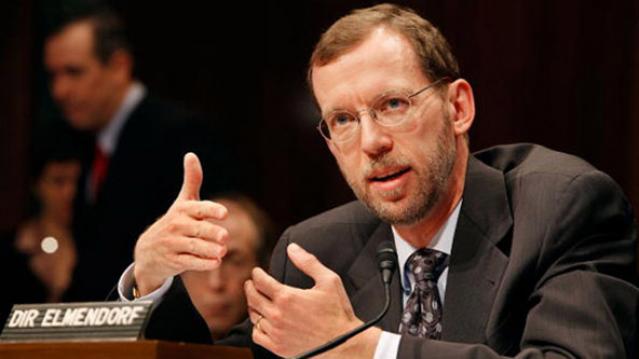
Douglas Elmendorf was the director of the Congressional Budget Office when Congress debated the bill, and on Tuesday he provided some ammunition to backers of the law who insist that that Congress did not intend to prevent payments of subsidies to consumers in states using the federal exchange.
Related: How Obamacare Could Be Squeezing Consumer Spending
In an interview with CNBC’s John Harwood at the Peter G. Peterson Foundation’s 2015 Fiscal Summit*, Elmendorf said that before the ACA passed, the CBO analyzed the bill for members of Congress, many of whom were powerfully opposed to it. At the time, he said, there was a common understanding on Capitol Hill that the subsidies would be available to states regardless of the status of their exchanges.
“That analysis was subject to a lot of very intense scrutiny and a lot of questions,” he said. “My colleagues and I can remember no occasion on which anybody asked why we were expecting subsidies to be paid in all states regardless of whether they established exchanges or not. And if people had not had this common understanding…then I’m sure we would have had a lot of questions about that.”
Pressed by Harwood, Elmendorf added, “My colleagues and I talked to a lot of people, with a lot of questions about nearly every aspect of the analysis that we did…and we could not remember anybody asking us any questions about what would happen in the federal exchange different from what would happen in the state exchanges.”
Even so, the language of the law states that the subsidies would apply to exchanges “established by the State” and the Supreme Court will decide how literally those words must be interpreted.
*Pete Peterson also funds The Fiscal Times.
‘Spider Rain’ as Millions of Baby Arachnids on Web Parachutes Fall from Sky
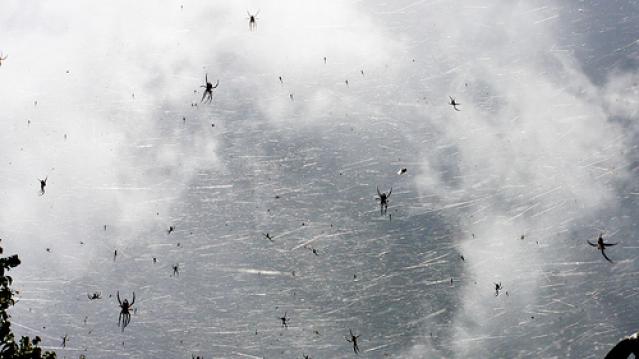
Imagine waking up to millions of baby spiders raining down from the heavens. It sounds like Charlotte’s Web meets Cloudy with a Chance of Meatballs – only a whole lot creepier.
Yet that’s exactly what happened in rural Golburn in the Southern Tablelands of New South Wales, Australia, according to The Sydney Morning Herald.
Ian Watson of Golburn told the paper that he looked up and saw a sky full of little black spiderlings and a tunnel of webs going up for hundreds of meters.
Related: The Five Most Dangerous States to Work In
An Australian naturalist said what’s called “ballooning” is a migration technique used by baby spiders, which climb up on a plant and release a streamer of silk web that is caught by the wind and carried away.
Martyn Robinson of the Australian Museum said the traveling spiders can go quite a distance, and that’s why there are spiders on every continent. They even land in Antarctica, he said, though they don’t last long.
Rick Vetter, an arachnologist, told the website LiveScience that "ballooning” is not unusual among certain types of spiders, but people just don’t notice it.
What is unusual, biology professor Todd Blackledge of the University of Akron in Ohio told LiveScience, is for millions of spiders to be blowing in the wind at the same time. He said the mass migration may have been caused by a sudden change in the weather that carried so many spiders aloft all at once.
The Washington Post says other incidents of so called spider rain have occurred recently in Texas, Brazil and another town in Australia.