
Don’t Feel Like a Chump When You Close on Your New Mortgage

Mortgage closing costs dropped 7 percent over the past year, falling to $1,847 on a $200,000 loan, according to a new analysis by Bankrate.
Typical closing costs varied by state, ranging from $2,163 in Hawaii to $1,613 in Ohio. You can find the average rate for your state in the table below.
Lenders compete for business, so shopping around with at least three mortgage providers can help you reduce the fees associated with your loan. “Homebuyers have more say over closing costs than they think,” Bankrate Senior Mortgage Analyst Holden Lewis said in a statement.
Even as banks lower their mortgage fees, they’re increasing fees in most other categories, according to MoneyRates.com.
While lower mortgage fees are good news for homebuyers and those refinancing their loans, the average saving amount to just $140. That’s not much relative to the total costs associated with buying a house. The average down payment for homebuyers in the first quarter of 2015 was $57,710, for example.
Related: Want Your Own Home? Here’s How to Do the Math
The costs don’t stop once the buyers move in. On top of mortgage payments, homeowners face an average of more than $6,000 in additional costs related to their house, including homeowners insurance, property taxes and utilities.
The National Association of Realtors expects home prices to increase 6.5 percent this year to a median $221,900, which would put them at the same level as their 2006 record high.
For buyers, better news than the lower mortgage fees is that rates remain relatively low, falling to 3.98 percent last week, per Freddie Mac.
Closing costs | |||
|---|---|---|---|
| State | Average origination fees | Average third-party fees | Average origination plus third-party fees |
| Alabama | $1,066 | $776 | $1,842 |
| Alaska | $935 | $922 | $1,857 |
| Arizona | $1,208 | $761 | $1,969 |
| Arkansas | $1,057 | $760 | $1,817 |
| California | $937 | $896 | $1,834 |
| Colorado | $1,192 | $719 | $1,910 |
| Connecticut | $1,074 | $960 | $2,033 |
| Delaware | $904 | $924 | $1,828 |
| District of Columbia | $1,077 | $718 | $1,794 |
| Florida | $1,028 | $778 | $1,806 |
| Georgia | $1,058 | $821 | $1,879 |
| Hawaii | $1,033 | $1,130 | $2,163 |
| Idaho | $894 | $788 | $1,682 |
| Illinois | $1,080 | $767 | $1,847 |
| Indiana | $1,067 | $770 | $1,837 |
| Iowa | $1,161 | $762 | $1,923 |
| Kansas | $1,047 | $753 | $1,800 |
| Kentucky | $1,060 | $737 | $1,797 |
| Louisiana | $1,060 | $817 | $1,877 |
| Maine | $897 | $830 | $1,727 |
| Maryland | $1,093 | $742 | $1,835 |
| Massachusetts | $905 | $851 | $1,756 |
| Michigan | $1,072 | $746 | $1,818 |
| Minnesota | $1,067 | $689 | $1,757 |
| Mississippi | $1,046 | $837 | $1,884 |
| Missouri | $1,040 | $792 | $1,833 |
| Montana | $1,062 | $855 | $1,917 |
| Nebraska | $1,047 | $770 | $1,817 |
| Nevada | $1,002 | $848 | $1,850 |
| New Hampshire | $1,084 | $750 | $1,835 |
| New Jersey | $1,181 | $913 | $2,094 |
| New Mexico | $1,076 | $876 | $1,952 |
| New York | $1,032 | $879 | $1,911 |
| North Carolina | $1,036 | $875 | $1,911 |
| North Dakota | $1,045 | $791 | $1,836 |
| Ohio | $933 | $681 | $1,613 |
| Oklahoma | $1,027 | $734 | $1,761 |
| Oregon | $1,080 | $785 | $1,864 |
| Pennsylvania | $1,055 | $678 | $1,733 |
| Rhode Island | $1,093 | $802 | $1,896 |
| South Carolina | $1,058 | $837 | $1,895 |
| South Dakota | $1,055 | $704 | $1,759 |
| Tennessee | $1,033 | $773 | $1,806 |
| Texas | $1,031 | $833 | $1,864 |
| Utah | $909 | $788 | $1,697 |
| Vermont | $1,074 | $862 | $1,936 |
| Virginia | $1,050 | $787 | $1,837 |
| Washington | $1,077 | $824 | $1,901 |
| West Virginia | $1,067 | $904 | $1,971 |
| Wisconsin | $1,047 | $723 | $1,770 |
| Wyoming | $874 | $814 | $1,689 |
| Average | $1,041 | $807 | $1,847 |
Bankrate.com surveyed up to 10 lenders in each state in June 2015 and obtained online Good Faith Estimates for a $200,000 mortgage to buy a single-family home with a 20 percent down payment in a prominent city. Costs include fees charged by lenders, as well as third-party fees for services such as appraisals and credit reports. The survey excludes title insurance, title search, taxes, property insurance, association fees, interest and other prepaid items.
Top Reads from The Fiscal Times:
- You’re Richer Than You Think. Really.
- The 10 Fastest-Growing Jobs Right Now
- The 5 Worst Cities to Raise a Family
Privacy-Focused DuckDuckGo Search Engine Says Traffic Has Soared Since Snowden Leaks

If you haven’t yet heard about DuckDuckGo, you probably will soon.
On its face, the search engine looks much the same as any other. A little more sparse, maybe, but nothing much separating it from, say, Google. There’s a logo and a box for your search.
Where it differs from its peers, though, is what happens when you hit enter.
Though silly in name, DuckDuckGo has a serious ethos: protection of user privacy at all costs. The engine, launched in 2009, shies away from the personalized filter bubbles so adored by search giants like Google and Bing, refusing to track searches or store user data. Users have the option to completely anonymize their search by routing it through the anonymizing TOR network, rendering it even more invisible to prying eyes. DuckDuckGo earns money through simple keyword-targeted advertising, steering clear of the tracking cookies used by more sophisticated ad campaigns.
Though the slavish dedication to privacy has its drawbacks — for example, results are less tailored to the user searching for them, and thus more likely to be irrelevant — the search engine has seen 3 billion searches a year and has a firm community of fans who are attracted to the site’s long-standing defense of user privacy.
Related: News Companies Have Good Reason to Fear Facebook
That ethos seems to be paying off. Gabe Weinberg, CEO of the Pennsylvania-based company, told CNBC last week that the search engine’s traffic has grown 600 percent since Edward Snowden’s 2013 revelations about the large-scale spying conducted by the government. DuckDuckGo’s search traffic was further assisted last year when Apple integrated it into the Safari mobile browser.
DuckDuckGo’s traffic is still tiny compared to the big players — the 3 billion searches a year that Weinberg claimed to have on CNBC is pretty much the same amount of searches that Google traffics in a single day. But DuckDuckGo expects steady growth as average users become increasingly educated about their privacy.
Millions of Samsung Galaxy Phones May Be Vulnerable to Hackers

If you’re one of the millions of users of a Samsung Galaxy phone, you might be a potential target for a malicious hacker.
A report released today by NowSecure, a security firm located in Chicago, found that a glitch in Swift, the keyboard software used by default on all Samsung Galaxy devices could allow a remote attacker to compromise your phone.
This particular bug makes the phone vulnerable to what is known as a “man in the middle” attack. The Swift software consistently sends requests to a server, checking for updates. To someone with the right knowhow, though, it’s possible to impersonate Swift’s server and send through software that can be used to gain control of the device.
The main problem with this vulnerability is that there’s no real solution. The Swift keyboard is so integrated into Samsung’s software that it cannot be removed or disabled — even if it is switched out with a different keyboard app. Steering clear of unsecured Wi-Fi networks will make you less likely to be targeted, but it won’t render you invulnerable.
Related: 10 Biggest Tech Flops of the Century
Swift runs with elevated permissions, giving it pretty much free rein around the phone. This means that a hacker that worms his way into it can also access the Galaxy’s microphone and camera, track the user’s location or listen to their calls. They can even install apps.
NowSecure claims to have made Samsung and Google’s Android team aware of this vulnerability in late 2014, and Samsung reportedly has made a patch available to network providers. It’s not clear, though, whether providers have pushed out the patch to users yet. Many networks have a record of being notoriously slow to push through updates and security patches, and NowSecure’s tests found a number of Galaxy phones on different carriers were still vulnerable as of Tuesday.
If you’re of a more technical bent, you may be interested in seeing the details of NowSecure’s report on their blog. If you’re of a less technical bent, you might want to check with your carrier and try to avoid insecure Wi-Fi networks.
Five States Account for 31% of Underwater Mortgages
Here’s another sign that the housing market keeps getting healthier: More than 250,000 formerly underwater homes regained equity in the first quarter of 2015, according to CoreLogic, meaning that the value of the homes rose above the value of the mortgages on them.
Borrower equity grew more by $694 billion in the quarter, and more than 90 percent of mortgaged American homes now have equity. Such a surge in homeowner wealth has historically led to increased consumer spending and investment.
“Many homeowners are emerging from the negative equity trap, which bodes well for a continued recovery in the housing market,” Anand Nallathambi, president and CEO of CoreLogic said in a statement. “With the economy improving and homeowners building equity, albeit slowly, the potential exists for an increase in housing stock available for sale, which would ease the current imbalance in supply and demand.”
Related: 9 Real Estate Trends to Watch in 2015
Still, 5.1 million mortgaged homes remain underwater, representing 10.2 percent of all mortgaged properties. Five states — Nevada, Florida, Illinois, Arizona and Rhode Island — account for nearly a third of all properties with negative equity. As of the end of the fourth quarter, 10.8 percent of homes — or about 5.4 million properties — were underwater.
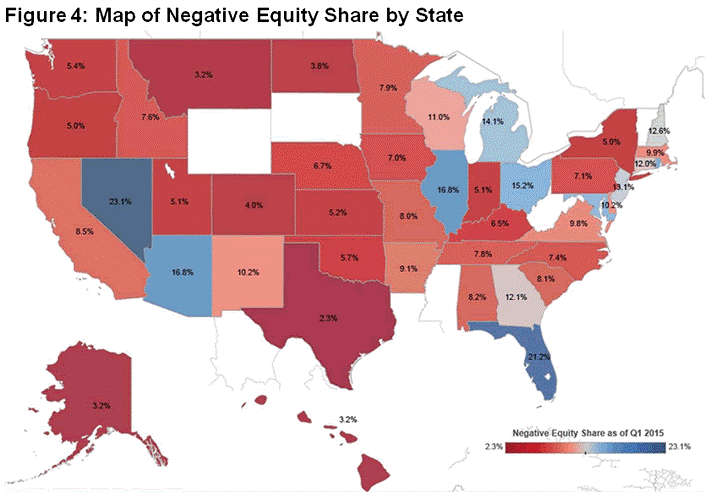
The number of underwater homes has decreased year-over-year by 1.2 million and the aggregate value of negative equity has fallen 13 percent to $337.4 billion.
Texas was the state with the fewest underwater properties; 98 percent of homeowners there with a mortgage have equity in their homes.
Just under 20 percent of homes with a mortgage are considered “under-equitied,” meaning that they have less than 20 percent equity and would likely have trouble refinancing their property or obtaining new financing to sell their home and buy another.
A 5 percent increase in home values nationwide would bring another million homeowners into positive equity territory, CoreLogic economists predict.
VA Cited for Neglecting Follow-Up Treatment for Depressed Vets

The embattled Veterans Affairs Department is once again under scrutiny for potentially violating agency guidelines when treating patients—this time, failing to ensure that veterans with depression are receiving sufficient follow-up care after being prescribed anti-depressant medication.
That’s the conclusion of an investigation by the Government Accountability Office. The GAO reviewed patients being treated for depression at six separate VA medical centers and found that after the veterans received anti-depressants, their doctors did not conduct follow-up appointments within four to six weeks, as the VA requires
Related: VA Wastes Millions, But Still Wants More as Vets Wait for Care
In its review, the GAO said that among all patients whose records were reviewed—almost none of them received check ups with doctors in the required time after they were given anti-depressant medication.
"Given the debilitating effect that depression can have on veterans' quality of life, VA's monitoring of veterans with [depression] is critical to ensuring they receive care that is associated with positive health care outcomes," GAO director of health care Randall Williamson said in congressional testimony this week. He went on to criticize the VA for not following its own guidelines to assure veterans receive sufficient treatment.
“This work illustrates, once again, a continuing pattern of VHA's [Veterans Health Administration] noncompliance with its own policies and established procedures,” Randall Williamson, the GAO's director of health care said in congressional testimony last week.
Separately, the GAP flagged the VA’s Behavioral Health Autopsy Program which is used to collect data on veterans that have committed suicide in order to inform policy decisions, saying it is plagued with inaccuracies.
Auditors said that the system had incorrect dates of death—sometimes off by one day, sometimes off by a whole year. The GAO said this made it nearly impossible to assess what kind of treatment they were provided.
The 3 Big Reasons You’re Getting Nothing Done at Work

Cell phones often get blamed for the always-on work culture that keeps us tethered to our jobs around the clock.
Turns out they might be the reason we’re not getting our work done during office hours in the first place. More than half of employers say that cell phones and texting are the biggest productivity killers at work, making them the number one distraction, according to a new survey from CareerBuilder.com.
Other top productivity killers included the Internet, named by 44 percent of employers, gossip (37 percent), and social media (37 percent).
Related: 10 Ways to Boost Happiness at Work
“There are so many stimulants in today’s workplace, it’s easy to see how employees get sidetracked,” Rosemary Haefner, Career Builder’s Chief Human Resources Officer said in a statement “The good news is, taking breaks from work throughout the day can actually be good for productivity, enabling the mind to take a break from the job at hand and re-energize you.”
Nearly half of employers said that such distractions compromised the quality of work, and 30 percent said they caused lower morale since other workers had to pick up slack for their preoccupied peers. A quarter of employers said that distractions hurt the boss/employee relationship.
Nearly 3 in 4 employers have been proactive about battling productivity killers, with a third blocking certain Internet sites and 23 percent banning personal cell phone calls and usage on the job.
Haefner recommends that workers stay focused by scheduling breaks, surrounding themselves with productive people and taking walks to rejuvenate the brain.